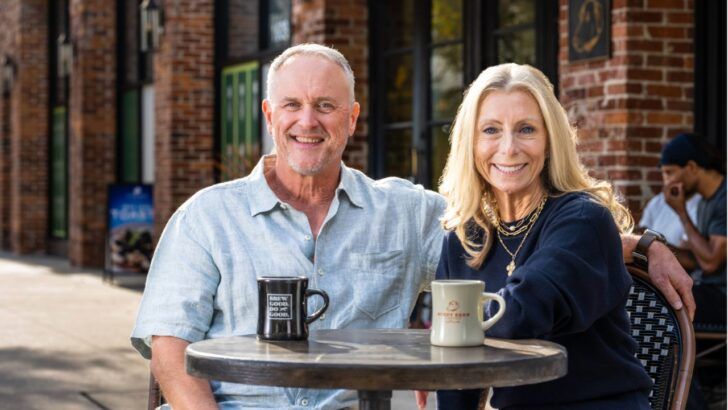
On the first morning they opened, Dave and Susan Ward did not own a register.
Instead, they placed a coffee can on the counter and trusted whoever walked through the door to leave $2 for a cup.
The old coffee can, its label peeled off, sat where a point-of-sale system should have been.
There was no explanation of values and no speech about trust. The assumption was simple. People would do the right thing.
Susan Ward later said the decision had nothing to do with money and everything to do with how the room should feel.
“We wanted to set the tone from the very first day,” she said. “We wanted people to feel welcome and trusted the moment they walked in.”
That can inside their small shop on Kennedy Boulevard in Tampa marked the beginning of something much larger, even if it did not look that way at the time.
This was before the roastery, before the cafes and before the name Buddy Brew Coffee meant anything to anyone else.
At its core, it was a marriage learning how to carry pressure.
Roots before business
Susan grew up in Clearwater in a house always open to others.
Her father was an entrepreneur and dinner often turned into long conversations about ideas and inventions.
Her mother worked beside him, steady and persistent and made sure anyone who entered the home felt welcome.
Hospitality was never framed as a concept. It was practiced daily, something Susan absorbed without realizing it would later shape her work.
“My mom and my grandma taught me that people gather around tables,” Susan said. “That’s where connection happens.”
Dave’s childhood followed a different rhythm. His father managed stores for JCPenney and each promotion brought a new city.
Dave’s upbringing mirrored that sense of hospitality in a different way.
His parents were deeply social, always hosting and entertaining, even as frequent moves forced him to adapt to new rooms and new people.
RELATED: Buddy Brew Coffee to open 10 cafés inside Sprouts stores
By high school, he was tired of leaving.
When his family moved again during his junior year, Dave chose to stay.
He stayed for his senior year with a family friend in a house full of six children and exchange students.
The lesson he carried forward was simple and lasting.
“I just wanted to stay somewhere,” Dave said. “I wanted to finish what I started.”
They met in the mid-1990s through work in Naples, where Dave was teaching a financial seminar. Susan stopped by afterward with a question about retirement planning.
“This cute little blonde girl pokes her head in and asks if I’d explain her retirement plan,” Dave said. “And I thought I would like to talk to you.”
Susan went home and called her mom.
“I remember saying ‘I think this guy is really cute,’” she said.
Four months later, they were engaged. Eleven months later, they were married.
Neither planned to build a coffee company.
Dave studied economics and built a career in real estate and finance. Susan studied nutrition and built a career in pharmaceutical sales and management.
Both were disciplined. Both were successful. Neither felt finished.
A garage and a hobby
Coffee was always a quiet, constant in their lives and they found joy in the search for a better cup.
After moving to Tampa, they struggled to find coffee they enjoyed drinking in the local coffee shop scene.
They began roasting their own coffee, first with a popcorn popper-style roaster and later with a small roaster in their South Tampa garage.
The first cup of freshly roasted coffee reset their expectations.
“We looked at each other and said, ‘This is a game changer,” Susan said.
They shared the coffee with friends, served it at dinner parties and brought it into offices.
READ: TAMPA BAY BUSINESS NEWS
As demand grew, friends began buying coffee directly from the Wards’ home. A bag by the front door, $10 in a box. Nothing more was required.
“People would just take the coffee and leave the money,” Dave said. “There was no checking.”
Then, they needed a name.
Buddy Brew was inspired by their dog, and stuck because it captured something they could not explain any other way.
Loyalty. Friendship. Unconditional Love.
For nearly a decade, coffee remained a hobby. It was something they did together after work, and it belonged to them alone.
Then the economy began to fracture.
When stability disappears
By 2007, Dave could see the collapse coming.
Commercial real estate did not slow down so much as it stopped.
Wall Street shut down property divisions, life insurance companies froze lending and long-term deals reached their endpoints with no refinancing options.
“At some point, you realize the thing you built your career on is no longer there,” Dave said.
READ: TAMPA BAY REAL ESTATE NEWS
At the same time, orders for their coffee were increasing.
One career was unraveling while the other was asking for more.
Dave began writing a business plan and running numbers. They bought a larger roaster and installed it in the garage. They traveled to Sandpoint, Idaho, to learn how to roast properly.
Susan stayed in her corporate role longer, holding the household steady while risk shifted beneath them.
Eventually, coffee became a calling.
“I loved my job,” she said. “But coffee was tugging on my heart.”
Burning the ships
They opened their first space in 2010.
It was not intended to be a cafe but a tasting room that allowed them to roast legally and sell wholesale.
The room measured just over 650 square feet.
Susan designed the room to feel like a kitchen rather than a counter service operation. The roaster sat in the center and the windows faced the street.
The night before opening, they realized they did not have a point-of-sale system.
They used the coffee can.
Susan left a job she loved weeks later. Friends questioned the decision, especially given the economic uncertainty. Security was exchanged for risk.
“That was the moment we burned the ships,” Dave said. “There was no going back.”
READ: TAMPA RETAIL & HOSPITALITY NEWS
Their days followed a strict rhythm. Brewing began in the morning. Roasting followed at midday. Packaging filled the afternoon. Deliveries happened by hand at night.
If customers walked in while the roaster was running, Dave and Susan chased them down the sidewalk with free cups and asked them to return the next day.
Losing customers was not an option.
“You don’t get many chances with people,” Susan said. “We didn’t want to waste one.”
One of their first regulars, Ralph, came from a nearby halfway house. He did not have money, but he kept coming.
“One day he came back with this big coin from some country I didn’t even recognize,” Dave said. “He didn’t really have money. He just wanted to give me something.”
They stayed behind the bar every day, learning names, habits and stories. The room filled because it felt personal.
Growth without distance
The opportunities arrived faster than they expected, even as they chose to move deliberately, including an invitation to open at Oxford Exchange in downtown Tampa.
The exposure was unplanned and impossible to manufacture.
About a year in, they were invited to walk through the building before it opened. At the time, it was stripped to its bones, with dirt floors and torn-down walls that revealed more vision than certainty.
“They took us on this vision walk,” Dave said, recalling the moment. “And we thought, this is incredible. They were doing something really special.”
It was not only an opportunity for expansion, but also a statement of trust, and what stayed with them was not the scale of the project but how it unfolded.
READ: TBBW COVER STORIES
“Oxford Exchange received so much attention for what it became,” Dave said. “Blake and Allison were incredibly gracious to us. They have an incredible talent, and we’re forever grateful.”
They were made part of the process, part of the thinking and part of what the space was meant to become.
Each opportunity raised the same question. How do you grow without losing warmth?
They designed against sameness and against intimidation. At a time when specialty coffee often felt exclusive, Buddy Brew felt accessible within the Tampa coffee and hospitality scene.
“No matter how much we scale, we will never compromise quality,” Dave said.
They were not building alone. Tampa was changing too, learning what local meant at the same time they were.
They grew with intention, guided by the same philosophy that shaped their first days.
The work inside the work
Building a company together did not protect their marriage. It challenged it.
There were sleepless nights and long stretches when the business followed them home. Decisions did not end at closing time. Pressure did not stop at the door.
“It forced us to become a better married couple, which allowed us to be better leaders,” Dave said.
One image stayed with them. When they came home, they learned to take their shoes off at the door and leave the business there.
Inside, they were parents and partners.
“That boundary saved us,” Susan said. “We made the decision to always prioritize our relationship with each other and our children.”
READ: DOWNTOWN TAMPA DEVELOPMENT & REAL ESTATE NEWS
Inside the house, roles shifted.
They were no longer operators or decision-makers but parents and partners, responsible for the life they were building together outside of work.
They also learned to focus on their strengths. Susan led culture, hospitality and design. Dave focused on systems, growth and risk.
The balance worked because it had to, and because each trusted the other to lead in their area of strength.
Their children, both in high school, grew up in the cafes, doing homework at tables and watching work happen in real time.
They heard conversations, saw effort and learned what commitment looks like before they could name it.
Responsibility was not taught explicitly. It was observed.
Faith as foundation
Faith runs quietly through everything they built.
“We felt like it was a divine leading to start a business that would do good in the world,” Susan said.
That faith was tested and refined over time.
Coffee is grown in some of the world’s most impoverished regions. The distance between the cup and its origin was not just geographic. It was structural.
From the very beginning, Dave and Susan were committed to sourcing coffees in ways that would help farmers thrive.
They developed direct relationships with smallholder farmers and importers who valued transparency and integrity.
That led them to Long Miles Coffee in East Africa, one of their first partners and one they still work with today.
What mattered to Dave and Susan was not just quality but philosophy.
Long Miles paid farmers differently. They invested year-round. They built relationships hill by hill, year after year and invited roasters into that accountability rather than shielding them from it.
Through that partnership, Dave and Susan saw what happens when incentives change.
Irrigation systems appeared. Processing improved. Knowledge spread. One farmer taught another. Then another.
They remain committed to that work in small repeated ways, cup after cup and year after year.
Over the years, Buddy Brew has quietly supported local and national organizations focused on disaster relief, anti-human trafficking, foster care support and community programs across Tampa Bay.
“We just try to be a bright light wherever we are,” Dave said.
A pattern emerged in how decisions were made. Their philosophy took shape through action rather than declaration.
Brew good. Do good.
“It’s how we decide,” Susan said. “Not just what we do but how we do it.”
Coffee is what they do. Love is why they do it.
What remains
Today, Buddy Brew operates eight cafes, a roastery and cold brew production facility, distributes nationwide, employs more than 130 people and clears over eight figures a year, yet the business still turns on decisions made up close.
What started with trust in a stranger and a coffee can lasted because that trust never stopped at the counter.