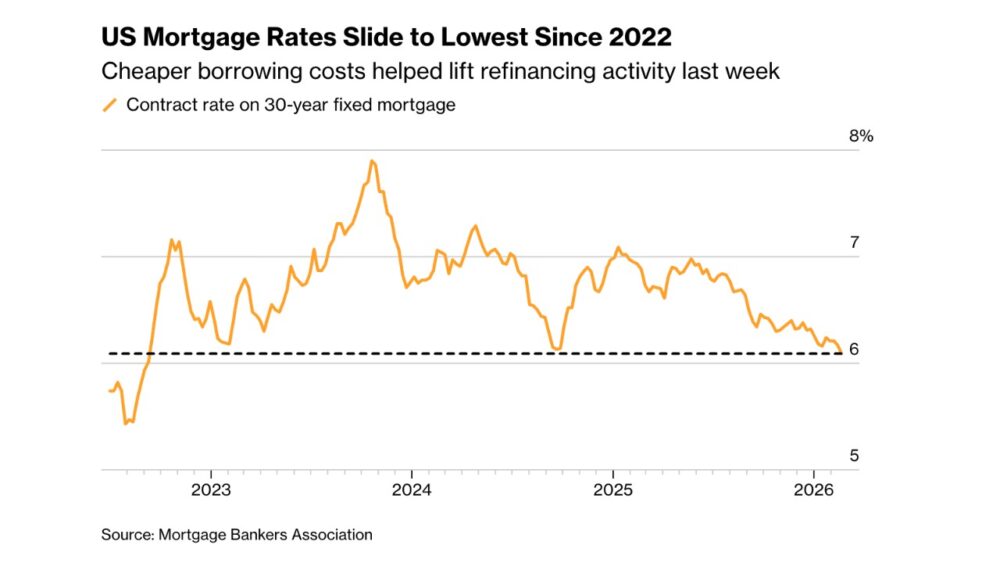
Mortgage rates fell Thursday to their lowest level since 2022, pushing more homeowners into refinancing and modestly improving purchasing power for Tampa Bay buyers as inventory builds ahead of spring.
The contract rate on a 30-year mortgage dropped to 6.09% in the week ended Feb. 20, down 8 basis points, according to Mortgage Bankers Association data. Five-year adjustable rates fell to 5.23%, also the lowest since September 2022.
Refinancing activity rose more than 4% and reached its second-highest level in five months. Applications to purchase homes declined 4.7%, falling to the lowest level since April.
Lower rates expand purchasing power
Lower rates increase affordability at the margin. Jamie Brown, founder and CEO of Homestyles Real Estate, said even incremental declines expand qualifying power.
“If that rate is lower than what has been typical, buyers can qualify for a larger loan amount for the same payment,” Brown said. “Monthly expenses decrease.”
READ: TAMPA BAY REAL ESTATE NEWS
A half-point drop in a 30-year fixed rate can allow buyers to afford roughly 5% more home without increasing their payment, according to industry estimates. That change can bring sidelined buyers back into the market and lift demand.
New supply reopens negotiation
In Tampa Bay, that demand is meeting a wave of new supply, particularly in South Tampa.
“There is still a buyer’s market for the most part, and that will likely continue this year,” said Robert Glaser, president and CEO of Smith & Associates Real Estate.
Glaser said a cluster of condominium and single-family projects that broke ground during the region’s recent building cycle is now delivering across 2025 and 2026. Much of that new product is priced between $1 million and $3 million, with additional homes still under construction and expected to close this year.
Inventory tightened after recent storms reduced available housing stock. As rebuilding progressed and new construction came online, listings expanded again. The added supply has widened buyer choice and reopened negotiations.
READ: TAMPA BAY BUSINESS NEWS
“There is definitely negotiation now,” Glaser said. “That wasn’t the case in years prior.”
Smith & Associates defines luxury as $2 million and above. Glaser said buyers at that level track rate direction, even when they can pay cash, because momentum influences urgency and competition.
“When the market is moving, that gives people some concern they could lose a property,” he said. “It creates motivation.”
Buyers return selectively
Brown said falling rates can shift market velocity when more buyers re-enter at once. Increased demand can shorten time on market and raise the likelihood of multiple offers, particularly for well-priced properties.
“Buyers are more discerning at 6%,” Brown said. “They’re willing to look, but they may not commit.”
He said some buyers are watching rate projections closely and could delay decisions if they expect further declines. Others move regardless of rates, including those relocating for work, downsizing, divorcing or making lifestyle-driven changes. Luxury buyers also remain active, though their participation tends to fluctuate less sharply with rate movement.
Glaser said many buyers remain active but have delayed decisions, waiting for clearer signals on rates and pricing. Even modest rate declines can change behavior if buyers sense activity accelerating.
READ: TAMPA BAY RAYS NEWS
Glaser said deals above roughly $4 million typically hinge on liquidity. Below that level, financing terms play a larger role in timing. Buyers trading up or reallocating capital often structure transactions around equity and borrowing strategy rather than focusing solely on headline rates.
Buyers trading up or reallocating capital often structure transactions around equity and borrowing strategy.
He said buyers entering the market should secure financing approval under current rates before shopping so they can move quickly when the right property surfaces.
Sellers with distinctive properties in strong locations continue to draw attention.
“If you have a very unique property in a great location, you are likely to be happy,” Glaser said. “There is competition, but you are getting more eyes and more opportunities for offers.”
The rate drop has increased refinancing nationally, though Glaser said most homeowners would need a larger shift to justify the cost.
“It would take a bigger change to refinance because of the cost,” he said.
Attention is also turning to state lawmakers, who continue to debate changes to Florida’s property tax structure. High-end homes can carry six-figure annual tax bills, and even incremental adjustments could affect long-term ownership costs and valuation decisions.
For now, Tampa Bay’s luxury market enters the spring cycle with new construction delivering and buyers recalculating purchasing power. Lower borrowing costs are influencing timing and confidence, even as expanded inventory continues to shape negotiating power.
Stay Informed
Stay up to date on Tampa Bay business news, executive profiles and the companies shaping the region.