

When Phil Lee stepped into the role of market president for Florida Blue’s West Florida region, just over a year ago, he wasn’t just filling a high-profile executive position. He was inheriting a legacy left by the late David Pizzo, a beloved and influential leader who helped shape the region’s health care landscape for over 16 years. For Lee, it was a deeply personal and professional transition.
“Dave’s legacy is tremendous,” says Lee, his voice steady but heartfelt. “He was a mentor and a friend. One of the first things I focused on in this new role was our team’s emotional well-being and how we could honor the culture he helped build, while continuing to grow our impact.”
It’s that same blend of empathy and leadership that defines Lee’s approach. At his core, he’s a relationship-first executive—one who takes the time to ask not just what needs to be done, but why it matters. That philosophy guides how he leads Florida Blue’s efforts in one of the most dynamic and fast-growing regions in the state.
From Pre-Med to Payers
Lee didn’t plan a career in health insurance. Born and raised in St. Charles County, Missouri, just outside St. Louis, he grew up steeped in the world of health care. His mother was a nurse turned hospital administrator. As a child, he often accompanied her to work, helping care for patients undergoing chemotherapy.
“I always thought I’d be a doctor,” he says. “I was pre-med in college, majoring in biology and chemistry. But when it came time to apply to medical school, I started to question whether that was truly my path.”
A conversation with a mentor opened his eyes to the business side of health. That led him into the insurance field and eventually, to Florida Blue, where he’s now been for nearly 19 years.
What he found along the way was something that rivaled the direct impact of practicing medicine: a chance to influence health outcomes at scale. “My father-in-law is a retired physician,” Lee says. “He had a great patient panel, but he could only see so many people a day. In this role, I can help serve over 1.3 million members in West Florida alone.”
Lee’s arrival in Tampa came at a pivotal time for the region, for Florida Blue and for his family. A longtime Jacksonville resident, he and his wife relocated with their children, embracing a community known for its warmth, momentum and challenges.
“Tampa Bay is unique,” he says. “It’s a growing city with a small-town heart. What struck me most was how quickly, and authentically, this community embraced us.”
That authenticity goes both ways. Lee made it a priority to meet with partners, staff and nonprofit leaders early on, not to present a new agenda but to listen. “We asked ourselves: ‘What do we need as a team? As individuals?’ We can’t lead strategically until we understand each other personally.”
Servant Leadership in Action
Those who work closely with Lee describe him as a servant leader in the truest sense. One who leads by example, listens deeply and doesn’t hesitate to kneel to the ground and tie a colleague’s shoes in front of board members, as one team member recalled.
That moment, as small as it might seem, captured Lee’s philosophy: empathy first. “In a world where things move fast and relationships can feel transactional; I try to slow down and ask the real questions. ‘How are you doing?’ Not just, ‘What are you working on?’”
His leadership style—rooted in trust, vulnerability and responsiveness—is something he says was shaped during his time as chief of staff to Florida Blue President and Chief Executive Officer Pat Geraghty. That experience, Lee says, was a “masterclass” in strategy, communication and values-based leadership.
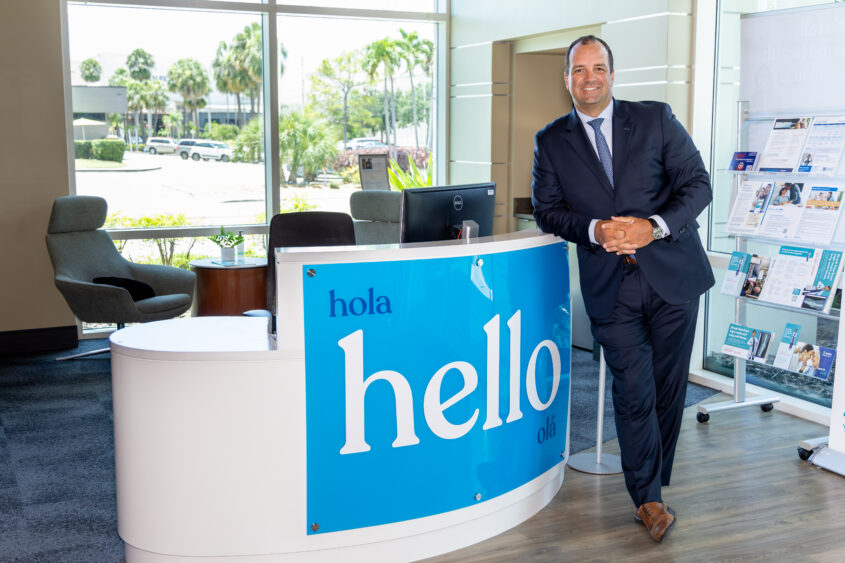
One of the ways Florida Blue embodies its mission, to help people and communities achieve better health, is through its retail centers, a concept Lee is passionate about. There are three centers across Tampa Bay, each offering much more than customer service.
“These are community hubs,” Lee explains. “Yes, you can get help with your insurance, but we also offer health screenings, wellness classes, mindfulness sessions, even gardening and line dancing. We’ve hosted over 10,000 behavioral health resilience trainings, just in West Florida.”
These centers are open to anyone, whether they’re a Florida Blue member or not. It’s not just a strategy but a statement about what health care should look like: accessible, human and local.
Under Lee’s leadership, Florida Blue has continued to expand its community partnerships, particularly around food insecurity, behavioral health and youth mental health. One standout initiative is “Strike the Stigma,” a partnership with the Tampa Bay Lightning that brings middle and high school students into Amalie Arena for a day of mental wellness programming and offers peer counseling training afterward.
“This is not just about doing the right thing,” Lee says. “It’s about doing what works. When you invest in behavioral health or food security, you’re investing in long-term health outcomes.”
Lee is equally energized about the role of emerging technology in health care. Florida Blue has been using AI tools for years, especially in streamlining time-sensitive processes like prior authorizations, reducing wait times from days to seconds, in some cases.
“AI won’t replace human interaction,” he says, “but it can enhance it, make it faster, more accurate, more equitable. That’s what innovation should do.”
Lee says Florida Blue has implemented ethical governance standards around AI and continues to partner with academic and policy leaders—including USF’s Muma College of Business—to foster community-wide dialogue on the future of health tech.
Continuing the Legacy
More than anything, Lee sees his role as one of stewardship by carrying forward a culture, building new pathways for care and ensuring Florida Blue continues to grow with integrity.
“There’s a lot of work to be done,” he says. “But I truly believe we’re making a difference one relationship, one community, one life at a time.”
And for those still wondering why a health insurer would invest in welcoming retail centers, host salsa classes or pour resources into nonprofits?
Lee has a simple answer: “Because it’s the right thing to do and because people deserve to feel seen, heard and supported. That’s health care, too.”