
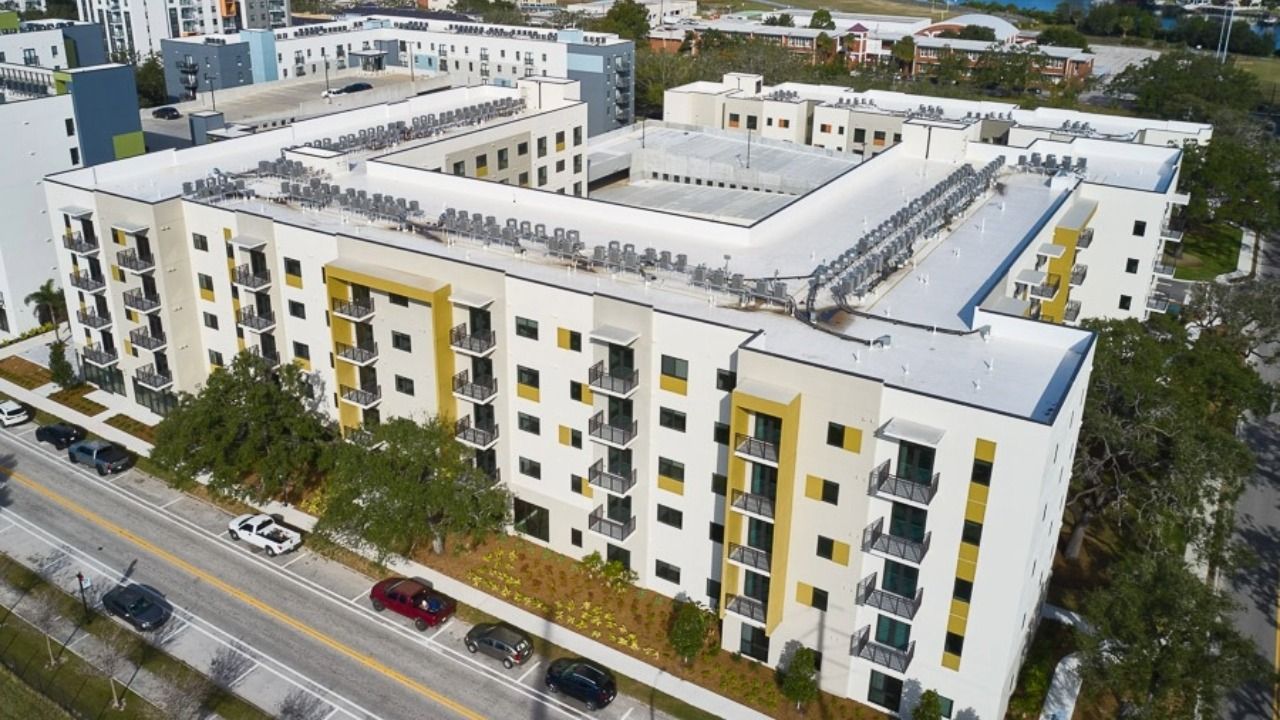
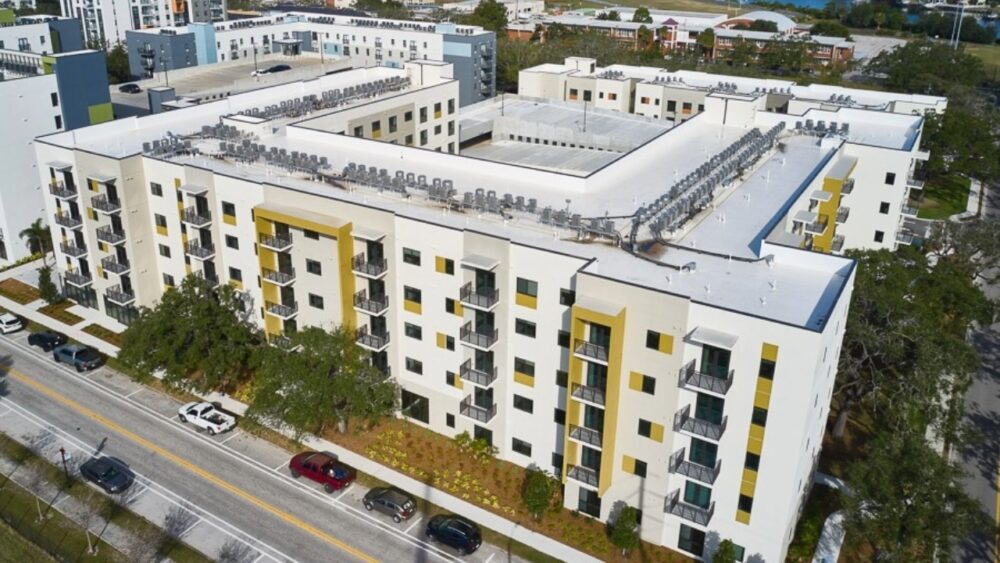
The Tampa Housing Authority and Related Urban have completed Canopy at West River, delivering 384 affordable apartments along Main Street and marking the closeout of the four-tower residential phase of the 44-acre former North Boulevard Homes site.
The final 188 units, located along North Delaware Avenue between West Chestnut Street and West Main Street, opened last week. Phase One delivered 196 units. Together, the buildings establish a fully built affordable residential base within a redevelopment that has been underway for more than a decade.
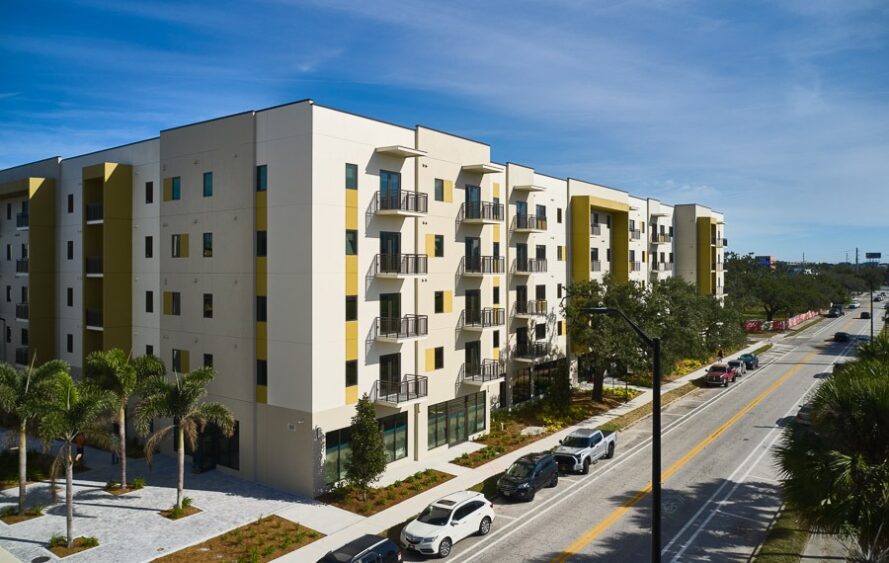
With those towers occupied, the emphasis shifts. The question is no longer whether the public housing complex would be replaced. It has been. The next test is whether Main Street functions as a mixed-use corridor tied to downtown rather than a boundary at its edge.
“We’re transitioning from public housing settings to developments that are indistinguishable from market-rate,” said David Iloanya, director of real estate development for the Tampa Housing Authority. “The difference is the subsidy.”
A different definition of affordable
At West River, affordable housing is defined by a hard threshold. Residents pay no more than 30% of adjusted income toward rent. Units at Canopy serve households earning between 22% and 80% of the area median income.
For Iloanya, affordability extends beyond rent.
“If they have to pay heavily on transportation because of where the housing development is located, it will take a chunk of their income,” he said.
The site sits immediately west of downtown and connects to it through the Riverwalk and a linear park system built into the redevelopment. A bus route runs along the frontage. Publix anchors nearby retail. Main Street buildings include ground-floor storefronts designed to support daily needs within walking distance.
READ: TAMPA BAY REAL ESTATE NEWS
The apartments range from one to four bedrooms. Phase Two includes six three-bedroom and 24 four-bedroom units. Structured parking, controlled access, fitness facilities and business space are standard. Some West River buildings hold LEED Silver or Gold certifications, while others are built to comparable green building standards.
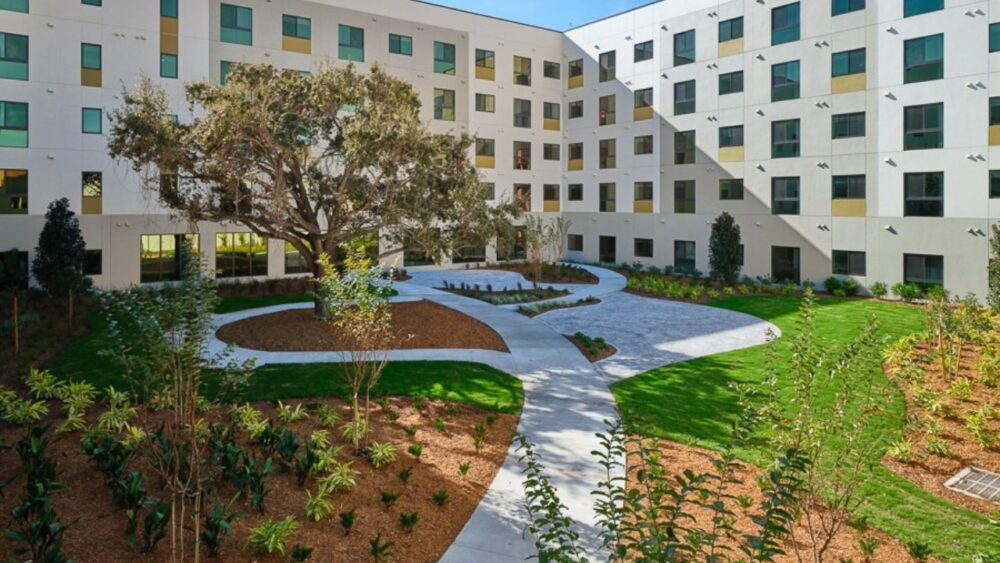
“You cannot drive through Tampa and recognize our product as a ‘project,’” Iloanya said.
The design objective is straightforward: no visible distinction between affordable and market-rate products.
From 820 units to a denser grid
The former North Boulevard Homes complex contained roughly 820 public housing units built in the 1940s and 1960s. Resident relocation was completed in 2016. Demolition followed in 2019. The first new vertical development began in 2020.
At full buildout, Iloanya said the 44-acre site is expected to support more than 3,300 units.
That acreage forms part of a broader West River master plan spanning roughly 150 acres from Columbus Drive to Main Street. Project materials identify Canopy Phase Two as the 10th of 15 phases within that larger framework, which projects approximately 2,188 residential units and about 160,000 square feet of retail and office space.
To date, Iloanya said roughly $500 million has been invested across the redevelopment area.
READ: TAMPA BAY BUSINESS NEWS
The modern planning effort traces to a 2011–2012 Ross Fellowship visit during the administration of former Mayor Bob Buckhorn, which recommended reconnecting the isolated public housing site to the waterfront and surrounding street network.
“We have reconnected access to the waterfront,” Iloanya said. “We have redeveloped that area and utilized those 44 acres.”
The rebuilt street grid now ties Main Street and Rome Avenue directly into downtown circulation. What was once internally oriented now faces outward.
Ownership and permanence
Canopy is 100% affordable. Lower income tiers, including units serving households at 22% of area median income, are supported through low-income housing tax credits, project-based vouchers and Rental Assistance Demonstration programs.
Development costs run roughly $375,000 per unit, Iloanya said, requiring layered public financing and 4% tax credits paired with bonds.
The housing authority retains ownership of its affordable developments even when partnering with for-profit developers, he said, and extends affordability restrictions beyond the initial 30-year compliance period for the tax credit.
“To us, it is in perpetuity,” Iloanya said.
The missing middle and the commercial edge
With Canopy complete, attention turns to the remaining parcels along Main Street.
One residential site, identified as T-5, is in design and could accommodate approximately 240 to 274 units. That phase is expected to focus on workforce housing for households earning between 80% and 120% of the area median income.
“That’s the missing middle,” Iloanya said, referencing teachers, police officers and firefighters whose incomes exceed traditional affordable thresholds but do not align with current market rents.
Across from the existing residential phases, a six-acre commercial tract has been divided into two-acre increments.
READ: TAMPA RETAIL & HOSPITALITY NEWS
At Rome Avenue and Main Street, a third-party developer has a project under contract for 234 market-rate units with approximately 20,000 square feet of ground-floor retail and a rooftop amenity.
A middle parcel is in design with Related for 202 affordable multifamily units paired with an 80,000-square-foot office building and 4,000 to 7,000 square feet of ground-floor retail, including early childhood education space.
Two hotel projects, including a Staybridge-branded property, are finalizing permits, with construction expected to begin in late spring, Iloanya said.
Retail space within existing residential buildings is under contract and will open following tenant buildouts.
“Main Street will blend effectively with the activities that you see in downtown,” Iloanya said. “The only difference is the river. You have the connector there, which is the Riverwalk.”
Relocation and return
Redevelopment required relocating residents before demolition. Iloanya said the authority provided transportation assistance, case management and education on voucher options. Staff held monthly meetings and maintained contact with former residents as construction progressed.
Former residents were offered the right to return and retain leasing priority.
Return rates average 10% to 15%, he said. Others have used vouchers to relocate elsewhere in Tampa, to other Florida cities or out of state.
“We give them the opportunity to come back,” Iloanya said. “The final decision is theirs.”
What will define the next phase
The residential replacement of the former public housing complex is largely complete. The next two to three years will determine whether the commercial frontage fills in at the pace projected.
Hotel construction either begins this spring or it does not. Office space either secures tenants or waits. Retail either opens its doors or remains under buildout.
“You’re going to see this portion of downtown overflow into West River,” Iloanya said.
The physical framework is in place. The next measure is activity: leases signed, storefronts lit, sidewalks used.
Stay Informed
Stay up to date on Tampa Bay business news, executive profiles and the companies shaping the region.