Tampa officials are preparing to brief the City Council this week on the South Howard Flood Relief Project, a long-planned infrastructure initiative that has grown into one of the city’s largest stormwater investments.
The project now carries an estimated cost of approximately $100 million and is scheduled for a detailed presentation at the January 29 City Council workshop.
City officials say the project is designed to address chronic flooding along South Howard Avenue and in nearby neighborhoods, including Parkland Estates and Palma Ceia Pines.
City engineers say the area remains vulnerable even during moderate rainfall and that existing infrastructure cannot handle the volume of water flowing toward Hillsborough Bay.
South Howard is one of 12 initiatives included in Tampa’s “Great Eight” capital projects program, a group of major undertakings flagged for additional oversight due to cost, complexity or public impact.
A flooding problem decades in the making
According to city materials, the South Howard area sits within a bowl-shaped topography that naturally directs stormwater toward lower elevations near the bay.
Engineering studies dating back to the early 1980s have consistently identified the same constraint: gravity moves water downhill faster than the current drainage system can carry it away.
City presentations reference multiple studies conducted over several decades, including work completed in 1983, 1988, 2009 and again in 2022.
Each reached similar conclusions about the limits of maintenance-only solutions.
READ: TAMPA BAY BUSINESS NEWS
Flooding has repeatedly affected homes, businesses and transportation access in the area, disrupting daily operations and limiting access to surrounding neighborhoods.
During a 2015 storm that dropped roughly 5.4 inches of rain, parts of Parkland Estates experienced flooded homes, stranded vehicles and road closures.
City officials say similar rainfall today continues to overwhelm the system.
Briefing materials prepared for the City Council outline the broader consequences of these events, including property damage, business interruptions, delayed emergency response and reduced access to nearby hospitals.
What the project would change
The South Howard Flood Relief Project focuses on constructing a new stormwater conveyance system to move water out of the basin more efficiently and reduce structural flooding.
According to city estimates, the project is designed to deliver up to a 95% reduction in flooding during a five year eight hour storm event.
For larger storms comparable to Hurricane Milton, officials estimate a 70% reduction in structural flooding, protecting more than 220 homes and businesses.
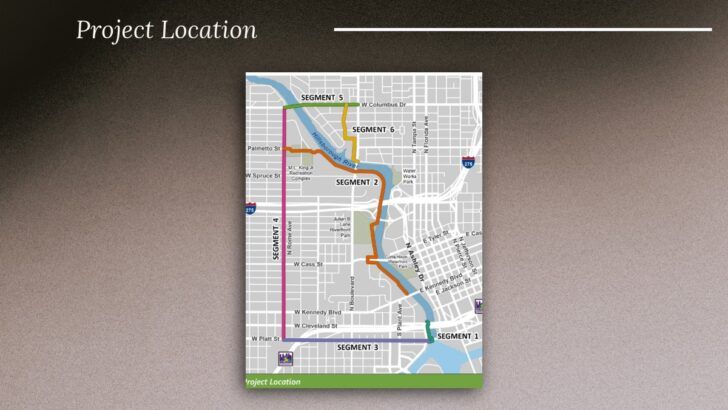
The project route has expanded over time, extending into Palma Ceia Pines and connecting to the AMI Pond system.
READ: TAMPA BAY REAL ESTATE NEWS
City engineers say the expansion reflects a broader goal of protecting as many properties as possible rather than focusing only on the most frequently flooded blocks.
In addition to drainage improvements, the project includes undergrounding power lines along South Howard Avenue in coordination with Tampa Electric.
Plans also call for upgraded water and wastewater infrastructure and a redesigned streetscape with wider sidewalks and expanded tree canopy.
Costs rise as scope expands
Early estimates placed construction costs at roughly $65 million. Updated materials now show projected costs as high as $98 million.
City officials say the increase reflects both inflation and the expanded scope of the project.
They also note that costs are expected to be refined as design progresses and that estimates could decrease as engineering advances.
READ: TAMPA RETAIL & HOSPITALITY NEWS
Funding sources include stormwater improvement fees and water system revenues.
As part of the upcoming workshop, City Council is expected to consider a financial resolution that includes a proposed $20.9 million budget transfer from a completed Lower Peninsula project.
A long timeline ahead
While the project is moving forward, construction remains several years from completion.
Preliminary engineering is complete. A 30% design milestone and public meeting are scheduled for early spring, followed by a 60% design phase and additional public outreach in late summer.
Final design and pre-construction activities are expected to conclude by the end of 2026.
If approved as planned, construction would begin in January 2027 with substantial completion projected for August 2030.
READ: ST. PETERSBURG BUSINESS NEWS
City staff have emphasized that no alternative plan would deliver comparable flood relief with less disruption or lower cost.
Officials say more limited approaches were evaluated and rejected as less effective given the scale of the problem.
Minimizing disruption during construction
Recognizing South Howard’s role as a major business corridor, the city’s phasing plan includes limits on the duration of construction impacts for individual segments.
Officials estimate impacts of 15 to 60 days per segment near business districts, with pauses planned during peak seasons.
Sidewalk access is expected to remain open throughout construction, and the city plans to coordinate closely with merchants on access and parking needs.
Materials also reference the possibility of a “Shop Howard” style campaign to support local businesses during construction.


A decision point for the city
City officials describe the South Howard Flood Relief Project as a generational investment that extends beyond drainage alone.
In addition to reducing flood risk, the project is framed as a resiliency measure that could stabilize property values, ease insurance pressure and improve water quality entering Hillsborough Bay.
The January 29 workshop will not serve as a final vote.
It will, however, mark a key moment in the project’s progression, setting the stage for future financial approvals and construction authorization.
For residents and business owners along South Howard Avenue, the presentation offers the clearest outline yet of how the city plans to address a problem that has persisted for decades, what that solution will cost and how long it is expected to take.