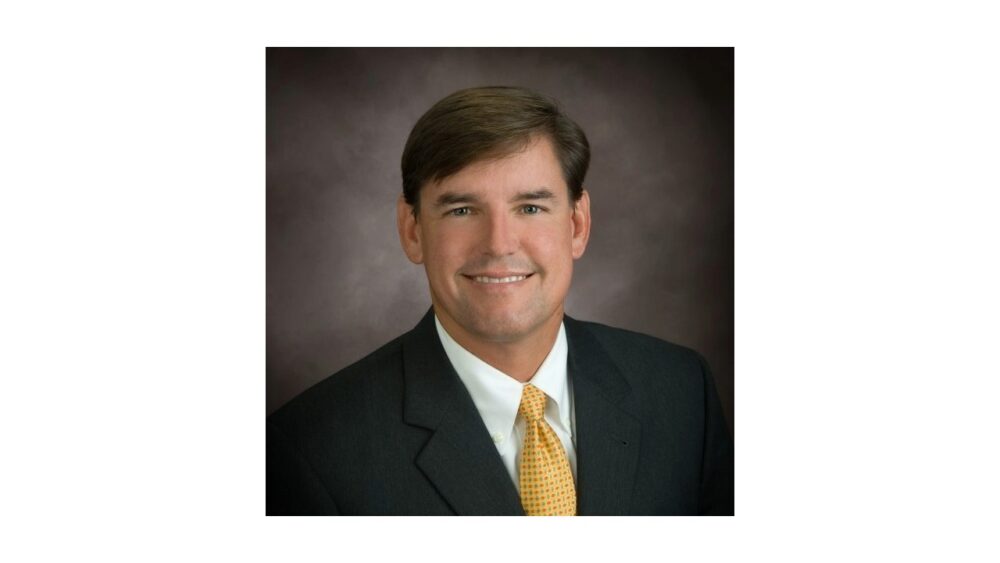
Eric Obeck runs commercial banking for Hancock Whitney across seven states from his base in Tampa. His mandate is straightforward and expansive: position the $36 billion-asset regional bank as the best bank in the country for privately owned businesses.
It is a growth strategy focused on privately owned businesses in the middle market, where Obeck sees demand for both lending capacity and relationship-driven banking.
Hancock Whitney ranks as Tampa Bay’s 15th largest bank by local deposits and operates across Florida, Texas, Louisiana, Mississippi, Alabama, Georgia and Tennessee. Texas and Florida are its strongest markets, with Tampa positioned as a growth center.
The strategy concentrates resources on privately owned businesses in the middle market.
“Our specialty is banking for privately owned businesses,” Obeck said. “Not the super large companies where banking becomes commoditized. The business owner wants a very good banker who can add value beyond just a product.”
Banking the middle market
Large national banks control most deposits and corporate lending in Tampa Bay. Community banks compete for small-business relationships. Obeck entered the market 18 years ago, believing there was room for a regional bank with the lending capacity of a larger institution and the access of a local one.
He had previously spent 12 years at what was then the largest bank in Florida, which was acquired by Bank of America in the late 1990s. During his time outside banking, he launched and operated several companies in Tampa Bay. That experience reshaped his view of what business owners expect from their bank.
“In this market, you had very large banks and relatively small community banks,” he said. “There really wasn’t a bank that sat in the middle that had big bank capacity and sophistication, but a relationship orientation with connectivity to decision makers.”
READ: TAMPA BAY BUSINESS NEWS
At $36 billion in assets, Hancock Whitney operates as a regional bank with local credit authority and national-scale lending capacity.
Each of Hancock Whitney’s markets has a market president responsible for local decision-making. Senior executives, including Obeck and the CEO, spend time directly with clients. Obeck estimates he spends roughly 20 percent of his time meeting customers across the footprint.
“Business owners want to know who is making the call and that the banker will be there through cycles,” he said.
Where growth is occurring
The bank entered the Tampa Bay market in 2006. Since then, it has steadily increased its share in what Obeck describes as the lower middle market: privately owned companies that require lending capacity, treasury sophistication and advisory support.
Those companies are typically too complex for branch-only banking but not large enough to command customized treatment from national corporate divisions.
Hancock Whitney can extend loans well above what most community banks can hold on their balance sheets. It can also invest in treasury technology that smaller institutions struggle to fund.
“Cash cycle management and treasury management are incredibly important for businesses,” Obeck said. “Those products are technology-driven. They require a large investment and knowledgeable people to support them.”
READ: TAMPA BAY REAL ESTATE NEWS
Purchase cards, payment services, fraud protection, reporting systems and depository tools are not novel offerings. The difference, Obeck said, is pairing those tools with a banker who understands how the client operates and who has the authority to act.
The bank’s middle-market share in Tampa has grown faster than its share in micro-business accounts. That trajectory has come largely through referral and reputation, rather than broad-based retail expansion.
Obeck describes the broader operating environment as stronger than headlines suggest. Inflation and unemployment have remained contained, and interest rates have eased from their recent highs.
While tariff volatility has created uncertainty, he said most companies have adapted rather than rewriting their business plans.
“Fundamentally, the economy is fairly healthy for most businesses,” he said. “Companies have proven resilient.”
The primary pressure points, he added, remain labor availability and supply chain constraints rather than broad demand weakness.
He expects two modest rate reductions from the Federal Reserve later this year, each a quarter point. He also notes that business valuations, which surged in recent years, appear to be plateauing.
“They don’t go up forever,” he said.
Obeck’s vantage point spans seven states. He sees Texas and Florida as outperformers in employment and business investment. Other markets are steady.
He attributes that outperformance to migration into business-friendly states, which in turn drives employment growth, capital investment and expansion among privately held companies.
Beyond the operating account
For many owners, the company and personal balance sheets are intertwined. Liquidity events, succession planning and estate strategies require coordination.
Hancock Whitney expanded its capabilities in that area through the acquisition of Sabal Trust in St. Petersburg last year. The independently owned trust company brought expertise in wealth management and estate planning, along with a significant client base in the Tampa Bay region.
“They needed a bank and we needed some of their expertise,” Obeck said.
The integration allows the bank to address a business owner’s commercial needs and personal financial planning within a single institution. For owners preparing for retirement, considering a private equity offer or structuring a management buyout, that coordination becomes consequential.
READ: ST. PETERSBURG BUSINESS NEWS
The bank models enterprise value and debt capacity for clients evaluating options. In some cases, Obeck said, a management team or employee stock ownership plan may present an alternative to an outright private equity sale.
In other cases, a liquidity event requires immediate coordination of tax strategy, estate planning and investment management — areas the bank now handles internally following the Sabal acquisition.
Private equity activity remains broad-based, spanning industries and company sizes. Many of the privately owned businesses Hancock Whitney serves receive acquisition interest.
“When someone has a large liquidity event, they’re going to need to do something with that money,” Obeck said.
He said the bank often continues the relationship after a sale, shifting from commercial lending to wealth and estate management while maintaining advisory continuity.
Growth with limits
As banks expand, decision-making often becomes centralized and product groups are siloed. Obeck acknowledged that scale introduces complexity.
“We have a long way to go before that risk presents itself,” he said.
At $36 billion in assets, Hancock Whitney remains focused on organic growth while remaining opportunistic on acquisitions.
The primary investment, he said, is in hiring experienced bankers and deepening relationships within existing markets rather than expanding indiscriminately.
The company has operated for more than 125 years and built a strong reputation in Louisiana, Mississippi and South Alabama before expanding into Florida and Texas.
Obeck points to a regional bank in the 1980s that developed a national reputation for serving privately owned companies before being absorbed by a larger institution. In his view, that positioning remains unclaimed today.
Over the next several years, performance will show up in middle-market loan growth, share of privately owned business relationships and client retention after ownership transitions.
In Tampa, performance will be measured by sustained lending growth in the lower middle market and by retaining client relationships through ownership transitions.
Stay Informed
Stay up to date on Tampa Bay business news, executive profiles and the companies shaping the region.