Hillsborough County hotels opened 2026 with one of their strongest January performances on record, as taxable hotel revenue reached $112.28 million for the month, according to Visit Tampa Bay.
The January total marked the second-highest January ever recorded in the county, signaling strong visitor demand heading into Tampa Bay’s busy spring tourism season.
From September 2025 through January 2026, taxable hotel revenue totaled $428.86 million, generating $25.72 million in Tourist Development Tax collections.
Those dollars help fund destination marketing, sports tourism, cultural programming and other tourism-related investments across Hillsborough County.
The next test arrives March 20 and 22, when Tampa hosts the first and second rounds of the NCAA Division I Men’s Basketball Championship at Benchmark International Arena.
The event will bring eight teams, media and traveling fans into the market over four days, then send them out into hotels, restaurants, bars, shops and entertainment districts across the region.
Tourism leaders say the cleanest measure will come after the event, when hotel and visitor data can be compared with the same dates from prior years.
“It is prime-time viewing,” said Santiago Corrada, president and CEO of Visit Tampa Bay. “It is all eyes on collegiate basketball at the destination. We can never put a price on that kind of exposure.”
A different city from the one that hosted in 2011
This will be the sixth time Tampa has hosted some version of the men’s NCAA tournament and the first time since 2011.
Corrada said any effort to compare this year’s event to 2011 runs into a simple problem. Tampa Bay has changed too much for that benchmark to carry much weight.
Downtown has grown into a broader visitor district. Water Street has added rooms, restaurants and pedestrian activity. The event will land in a market built to hold onto visitors longer than it once could.
Jason Aughey, senior vice president of sports tourism for the Tampa Bay Sports Commission, made the same point from the event side of the business.
“When you look at where Tampa was when we were scheduled to host in 2020 compared to today, the destination is in a much better place,” Aughey said. “We have more hotel inventory, more entertainment districts, more things to do, more restaurants and more local businesses that ultimately will benefit from March Madness coming to Tampa.”
In 2020, Tampa was set to host the NCAA tournament, but it was canceled due to the pandemic, which shut down sports across the country. Six years later, the city gets the event back in a market that is larger, more polished and more experienced in hosting national sports events.
Aughey said the region’s basketball resumé has also grown in that time, with the Women’s Final Four, conference tournaments and other major events helping deepen local experience.
“Basketball has been and continues to be one of the main sports from an impact standpoint in our community,” he said.
How the money moves
Neither Visit Tampa Bay nor the Sports Commission is releasing a definitive economic impact figure before the games are played. Both Corrada and Aughey were careful on that point.
Corrada said Visit Tampa Bay expects to review hotel data within one to two weeks by comparing performance on March 20 and 22 with the same dates in prior years to determine whether the games lifted occupancy and room revenue.
From there, the organization can estimate related spending in restaurants, retail and entertainment. Visitors arrive for warmer weather, spring events and the final stretch of winter travel from colder markets.
Any honest read of March Madness has to account for existing demand rather than assign the whole month’s performance to a single event.
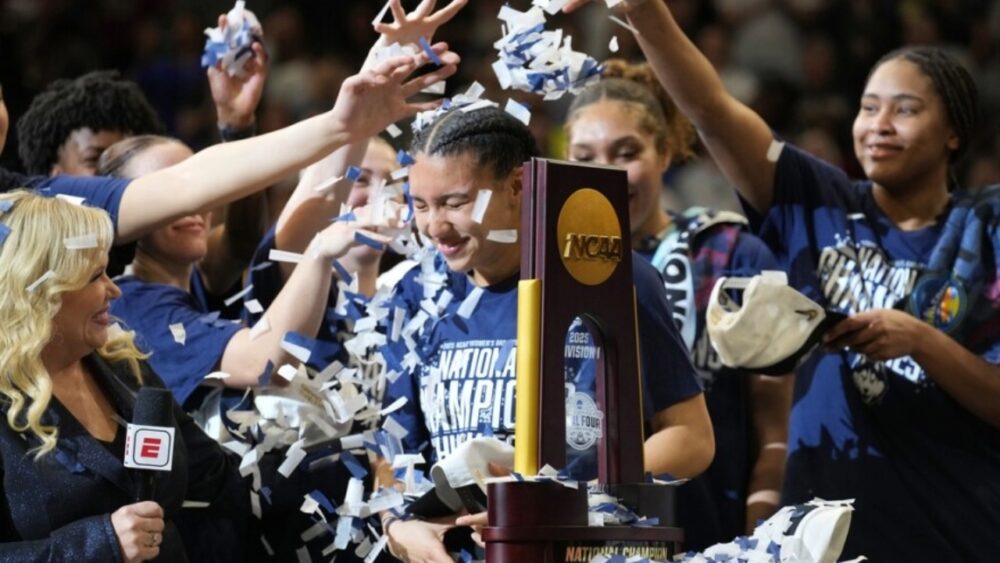
Corrada pointed to last year’s Women’s Final Four as a useful reference point, even though he described it as “like comparing tomatoes to watermelons” because the events operate on different scales and schedules.
During the 2025 Women’s Final Four week, hotel occupancy averaged 80.3% compared with 77.8% the year before.
On the Friday of the semifinals, occupancy was 92.3%, up from 85.8% the prior year. On Saturday, it reached 91.2%, up from 86.7%.
On the night of the championship game, occupancy was 73.1%, up from 59.9% the year before.
READ: TAMPA BAY REAL ESTATE NEWS
Those figures do not predict what the men’s first and second rounds will do. They show how a major college basketball event can move room demand in a busy market.
According to Visit Tampa Bay data, visitor spending outside the room breaks down as 38% for restaurants, 17% for retail and 46% for entertainment.
He said that works out to about $60 a day for meals, $66 in retail spending and $91 per day for entertainment and attractions.
“It’s not just about them coming and staying in the hotel,” Corrada said. “It’s all these other things that they support.”
Aughey said the last time Tampa hosted the opening rounds of the men’s tournament, the event generated more than 9,000 room nights through a mix of official hotel blocks and additional affiliated stays.
He said the Sports Commission builds those figures by combining NCAA housing data, hotel pickup reports and Ticketmaster zip code analysis to see where buyers are traveling from.
The city needs to know who came, how long they stayed and where they spent money if it wants to compete for future events.
The bracket decides part of the story
The final shape of the weekend will depend on Selection Sunday, when the NCAA reveals which teams are headed to Tampa.
Corrada said the geography of the bracket can quickly change the economics. Teams from farther away are more likely to drive overnight stays because their fans cannot simply make a same-day trip.
Nearby schools can still fill seats and create television energy, but they may not deliver the same hotel lift.
“The further away from the destination, the better for us,” Corrada said. “If we get a team that’s nearby, the fan base may just drive in for the game and drive back home and not even stay overnight.”
A sold-out arena and a successful tourism weekend are related, but they are not the same thing.
READ: TAMPA BAY BUSINESS NEWS
Aughey said certain schools and fan bases consistently travel well enough to turn an opening-round site into a destination weekend. Tampa benefits from that equation because it is easy to reach and easy to market as more than a game trip.
“With the accessibility that we offer in terms of direct flights domestically, and in some cases internationally, people can turn the trip into something more than just a game,” Aughey said. “A lot of visitors come in and treat it almost like a vacation.”
Fans usually arrive Thursday, attend games Friday and spend Saturday exploring the market before returning Sunday if their team advances.
“You usually see people come in on Thursday and then have that last day on Saturday where they’re looking for things to do,” Aughey said. “There is no shortage of options for things to do, places to go or events happening in the market.”
That spending reaches well beyond downtown, touching the airport, restaurants, retailers and attractions across the region.
A crowded March helps and complicates the picture
March Madness enters a market with several demand drivers already in motion.
Spring training is underway. The Tampa Bay Lightning are moving through the final stretch of their regular season. The Valspar Championship lands in the same week as the NCAA games. Meetings and conventions are also filling hotel blocks this month.
Visit Tampa Bay said more than 30 events, including four citywide conventions, are scheduled this month. Together, they are projected to generate nearly 40,000 room nights and tens of millions in estimated economic impact.
READ: TAMPA BAY RAYS NEWS
That context strengthens the case that Tampa Bay has a robust tourism pipeline. It also means March Madness arrives amid a crowded field of events, making careful measurement even more important.
Corrada acknowledged that reality directly. March and April are already busy months because travelers from colder markets are still looking to get south before the season turns.
The long game behind the weekend
For Tampa Bay’s sports and tourism leaders, March Madness is also a resumé event.
Corrada said bids for events like this are built years in advance through coordination among the Sports Commission, Visit Tampa Bay, venue operators, local government and host institutions.
Aughey said the region approaches these opportunities through what local partners call Team Tampa Bay, a model that brings together the Sports Commission, Visit Tampa Bay, USF, Vinik Sports Group, Hillsborough County, the city of Tampa and the NCAA.
“We ultimately judge whether they’re successful by whether they return,” Aughey said.
That is the strategic layer beneath the room-night math. The weekend has immediate value, but it also serves as proof of performance.
What can be said now
Hillsborough County entered 2026 with strong hotel revenue, and Tampa Bay will host a major NCAA event during peak tourism season.
Local tourism and sports leaders expect the tournament to lift hotel demand, bring added spending to restaurants and entertainment venues and deliver national visibility for the destination.
Tampa Bay enters the tournament with more hotel rooms, more restaurants and a larger tourism infrastructure than it had when these rounds last came through.
The bracket, the fan bases and the data that follows will ultimately determine how much the tournament moves Tampa Bay’s tourism economy.
Stay Informed
Stay up to date on Tampa Bay business news, executive profiles and the companies shaping the region.