
Bob Glaser built his life around one rule: never run out of money again.
It took shape in a double-wide off Fowler Avenue, where he slept on a waterbed that never would warm and caught bronchitis through the winter while biking to the University of South Florida by day and waiting tables at Red Lobster on Busch Boulevard by night.
Before that, he worked as a night guard at Alfred State College in upstate New York, walking dorm halls to lock doors in exchange for room and board. He covered the cafeteria shift when needed and paid his own way through school.
In high school, he stocked shelves at a farm market and worked the sporting goods counter at Woolworth’s. After college, he sold travel packages door-to-door for Morgan Travel before joining Mass Mutual, where he learned to sell in a coat and tie and built the discipline that would later define his brokerage career.
“I was always trying to catch up on a bounced check,” Glaser recalled. Seven dollars. Ten dollars. Fifteen. You just tried to stay ahead of the utilities and the driver’s license sticker.”
He grew up in Rochester, New York, the youngest of four. His mother ran the household from a party-line phone, ironing board open in the living room, while his father managed construction at Eastman Kodak. In his spare time, his father built boats and later bought land in the Florida Keys, where he constructed a stilt house in The Keys.
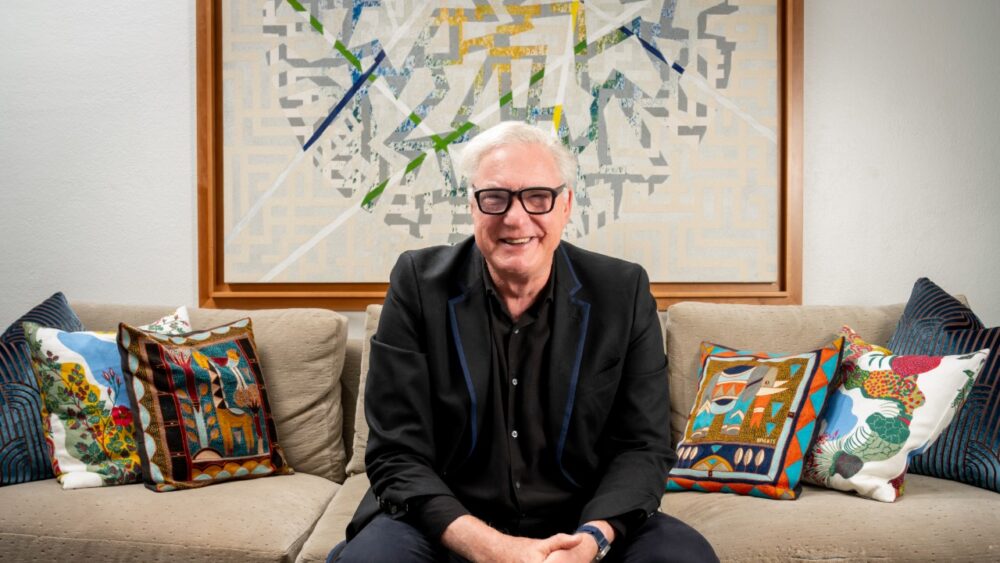
Four decades later, Glaser leads Smith & Associates Real Estate, the largest independent brokerage in Tampa Bay, and he still frames performance in terms of market share, discipline and endurance.
He runs the firm with the same cash-flow discipline he learned covering bounced checks in college.
The firm fields more than 300 agents and it closes more than $2 billion in annual sales.
Glaser has set a $2.5 billion target for the current year. He is pursuing that goal in a high-end market he describes as steady, competitive, and unforgiving, where inventory above $1 million exceeds 4,800 listings and reputation compounds or decays quickly. Smith is the number one broker above the $1,000,000 price point in both counties.
“Luxury is a network business,” he said. “The best agents attract the best listings, and the best listings attract the next client. By building the talent, you’re winning the market.” “
In that environment, scale without control erodes margins, and margins without culture fail to retain talent.
Glaser has organized Smith & Associates around ownership of fixed assets, disciplined expense management and a developer advisory arm that embeds the firm early in condominium projects, often years before compensation materializes.
The developer services division collaborates with developers on unit mix, pricing architecture, amenity programming and absorption sequencing, positioning the firm upstream in project economics.
Over the past two decades, that advisory model has shaped some of Tampa Bay’s most visible condominium towers, including ONE St. Petersburg, Saltaire, The Salvador, Signature Place and the Tampa EDITION Residences.
On Bayshore Boulevard, the firm has led sales for projects such as Altura Bayshore and Virage. In St. Petersburg, it has partnered on Water Club Snell Isle and 400 Beach.
Because the firm is patient on compensation and takes no upfront fees, it interrogates capital structure early and makes hard judgments about execution risk.
A Tampa education funded in real time
Glaser enrolled at USF in the 1970s after two years at Alfred State College, entering a campus he describes as still in its “incubation years.”
He briefly returned to Rochester after his initial stretch in Tampa, but another winter convinced him to head back south. He re-enrolled at USF, finished his degree in the business college and decided to make Florida his home.
At USF, he learned to work, study and survive on a schedule that left no margin.
The intervention that redirected his trajectory
During one presentation at a Davis Islands brokerage led by Dorothy Yates, a formative figure in Tampa real estate, she reframed his career path with blunt clarity.
“She said, ‘Young man, you should do real estate,’” Glaser recalled. “If you can sell insurance to real estate people, you should be doing real estate.”
He had the discipline to prospect and the resilience to handle rejection, traits that brokerage rewards.
A subsequent conversation with Skipper Morrison in Atlanta reinforced the decision, and she handed him some vintage career advice: buy a big car and let the payment drive you.
“If you buy a big car, you’ll work real hard because you gotta make the payment,” she told him.
He ignored the advice, bought a yellow Maverick, later traded it for a brown hot-rod and eventually lost that one in a poker game.
“They really made me pay it off, like, OK, we’re taking the car,” Glaser said, laughing.
He replaced it with an old Buick or Oldsmobile, put his money into Hyde Park instead of chrome, stretched each tank of gas while driving buyers to showings in Brandon and covered the tolls himself.
Hyperlocal density as strategic entry
In the early 1980s, as Hyde Park homes sold for between $22,000 and $120,000, Glaser rented an office in the DeSoto building and launched Hyde Park Realty under a small franchise banner.
When he contracted to buy his first Hyde Park house, he arrived at closing without enough for the down payment. Yates and another principal each lent him $5,000 so he could complete the purchase, a small act that signaled his thin capital and the trust he had already built in the neighborhood.
He renovated the house himself, replacing the roof, ceilings, washing dishes in the bathtub and living without heat, because he could not afford to do it any other way.
He canvassed the neighborhood, door-to-door, with printed pamphlets, introduced himself to longtime residents and built trust before he had scale.
Neighbors began referring to him as “Bob around the corner,” the broker who would show up if you needed something. The nickname stuck.
“You don’t know what you don’t know,” he said. “You just say, I can do this, and keep going.”
Platform expansion under Mary Smith
At a University Club cocktail party in the late 1980s, Mary Smith, founder of Smith & Associates, invited Glaser to join her firm.
The brokerage carried a reputation for luxury and operated with a small footprint. Glaser accepted within days, understanding that platform and positioning shape opportunity.
He moved into management and encountered a balance sheet under pressure. The company had expanded beyond its financial capacity. Offices multiplied, margins narrowed and compensation structures outpaced revenue.
“Many of these people were great, but they all came on board with 110% compensation,” he said. “None of it made sense.”
Smith told him that if he restored the capital she had lost from her trust, he could take control of the firm. Glaser accepted the obligation and the risk.
He consolidated offices, narrowed the firm’s geographic focus to core luxury corridors and centralized operations on Swan Avenue. He reset compensation, reduced expenses and monitored receivables daily. After repaying the trust, he assumed ownership.
For years, he avoided aggressive expansion because he feared running out of cash.
“I was afraid of having nothing again,” he said. “That always held me back from really pushing growth.”
He scaled deliberately because he understood how quickly receivables disappear and how steadily overhead accumulates.
When revenue later contracted, staff accepted temporary pay reductions to stabilize operations. Glaser repaid those reductions with interest once performance recovered. Several of those employees remain with the firm decades later.
He institutionalized weekly meetings in which agents stand, present listings, exchange market intelligence and refine pricing, staging and access standards. He treats presentation as a fiduciary duty.
“This is how you open the front door,” he tells agents. “You don’t put a lockbox on it. You don’t bring your kids to show the home.”
He views those details as signals of competence to high-net-worth clients and as standards that protect the firm’s reputation.
Developer advisory as structural differentiator
Smith & Associates expanded from roughly $80 million in annual volume decades ago to more than $2 billion today.
The roster includes more than 300 agents. Glaser identifies developer services as the firm’s structural differentiator beyond resale velocity.
Beyond resale luxury, the firm built a distinct advisory platform that sits upstream in development economics — a structure rare among independent brokerages of its size.
The developer advisory division engages sponsors early, often at the land acquisition stage, and collaborates on product design, pricing architecture, amenity configuration and absorption sequencing.
READ: TAMPA BAY REAL ESTATE NEWS
Because the firm waits for years to receive compensation and charges no upfront fees, it vets sponsors with disciplined skepticism and rigorous capital analysis.
“In some cases, we’re not paid until the project closes,” Glaser said. “We could be representing something for four or five years before we see anything.”
That structure demands early scrutiny of capital, partners and execution plans.
“That’s experience,” he said. “You start asking the right questions.”
Independence as economic structure
He has declined multiple acquisition offers and structured Smith & Associates around asset ownership and the retention of internal capital.
Over time, the firm acquired and paid down its core locations, reducing exposure to rent volatility and franchise obligations.
That structure keeps revenue inside the company and preserves flexibility in recruiting, marketing and technology investment.
It also reinforces retention. Several top agents have remained with the firm for three to four decades. The brokerage closes roughly 2,000 transactions a year, and Glaser continues to conduct weekly meetings where agents stand, present listings and refine their business plans.
He still appears at groundbreaking ceremonies, often turning the ceremonial shovel while his development team manages underwriting, design coordination and absorption strategy behind the scenes.
Recently, he met one-on-one with more than 60 agents in St. Petersburg to review production goals, reinforcing the culture he built around accountability and shared standards.
He plans to grow by taking share, step by step, and treats the $2.5 billion goal as measured progress.
Personal realignment and continuity
At 50, Glaser dismantled the life he had built.
He had been married for more than two decades and served as a Gasparilla pirate, moving within a tight circle of South Tampa peers anchored at the yacht club. Smith & Associates was stable but exposed to market cycles, and his children were still young.
He could no longer compartmentalize who he was. As a Gasparilla pirate , he stood on stage introducing debutantes and could barely speak. He recalls feeling emotionally undone, aware that the life he had constructed no longer aligned with the person inside it.
“I was emotionally breaking down,” he said.
The divorce that followed was deliberate and collaborative. The family prioritized stability for their children and maintained close ties.
“‘We’ll get through this,’” Glaser recalled his ex-wife, Dada, saying after he came out.
READ: TAMPA BAY RAYS NEWS
Outside the family, reactions split. Some peers offered support, while others confronted him directly. In one instance, he recalls being slapped in the face at Selena’s restaurant and called a liar.
Agents requested one-on-one meetings to understand what the change meant for their listings and the firm’s stability, and competitors quietly questioned whether luxury clients would leave.
That same year, Glaser decided to leave Tampa.
He relocated to St. Petersburg and rebuilt his life on the other side of the bridge. He stepped away from long-standing social institutions and immersed himself in civic and arts organizations in Pinellas County. He moved into an early Beach Drive tower and began establishing new relationships while maintaining leadership of the firm.
“I had to leave,” he said. “I was trying to find my new life.”
Years later, he met Miles, now his husband, at a private gym in St. Petersburg. Their relationship developed steadily, with Glaser’s children offering early support. Miles, who has a background in nonprofit and philanthropic work, would later take a leadership role in the family foundation.

The move increased financial risk. Expanding into St. Petersburg required new offices, additional staff and higher fixed costs in a business built on thin margins.
When the market later stalled and Colonial Bank tightened credit, several developers secured loan write-offs. Glaser asked whether similar consideration was possible. Bank executives declined.
“They said, ‘Bob, we know your history. You’ll pay us,’” he recalled.
He paid the debt in full and proved the bank right.
The decision, however, required stretching payables, tracking receivables daily and asking staff to share the strain. For several months, employees accepted temporary pay cuts to stabilize operations. When revenue recovered, Glaser repaid them with interest.
He had learned the rule decades earlier while waiting tables and covering utilities: cash flow determines survival.
READ: ST. PETERSBURG BUSINESS NEWS
Over time, stability returned, and his three children assumed defined roles in the family business.
His daughter, Katie, sells real estate and provides frontline market feedback. His son Drew manages company-owned assets and oversees maintenance and capital planning. His youngest son, Chad, helped restructure financial systems within developer services before relocating to Atlanta.
A leadership team with more than two decades of tenure manages brokerage, finance, HR and development advisory services.
“I see myself as a caretaker,” Glaser said. “It’s not my name on the sign. It’s the firm.”
Stewardship
Stewardship extends beyond brokerage. Through a family foundation, Smith & Associates directs annual funding toward three pillars: housing, community vibrancy, positive education and mental well-being. .
The foundation distributes roughly $125,000 each year, often through multi-year commitments designed to strengthen operations rather than fund single events.
The funds are structured to underwrite leadership, finance and fundraising capacity — infrastructure that allows organizations to endure beyond a single donor cycle.
Miles oversees the grant process, reviewing applicants for measurable impact, while Glaser, his children and the firm’s CFO participate in final decisions.
Recent support has included arts and community groups such as the Arts Alliance Tampa, Tampa Theatre and Studio 620, along with ACT, a music and arts program that has trained thousands of students and is now working to build the back-office capacity to match its reach.
“The goal is to help organizations build durable infrastructure that outlasts any one donor cycle,” Glaser said.
A Tampa institution
Over four decades, Glaser embedded Smith & Associates in Tampa Bay’s economic and civic life, tying the firm’s capital and decision-making to the same streets and waterfront corridors his agents represent. He began by trying to secure his own footing, and in doing so, built a brokerage that keeps capital, talent and control in Tampa Bay.
That structure allowed Smith & Associates to move early on projects that now define Bayshore Boulevard, Beach Drive and downtown Tampa, while its foundation directed resources into the region’s arts and community institutions.
In securing his own stability, Glaser secured something larger: a firm that keeps its power, its profits and its permanence in Tampa Bay.
Stay Informed
Stay up to date on Tampa Bay business news, executive profiles and the companies shaping the region.