
When I was younger, I didn’t pay much attention to politics. I just saw it as something older people were interested in because they didn’t have anything better to do. But as I grew in my entrepreneurial journey, I began to realize the direct impact it had on the business community, which is the lifeblood of the American economy.
As my own family grew along the way, I began to see how society was changing for the worse.
While raising my seven children, I’ve watched the public school system push increasingly extreme anti-American propaganda, politicians and activists demonize capitalism and success, and liberal politicians open the borders allowing a flood of people who refuse to assimilate to American values.
And the outcome of these leftist policies is abundantly clear today.
Once I saw that, I couldn’t unsee it. More importantly, I realized I could no longer ignore politics.
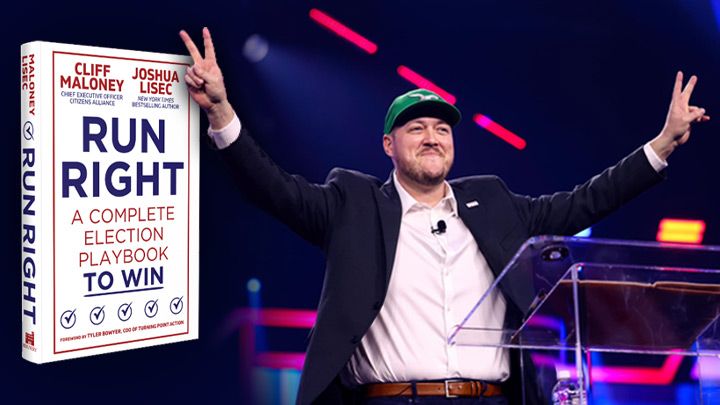
That’s why I was so excited to read an advance copy of Cliff Maloney’s latest book, Run Right: A Complete Election Playbook to Win. If you don’t know who Cliff is, he’s the mastermind behind a lot of the political wins conservatives have achieved over the last several years, and he did that by using many of the tactics that liberals have been using for decades to dominate elections all across America.
So as an entrepreneur, I implore my fellow entrepreneurs to get more involved in politics, both to save the capitalist economic model that has created so many opportunities for so many of us, and to save America itself.
I truly believe this is a battle we have to fight and win.
So that being said, I’m going to unpack what I learned from Maloney’s latest book, Run Right: A Complete Election Playbook to Win.
This is a handbook built for a political moment
In a time when many conservatives feel frustrated by repeated losses and slow-moving change, Run Right: A Complete Election Playbook to Win offers a direct and unapologetic answer: winning elections is the only way to turn ideas into policy.
Written by political activist Cliff Maloney and co-author Joshua Lisec, the book is not another theory-heavy discussion of politics.
It is a field manual.
From the start, Maloney makes it clear that conservatives have made a costly mistake for years by focusing more on ideas than outcomes.
As one endorsement in the book puts it, “For generations, conservatives have defended our principles with passion. But too often, we’ve put principles before power—and lost both.”
That idea drives the entire book. If conservatives want to stop what they see as failed leftist policies, they must organize, campaign, and win.
Why the Left keeps winning
One of the most important themes in Run Right is simple but uncomfortable: the political Left wins because it’s better organized.
Maloney explains this in plain terms. “Why do candidates with wildly unpopular ideas keep winning? The answer is simple: The Left organizes.”
The book argues that left-wing activists turn energy into results by building teams, training volunteers, and showing up election after election. Meanwhile, conservatives often rely on passion alone.
The authors point out that this gap has real consequences. “Democrats have out-organized conservatives, flipped red seats, and built pipelines producing professional operatives.”
From a conservative perspective, this is not just a political problem. It is a national one. If organization continues to favor the Left, then policy outcomes will follow, regardless of what the majority of Americans believe.
That is why Run Right frames elections as more than contests. They are the deciding factor in the future direction of the country.
A critical shift from ideas to action
Maloney is a political activist known for his focus on door-to-door campaigning, and in this book, he pushes readers to move beyond online debate and into real-world action.
“It’s time to stop arguing online and start changing things yourself,” he says.
That line captures the tone of the entire work. This is not a book for spectators. It’s for people willing to run for office, volunteer, or build campaigns from the ground up.
Maloney’s own experience shapes much of the advice. He describes large-scale efforts to knock on hundreds of thousands of doors and improve Republican turnout, especially in key states like Pennsylvania.
The book’s strength lies in this practical focus. It doesn’t spend much time debating whether conservative ideas are correct—it starts from the assumption that they are and then explains what it takes to make them law.
Understanding power in politics
One of the most striking sections of the book deals with the nature of political power. Maloney explains it in blunt terms:
“Politics is the adjudication of power.”
He goes even further by defining power as “The ability and opportunity to force people to act the way you want—and to incentivize or punish them when they don’t.”
This view may seem harsh, but it reflects the authors’ belief that politics is not about good intentions. It’s about results.
For conservatives concerned about the growth of government programs, rising debt, or cultural changes, this argument carries a lot of weight. If political power determines policy, then losing elections means surrendering control over those issues.
The book makes this point clearly: “When someone wins an election, someone else loses, and losers don’t legislate.”
The failure of passive conservatism
Another key argument in Run Right is that many conservatives have taken a passive approach to politics.
Maloney criticizes the idea that simply sharing information or “educating” voters will lead to change. He writes that even when people agree with an issue, they often do not act on it.
Instead, the book emphasizes mobilization. That means building teams, assigning tasks, and turning supporters into active participants.
This is where the conservative critique of leftist success becomes sharper. The authors argue that the Left does not just persuade people. It organizes them into a machine that consistently produces wins.
For readers who believe current policies on issues like spending, regulation, or cultural debates are failing the country, this analysis reinforces a key point: without action, frustration changes nothing.
A practical roadmap to winning
Beyond its broader arguments, Run Right is structured as a step-by-step guide to running a campaign.
The table of contents outlines a clear process, from deciding to run for office to raising money, building a team, and getting out the vote.
The book covers:
- Choosing the right district
- Crafting a message
- Fundraising and budgeting
- Recruiting volunteers
- Door-knocking and voter outreach
- Election day strategy
This level of detail sets the book apart from many political titles. It’s not just commentary. It’s an instruction manual.
Maloney also stresses the importance of small margins. In many races, only a small percentage of voters decide the outcome.
That reality supports the book’s main message: disciplined effort can overcome larger but less organized opposition.
Elections as the path to change
From a conservative perspective, the most important takeaway from Run Right is its focus on elections as the only reliable path to change.
The book rejects the idea that cultural debates alone can shape the future. Instead, it argues that laws and policies are set by those who win office.
As Maloney writes, the goal is to “build your team, mobilize your community, and turn your values into policy.”
This is where the book connects directly to concerns about failed leftist policies. Whether the issue is economic policy, education, or national security, the authors argue that outcomes depend on who holds power.
Without electoral victories, conservative ideas remain just that—ideas.
A call to action for conservatives
In the end, Run Right is more than a guide. It is a call to action.
Cliff Maloney presents the book as a response to a gap on the Right. For years, he argues, conservatives lacked a clear, accessible playbook for organizing and winning.
“This is essential reading for every citizen activist who wants to take our country back, one election at a time.”
The book succeeds in delivering a clear message. It may not appeal to readers looking for a balanced or academic view of politics. But that is not its goal.
Its goal is to win.
If we want to win as a nation, conservatives need to win more elections
Run Right offers a straightforward argument: if conservatives want to stop what they see as harmful policies, they must compete at the same level as their opponents.
That means organizing, mobilizing, and most important, focusing on end results.
Cliff Maloney presents politics as a tough and often unforgiving arena. But he also presents it as one where determined individuals can still make a difference.
For readers who believe the country is heading in the wrong direction, the message is clear.—complaining is not enough.
Winning elections is what changes everything.