
Moez Limayem began his presidency at the University of South Florida in February with a clear workforce agenda: embed internships into every student’s path and position USF as a frictionless partner for employers.
“This is my second week of the job,” Limayem said in an interview with Tampa Bay Business and Wealth. He described his first priority in three words: “Listen, listen, listen.”
He returned to USF as its ninth president after leading the University of North Florida and after spending a decade in Tampa as dean of what is now the Muma College of Business, where he helped raise more than $126 million in private support, including a $25 million gift from Pam and Les Muma that reshaped the college.
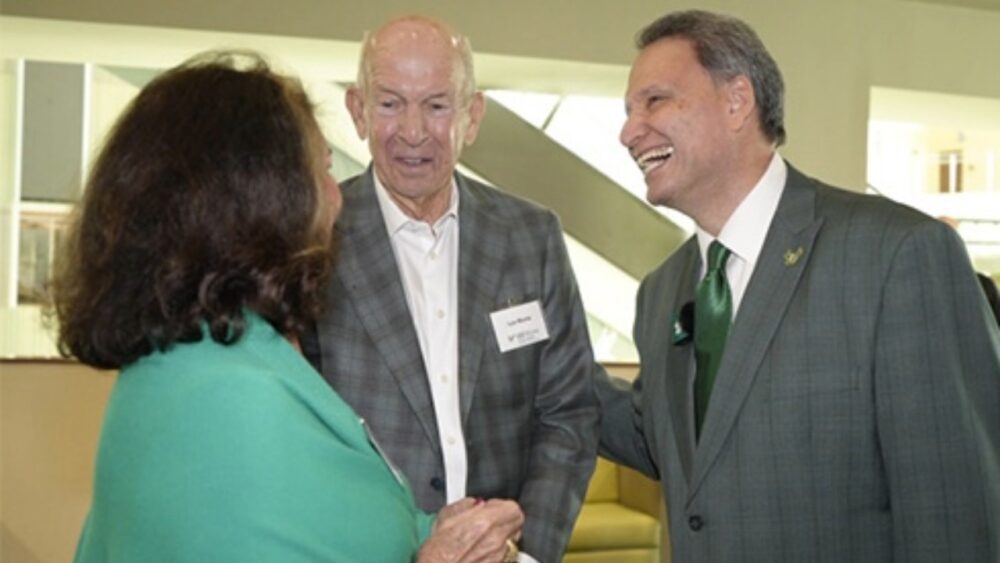
He called the move “coming back home,” describing Tampa as the city where he has lived the longest and where his children grew up.
“Assuming that I know the institution very well is a big mistake that I’m not willing to make,” he said.
He has started a listening tour inside and outside the university to understand what has changed, what pressures have emerged and where USF has room to move.
What he sees is an institution that has climbed quickly in research profile and national visibility, earned admission to the Association of American Universities in 2023 and now carries the momentum and expectations of an AAU institution as it defines its next phase.
“The institution is ready for the next chapter,” he said.
Internships as infrastructure
Limayem’s early vision centers on internships as a structural part of the student experience.
“Students who have at least one internship or similar experiential learning, 80 to 90% of them have higher chances to have a job at graduation or shortly after with a competitive salary,” he said. “That is the number one factor affecting student success, placement and salaries, starting salaries.”
He wants at least one internship or comparable experience to become standard, with USF building it into the academic pathway and backing it with institutional infrastructure.
“We’re starting to see this trend where businesses will hire interns before they hire full-time employees,” Limayem said.
PREVIOUS: Rhea Law’s lifetime bet on the University of South Florida
That shift matters for companies that need talent and for students seeking immediate entry into the workforce. Limayem said USF should treat internships as a system the university builds and manages, with structure and accountability.
That means moving beyond student outreach and building a system companies can access, understand and use with ease.
“We’re going to make it very easy for them to do business with us,” Limayem said. “We will have models. We will help them test a rigorous, important and productive internship.”
He also made the service promise explicit. “We won’t leave them to their own devices,” he said, describing a role for USF in helping employers design and run internships, especially if they do not already have a platform.
He described internships as real operating roles inside companies where students contribute to core work.
“The best case scenario, my vision of an internship, paid or not, is that the customers of the business who employ our interns did not know the difference if they were working with full-time employees or USF interns,” he said.
Limayem said paid internships remain the preference. He also acknowledged that nonprofits and smaller firms often lack the budget to support them. He said USF should raise funds to help students who take unpaid placements because an organization cannot cover wages.
USF wants to function as a smoother talent engine for Tampa Bay and the state. Limayem said employers should have a voice in curriculum conversations to keep academic programs aligned with workforce demand.
“USF is open for business,” he said.
He paired that line with a larger argument about what a public university does for a growing metro. “If you look at every single metropolitan region city, there’s always a very strong public university in its backyard,” Limayem said.
He tied that logic to visibility and presence in the community. “The worst thing that could happen to our university is to be isolated from our community,” he said. “The success of our community is related to the success of USF and vice versa.”
AI as an economic strategy
He has organized his early agenda around two pillars: internships and artificial intelligence.
USF recently launched the Bellini College of Artificial Intelligence, Cybersecurity and Computing, backed by a $40 million gift from Arnie and Lauren Bellini.
Limayem sees the college as both an academic and an economic asset, and he wants it to serve as a point of connection for employers seeking help with AI and cybersecurity.
He framed the ambition as a shift in national standing. “We want to move from the rising star to the star,” he said. He defined that move in practical terms: talent development, industry partnerships and research that responds to problems businesses and communities face.
READ: USF NEWS
He said AI should shape how USF trains students and how it operates as an institution. “We also use AI for operational excellence,” he said, pointing to opportunities to improve processes for faculty, staff, students and alumni.
He also sees USF serving as a resource for companies and nonprofits that need help navigating AI and cybersecurity. The infrastructure already exists, he said, and he wants employers to view the university as a partner that can move at business speed.
Athletics and campus development sit inside that broader positioning. Limayem described intercollegiate athletics as a tool that strengthens institutional identity and alumni engagement.
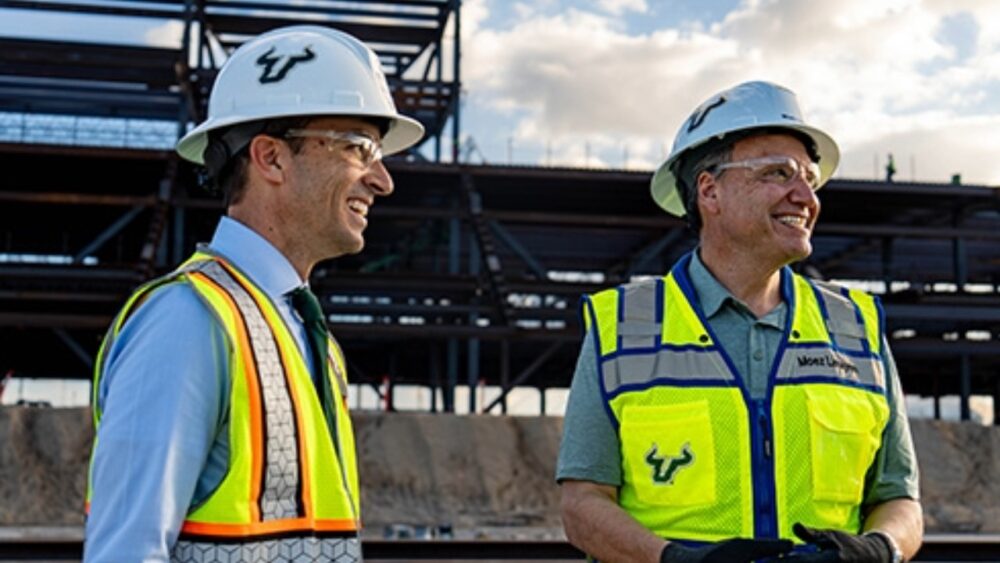
He called the planned on-campus stadium, scheduled to open in 2027, part of USF’s transformational moment.
A legislative crosscurrent
Limayem begins his tenure as state lawmakers weigh proposals that could change the future of the Sarasota-Manatee campus. Lawmakers are still debating the proposals, and he stressed that the outcome will depend on them.
“This is my second week on the job,” he said. “A lot has happened before even my arrival.”
He described the issue as active and unsettled. “The House of Representatives has one bill,” he said, “but the legislative process has just begun.”
He said he is listening closely to faculty, staff and students to understand their concerns. He emphasized responsibility for the people who could be affected.
READ: TAMPA BAY REAL ESTATE NEWS
“People need to understand that we don’t have any control over the outcomes,” Limayem said, “but we are committed to doing everything we can to protect our faculty, staff and students, regardless of the outcome.”
He also promised transparency as developments unfold. “Everything that develops, when there are new things that happen, our faculty, staff, students and community, you will know of any development,” he said. He added that, as of the morning of the interview, “no final decision has been made, to the best of my knowledge.”
Civil discourse as workforce skill
Limayem also introduced a cultural priority he framed as practical training. He wants USF to become a model for civil discourse, and he described it as a skill students need for work, leadership and public life.
“I want our students to graduate with a shot in the arms of civility and civil discourse,” he said.
He described civil discourse as something USF should teach deliberately, then reinforce through the institution’s operations. He described civil discourse as something USF should teach deliberately, then reinforce through the institution’s operations.
READ: TAMPA BAY BUSINESS NEWS
“Freedom of speech comes with the responsibility to let others speak, and to listen to them and to understand them,” he said.
He described a method built into curriculum and credentials. “By incorporating these concepts in the curriculum, by adding micro-credentials on civil discourse, by modeling civil discourse, we can achieve that,” he said.
Writing the next chapter
Limayem has not released a full strategic plan and is spending his opening months meeting with faculty, staff, students, donors and community leaders to define what comes next.
“Now, what is next?” he said, “and that’s where I will be working with my team, with our faculty, staff, students, but also leaders in the community in the state to hopefully write the next chapter for USF.”
For Tampa Bay’s business community, his early priorities are clear. He wants USF graduates to leave campus with real work experience.
He wants to build AI capacity that supports students and employers while positioning USF at the center of the region’s economic life.
He is beginning with a listening tour. The next phase will determine whether those priorities translate into structure, investment and measurable results for Tampa Bay.
Stay Informed
Stay up to date on Tampa Bay business news, executive profiles and the companies shaping the region.