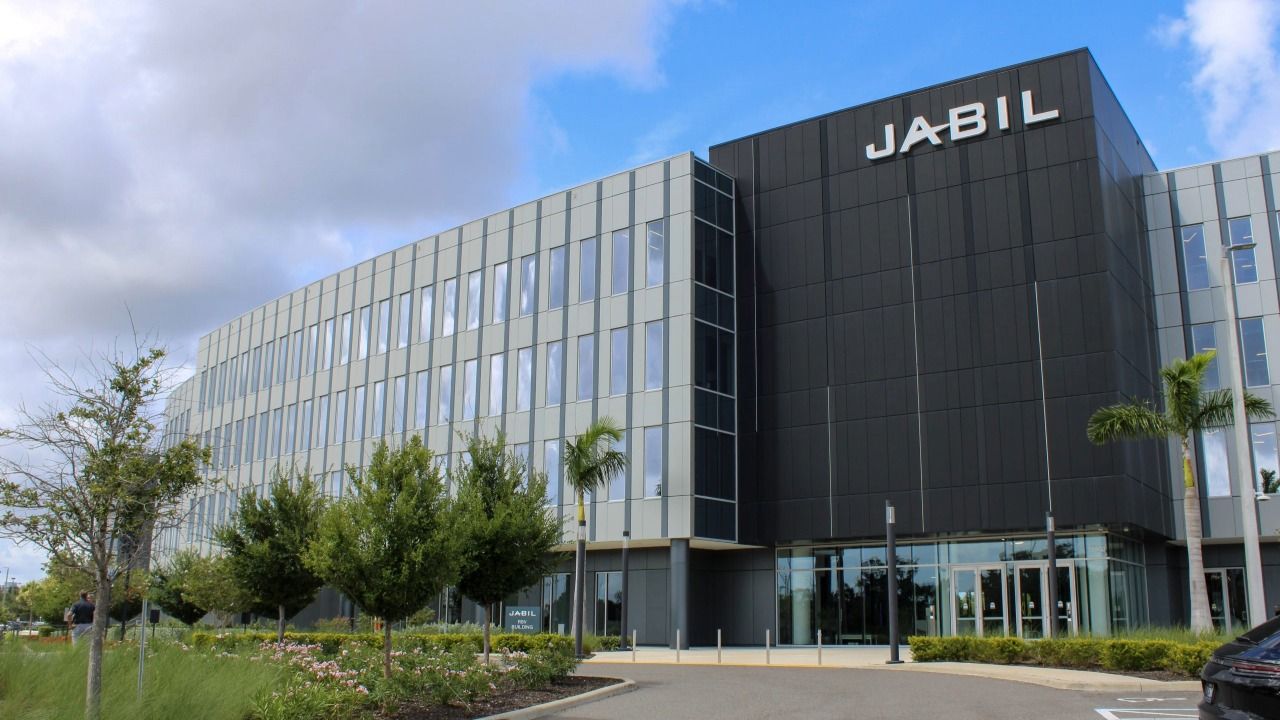
St. Petersburg-based manufacturer Jabil expects revenue to climb 24% to $44.5 billion in fiscal 2027 as accelerating demand for artificial intelligence infrastructure adds to growth across automotive, healthcare, energy infrastructure, defense and aerospace and automation markets.
Jabil issued the outlook Wednesday alongside preliminary fiscal 2026 results that showed revenue rose 21% to $36 billion, while net income increased 58% to $1.04 billion. The company finished the year with an especially strong fourth quarter, when revenue jumped nearly 29% to $10.6 billion.
Much of that growth is coming from AI infrastructure, where Jabil — the 60-year-old St. Petersburg manufacturer with more than 100 sites worldwide — has been adding capacity and handling more of the engineering, supply-chain and manufacturing work for its customers. CEO Mike Dastoor said the company brought “critical new capacity” online during fiscal 2026 as AI infrastructure produced significant growth.
That new capacity already has business committed to it, according to Jabil, and AI is not the only market filling it. The company expects growth across automotive, healthcare, energy infrastructure, defense and aerospace and warehouse and retail automation as customers turn to Jabil for more of their engineering, supply-chain and manufacturing needs.
For fiscal 2027, Jabil expects its core operating margin to increase from 5.8% to 6.1%, while adjusted earnings per share rise 34% to $17.55. The company is also forecasting roughly $1.6 billion in adjusted free cash flow.
Jabil expects $10.6 billion to $11.4 billion in revenue during its first fiscal quarter, putting the company near the pace needed to reach its full-year forecast from the start.
The company put $628 million into property, plants and equipment during fiscal 2026, up from $468 million a year earlier, and spent another $852 million on business and intangible-asset acquisitions — more than twice the previous year’s total.
Jabil also generated $2 billion in operating cash during the year and spent $1.06 billion buying back shares. If its new forecast holds, the St. Petersburg manufacturer would follow its first $36 billion revenue year with its first above $40 billion.