Tampa Bay is attracting venture capital at its fastest pace in years, but the money is not getting easier for startups to reach.
AI has changed what $1 million in revenue tells an investor. Companies can launch faster, reach customers sooner and sometimes hit that mark with far less money. With more companies to choose from, investors can wait longer—and put the bigger checks behind businesses that keep growing.
Companies in the Tampa-St. Petersburg metro raised $209.8 million across 25 venture deals in the second quarter, up from $129 million in the first, according to PitchBook figures cited by Tampa-based Florida Funders.
That put the metro at roughly $338.8 million through June, on pace for its strongest funding year in more than a decade. Add Sarasota-Bradenton and the first-half total exceeds $650 million, helped by Sarasota cybersecurity company TENEX.AI, which raised a $250 million Series B led by Crosspoint Capital at a valuation above $1 billion.
Tampa Bay’s increase comes during a huge year for venture capital nationally. U.S. investors put $412.7 billion into companies in the first half of 2026, according to figures cited by Florida Funders—nearly 30% more than they invested during all of last year. Rounds of at least $100 million accounted for 87.5% of the dollars invested, and AI companies took 86% of the total.
Amit Agrawal sees what those national totals look like earlier in a company’s life. As Tampa Bay Wave’s director of investor relations and platform operations, he matches startups with investors.
“The numbers are going up,” Mr. Agrawal said. But more of that money is landing with companies already breaking away from the pack. For everyone else, record venture spending has not made raising money much easier.
“It’s harder for the early-stage founders to differentiate themselves and get ahead,” he said. “But when you make it past a certain inflection point, then it’s better for you because you’ve now proven yourself and can get capital.”
Saxon Baum, managing partner of Florida Funders, said easier company-building has changed what early revenue tells investors.
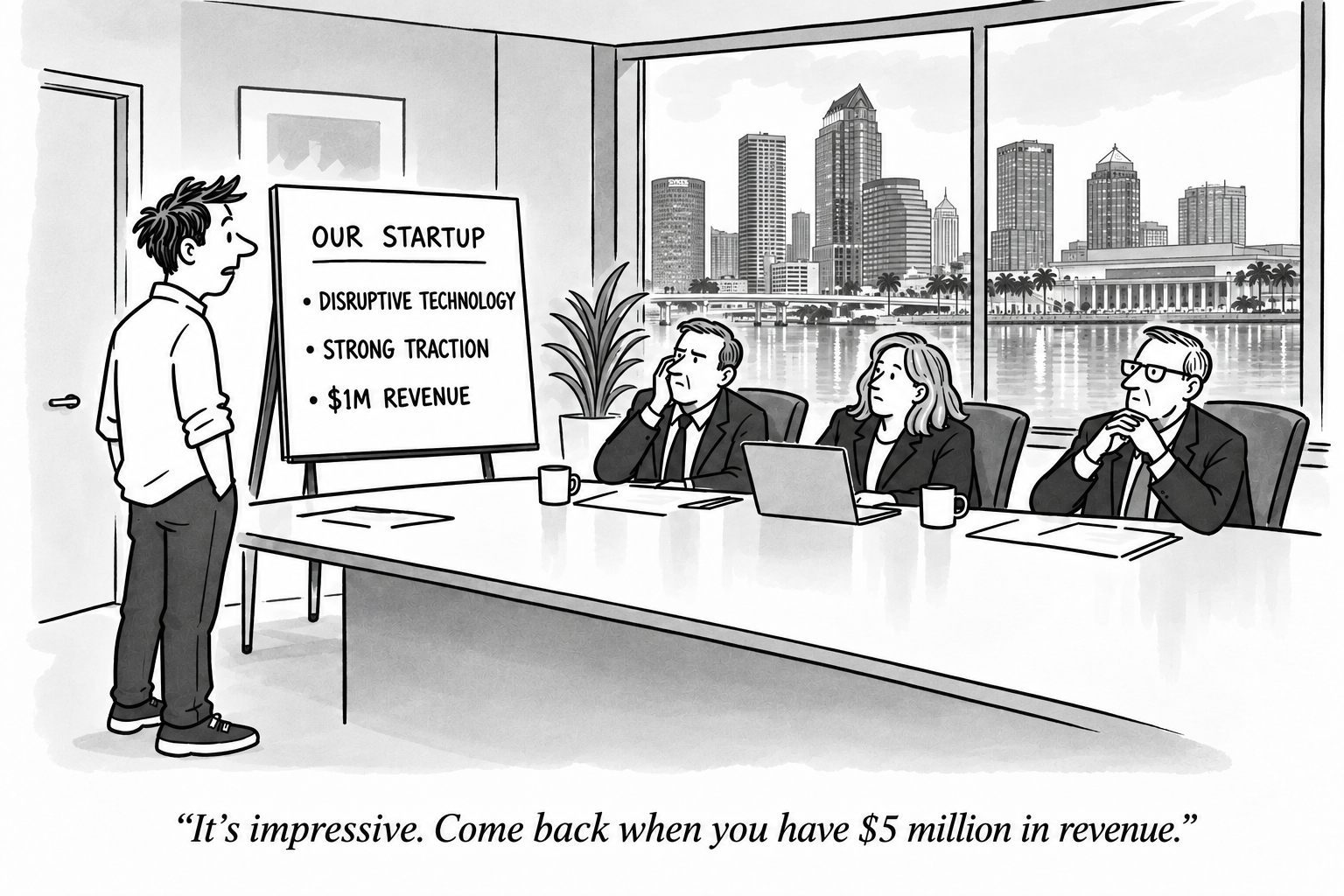
“Getting from zero to $1 million in revenue used to feel like, ‘That’s super exciting.’ That’s not really that exciting anymore,” Mr. Baum said. “We’re looking for companies to get to $5 million in revenue and then go from $5 million to $20 million to $100 million. The scale and the speed of things, I don’t think we’ve seen before.”
Mr. Agrawal has watched the price of a venture round rise in revenue rather than dollars. A company reaching $1 million in sales could once raise roughly $2 million to $5 million, he said, while about $3 million in revenue was a common benchmark for a $5 million to $10 million Series A. Now investors want closer to $3 million to $5 million in revenue before writing roughly the same check.
“VCs have the luxury of waiting for startups to hit certain metrics,” Mr. Agrawal said.
Companies racing through those milestones remain the exception, Mr. Baum cautioned. AI startups can generate revenue unusually early, but early sales do not guarantee staying power. “There’s going to be a lot of losers in the space,” he said.
Mr. Agrawal sees another problem behind that speed: What became easier for one founder also became easier for the next. If an investor can reproduce half a company’s product within hours using AI tools, early revenue matters less if a competitor can do the same.
“You can build a lot of quick, sharp, easy ideas that can start selling,” Mr. Agrawal said. “But can you build a really venture-explosive idea? That’s a lot more rare.”
On a recent Tampa Bay Wave panel, investors described what they want instead: software with a “real-world touchpoint,” whether proprietary hardware, a physical process or a supply chain another founder cannot reproduce with more code.
Florida Funders wants AI companies that can take over larger pieces of a customer’s operation, not another feature inside somebody else’s software. Distribution, paying customers and contract size matter, too.
Mr. Baum pointed to annual contracts above $100,000 as evidence that a product has moved beyond an experiment and become important enough to run inside a larger company’s operation.
“Small logos prove somebody will try your product,” Mr. Baum wrote in his second-quarter letter to investors. “Six-figure contracts prove an enterprise will run its business on it.”
“A lot of what we’re looking for is the application of artificial intelligence in the real world, so the application of AI being able to intersect with people actually doing things,” Mr. Baum said. “We’re also looking for replacing operating systems. We’re not looking for what’s called a point solution, like this one thing inside of a business. We’re looking for replacing an entire operating system with AI-native software.”
Mr. Baum described a potential investment in an AI-native debt-collection company attempting to replace much of the industry’s operating system, from automated communications to collections and customer management. Another uses AI to perform work associated with large consulting firms, analyzing where businesses could deploy the technology and how their workforces and operations could change.
Building on somebody else’s AI model creates a different vulnerability. Mr. Agrawal used Anthropic’s Claude as an example: If Anthropic doubles the price of Claude credits, a startup dependent on it pays more. Anthropic could also build the startup’s functions into Claude, turning a standalone product into somebody else’s feature.
That uncertainty reaches the buyer, too. “Companies don’t want to be holding the bag that they purchased this billion-dollar thing, but it turns out it’s replicable by Gemini in a couple months,” Mr. Agrawal said.
Longer waits for exits reach founders raising their first rounds. Mr. Agrawal said investors once expected exits within three to five years; now the wait can run five to seven years, if not seven to 10. Until those investments become cash, less money returns to limited partners—and less can cycle into funds writing the next checks.
Florida Funders says more than 10,000 U.S. companies are on pace to raise their first venture round this year, an all-time record, while seed round sizes remain flat. That supply is meeting fewer sources of capital: Corporate venture participation is at a decade low, crossover funds are completing their fewest deals since 2019 and first-time fund formation is at its lowest since 2016, according to Florida Funders.
That imbalance gives investors another advantage: Pre-seed and seed valuations have not climbed as sharply as later-stage valuations. Florida Funders is moving earlier to buy before they do. Its $5 million FLF Accelerate Fund invests in companies emerging from Andreessen Horowitz’s speedrun accelerator, while Florida First Check writes $75,000 to $100,000 checks alongside universities, accelerators and incubators.
AI is also giving some founders a reason not to raise venture capital. Mr. Agrawal said a software company once might have needed millions to hire enough engineers, salespeople and other workers to reach its first few million in revenue. Now a founder might raise a few hundred thousand dollars from friends and family, hire one AI engineer and automate enough work to reach profitability without giving an investor 15% or 20% of the company.
Those lower costs have brought in people who might never have started a software company. Someone who once needed hundreds of thousands of dollars and a technical co-founder can now spend a few thousand building an idea on the side, test demand and then decide whether to pursue it full time.
Mr. Agrawal hears “AI wrapper” regularly in venture circles, while “vibe coding” can carry a dismissive connotation toward products built quickly around somebody else’s technology. Investors must determine how deeply a founder understands the market, how defensible the product is and how committed the founder is.
Tampa Bay founders face another problem: There still are not enough investors here writing first checks, Mr. Agrawal said. Florida Funders, TampaBay.Ventures and other firms supply pieces of that market, but he wants more local venture funds, particularly angel and seed investors.
“There needs to be a return of strong angel capital here,” Mr. Agrawal said. “If our tech ecosystem is going to get bigger, we have to invest in our own people.”
Without enough local backing, he said, startups that exhaust the capital available nearby can eventually leave in search of deeper pools of money and technology talent elsewhere.
Tampa Bay has seen plenty of companies attract capital this year but few large transactions returning it to investors, Mr. Baum said. Mr. Agrawal points to ConnectWise and KnowBe4 for what can happen when one finally does: Employees leave with money, experience and networks, and some put all three into the next Tampa Bay company.
Buyers became harder to find after interest rates began rising in 2022, when the higher cost of capital weakened acquisitions and IPOs. Mr. Baum said that began to change around the start of 2025. Private-equity firms and strategic buyers returned, while a growing secondary market gave Florida Funders another way to sell shares without waiting for either an acquisition or an IPO.
Three of Florida Funders’ exits during the past two years came through secondary transactions.
RepScrubs provided another source of liquidity in the second quarter when the Fund 1 company was acquired after raising no additional capital following Florida Funders’ investment. That left the firm’s ownership undiluted through the sale. The transaction produced an 11.84 times gross multiple on invested capital and returned roughly 30% of Fund 1’s paid-in capital, according to Florida Funders.
Flex raised a $70 million Series B1 at a $1.2 billion post-money valuation, putting Florida Funders’ stake at approximately 16 times its original entry price. But none of those shares changed hands. Unlike the RepScrubs acquisition, the new round raised the value of Florida Funders’ investment without returning cash to the firm.
“In a healthy market, you’ve got both things happening. There’s a lot more money being deployed right now than exits, so as an investor, at some point we need exits,” Mr. Baum said.
Mr. Agrawal is watching for more of those exits. “If we start seeing a lot of rapid news about exits, that gives me confidence in a healthier venture ecosystem going forward,” he said, “because that means there’s liquidity returning.”
Mr. Baum is waiting for the people, too. “If you have a company go public, there’s going to be X amount of new millionaires, and then they become investors and they run their own businesses and start their own companies,” he said. “That’s really how an ecosystem continues to flourish. You’ve got assets that can be invested into the ecosystem.”