
An apartment property that could support roughly $15 million of debt when interest rates were around 3.5% might qualify for only about $10 million refinanced around 7% today, leaving the owner to produce another $5 million, find a new source of capital or sell. Matt Chadwick, head of acquisitions at Tampa-based Ally Capital Group, is increasingly watching that problem land in front of owners as loans taken out during Tampa Bay’s apartment boom come due.
Rising rents, climbing property values and cheap debt made increasingly expensive apartment acquisitions work in 2021 and 2022 even when the cash flow was thin and the deal depended on rents continuing to rise. Tampa Bay then added thousands of apartments, rent growth slowed and the five-year loans behind many of those purchases started reaching maturity.
Falling occupancy and rents are now leaving Tampa Bay apartment owners with less income to support those loans, with first-quarter multifamily occupancy dropping to 91%, its lowest level in a decade, and effective rents declining 4.9% from a year earlier to $1,806, according to Cushman & Wakefield data previously reported by TBBW. Another 8,908 apartments remained under construction across the region.
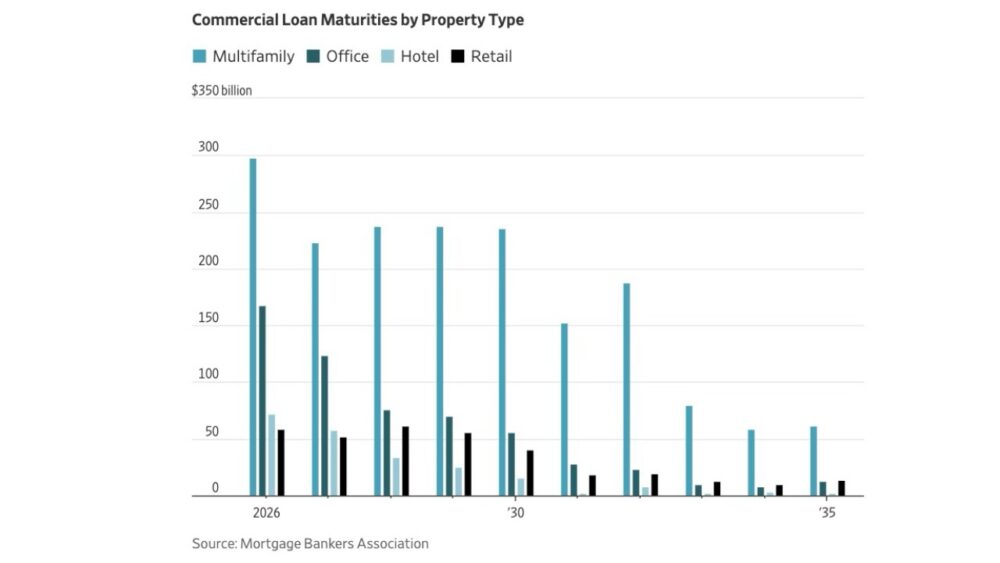
Nearly $300 billion in U.S. multifamily loans are scheduled to mature in 2026, part of roughly $757 billion coming due through 2028, according to the Mortgage Bankers Association, while apartment values nationally have fallen more than 20% from their 2022 peak, according to The Wall Street Journal.
Tony DeSisto, president of Tampa-based Franklin Street, said some owners are reaching refinancing with properties that no longer generate enough income or support enough value to replace the debt they already have. “Now all of a sudden you’re paying almost double on a monthly basis, and can your NOI handle that?” DeSisto said. “Some people can’t. They’re getting upside down. The value of their property has gone down significantly, and so they can’t actually make their debt-service coverage ratio or get the valuation to where their refinance works. They’ve actually got to put money into the deal in order to refi.”
“Extension options gave owners additional time to evaluate their options and navigate a changing market,” Chadwick said. “That additional time also created some challenging portfolio management decisions, whether to continue investing capital into an existing asset and wait for a recovery, or recycle that capital into opportunities with a more attractive risk-adjusted return. There was a lot of uncertainty around whether to stay the course or make a change. Now, extending and pretending is no longer an option.”
“There was this sense of, are we in the first inning, the fifth inning, the eighth inning or are we in a rain delay?” DeSisto said. “People were just paused, not taking any action and hoping for some change. I think everyone has just woken up to the fact that we’re in this higher-interest-rate environment for the foreseeable future.”
Distressed apartment sales accounted for 4.7% of U.S. multifamily transactions during the second quarter, up from 1.5% a year earlier, according to MSCI data reported by The Wall Street Journal, as more owners reached the point where extensions and waiting were no longer enough. Among commercial real estate collateralized loan obligations, a type of floating-rate financing used for some riskier apartment purchases, the distress rate jumped from 19% in July to 28% in August.
Owners who exhaust their extensions without a new loan large enough to pay off the old one have only a few places left to turn: contribute more money, bring in another investor, borrow more expensive private capital or sell the property. “At the end of the day, no one sells for a loss unless they’re forced to,” DeSisto said. “If they’re not forced to, they’ll just hold on or put some money into it. It’s only when the bank and the refinancing force the issue at the current valuations versus where many of these assets were purchased that people do it. It doesn’t make sense to sell otherwise.”
Maturing loans are now pushing properties Ally has tracked for years onto the market as owners run out of time to postpone decisions about whether to contribute more capital, recapitalize or sell. “We’re seeing a lot of owners who acquired assets during the previous cycle now being forced to make a decision,” Chadwick said. “Some are selling at losses from where they originally purchased, while others are finding ways to recapitalize their deals and bring in new capital. It’s painful for existing investors, but it’s healthy, and how the market clears and pricing gets back in line with where it makes sense today.”
The 259-unit Edge at 1702 shows how far that repricing can go, selling for $70 million in September after changing hands for $83 million in 2024 and $115 million in 2022, a $45 million drop from its price near the market’s peak. The latest buyer assumed about $45.5 million of existing debt as part of the acquisition.
Ally largely stayed out of multifamily while investors were competing aggressively for apartments, instead moving toward office properties that Chadwick said could be acquired at substantial discounts to replacement cost and still produce positive leverage. The firm’s broader investment history also includes distressed real estate, with Ally describing past deals as spanning note acquisitions, recapitalization buyouts and bankruptcy foreclosures alongside conventional acquisitions and development.
Ally put its office strategy to work in Tampa this spring when it partnered with Banyan Street to recapitalize Rivergate Tower, the 31-story downtown office building commonly known as the Beer Can Building, and committed about $8 million to improvements. The partnership gives Ally a stake in the next round of investment and repositioning at Rivergate.
Multifamily is now beginning to present the kind of pricing opportunity Ally found elsewhere as higher rates, maturing debt and weaker operating fundamentals force some owners to reset their basis or sell. “I think we may finally start to see some more normalized pricing as sellers adjust their expectations and buyers can underwrite to a basis that makes sense today,” Chadwick said. “The bid-ask spread between buyers and sellers is beginning to narrow, and that will create more opportunities for us to be constructive, recapitalize deals or acquire assets at a basis that makes sense today.”
DeSisto believes the broader market does not necessarily need dramatically lower interest rates to start moving again as much as it needs enough certainty for buyers, sellers and lenders to stop waiting for the financing environment to change. “I would much prefer — the industry would be in much better shape — if they announced, ‘We’re going to stay at this interest rate for the next three years,’” DeSisto said. “When there’s uncertainty about what’s going to happen, people just pause and don’t really know how to interact. That’s when the transaction volume really shrinks. As long as there’s some certainty, even if it’s at a higher interest-rate environment, then people know what the game is and know it’s going to be that way for a while. They have to adjust their understanding of value correspondingly, and then more transactions can occur.”