
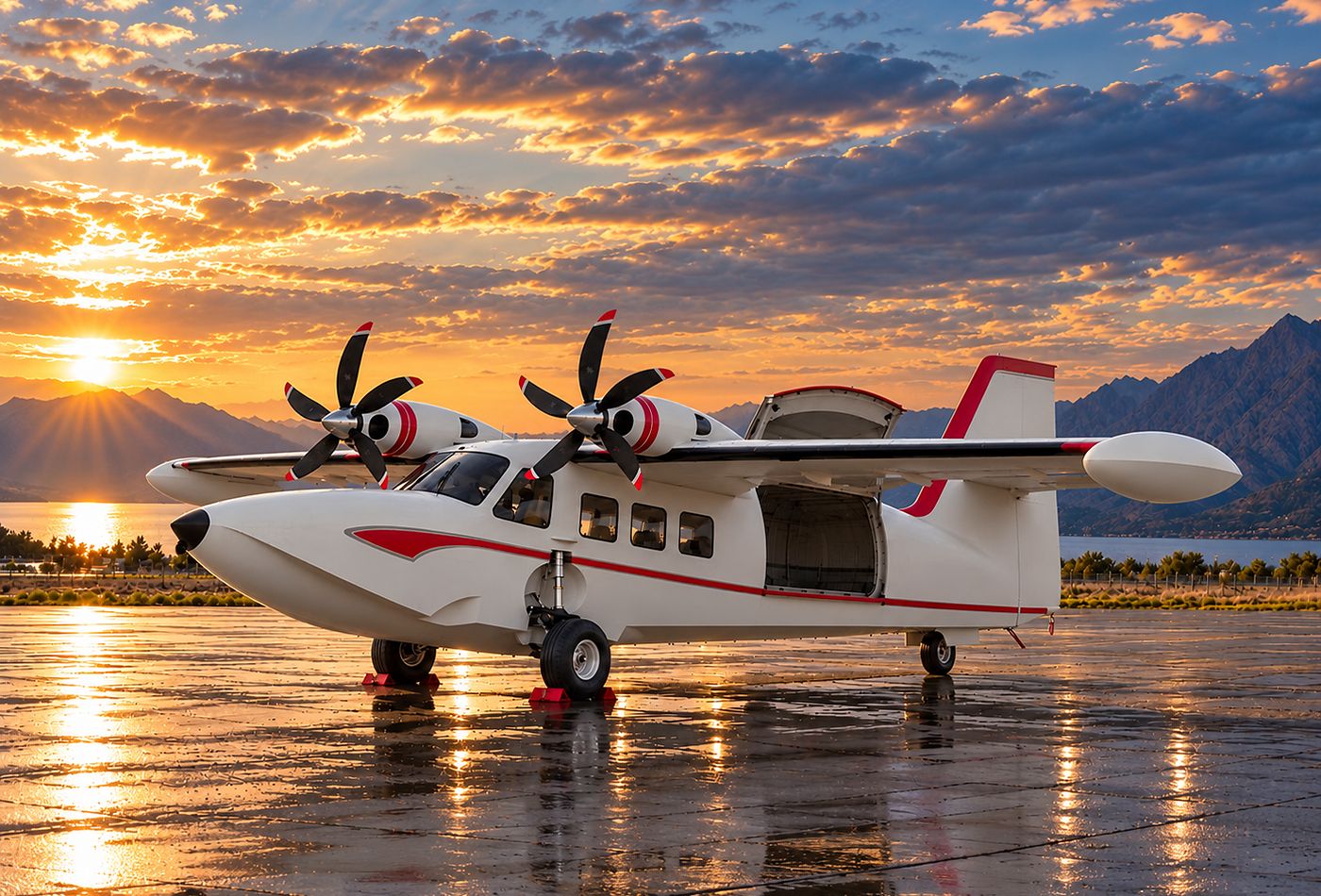
Bartow-based Maxwell Aircraft has unveiled a hybrid-electric amphibious airplane designed to carry 2,000 pounds of cargo over 1,000 nautical miles, with plans to begin flight testing in 2027.
The company announced its patent-pending M1 Hybrid on Friday, Nov. 6, with a cargo version designed to operate from land or water and a five-foot-wide door for loading freight. Maxwell sees potential customers among cargo operators, government agencies and military organizations that need to reach remote communities, islands and other places without conventional airports.
The aircraft is still in development, although Maxwell says the first carbon-fiber and Kevlar versions of its Gweduck-based airframe have come off the production line and are headed for final assembly. The company has not disclosed where those airframes were manufactured, where final assembly will take place or when it expects to begin deliveries.
Maxwell originally explored building an all-electric seaplane for relatively short flights of 200 miles or less. Its founders, who include experienced seaplane pilots and aviation executives, believed electric motors could provide the power needed to lift heavy loads from the water, potentially reducing fuel and maintenance expenses.
The problem was how much battery weight the aircraft would have to carry. Maxwell studied improvements in battery technology and the economics of electric aviation before advances in lightweight compression-ignition engines persuaded the company to reconsider its approach.
Those engines offered a way to use conventional aviation fuel during long flights while reserving electric power for takeoff and climbing, when an aircraft needs considerably more horsepower than it does at cruising altitude.
Conventional aircraft carry engines powerful enough for takeoff even though they need only a fraction of that output during cruise. Maxwell’s proposed hybrid system would produce as much as 1,500 horsepower during takeoff and initial climb, then rely primarily on two Jet A-fueled engines producing approximately 300 horsepower combined during cruise.
The arrangement is intended to reduce the battery capacity and weight required for electric propulsion while giving the aircraft enough range to carry a substantial cargo load.
“Our goal with the M1 Hybrid Cargo was to rethink what an amphibious aircraft can do,” said David Dillon, Maxwell’s CEO. “By combining the tremendous power of electric propulsion where it delivers the greatest benefit with the range and energy density of Jet A for cruise, we saw we could give operators an aircraft that carries more, travels farther, and reaches destinations inaccessible to conventional landplanes.”
Maxwell is developing the aircraft with Carbon Seaplanes, whose CEO, Walter Fellows, and general manager, Mark Mahnke, are also members of Maxwell’s ownership group. The M1 uses an airframe based on the Gweduck, a composite amphibious airplane descended from earlier Grumman seaplane designs.
Its carbon-fiber and Kevlar construction is intended to reduce weight and avoid some of the corrosion problems associated with metal aircraft operating in saltwater environments.
Maxwell’s advertised payload, range and horsepower figures remain design targets that have not yet been demonstrated through flight testing. The company says the cargo aircraft can be offered under experimental aircraft regulations for certain government uses, although the specific authorizations required for its planned operations have not been established.
Maxwell has not identified launch customers, announced aircraft pricing or disclosed its investment in the development program. The company expects to begin flight testing in 2027.