
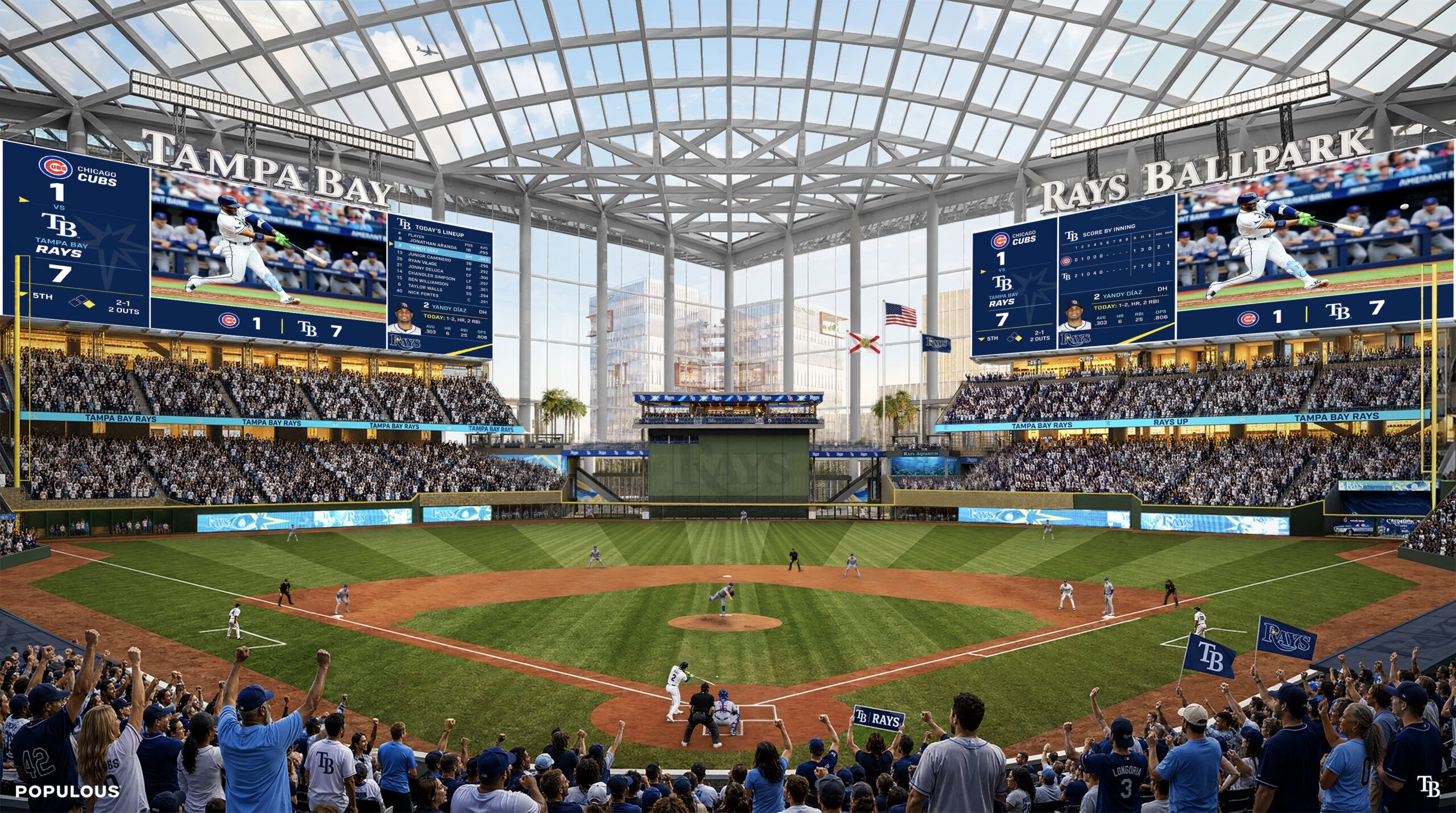
Less than 24 hours after Tampa City Council dealt two setbacks to the Tampa Bay Rays’ proposed $2.3 billion stadium project, Rays Chief Executive Officer Ken Babby met Friday morning with Councilman Bill Carlson and agreed to begin meeting individually with all seven council members, according to Carlson.
Carlson said the outreach marked a long-overdue shift in the Rays’ approach after the Community Redevelopment Agency board voted unanimously last month to request direct negotiations with council members. City Hall disputed Carlson’s characterization, saying the Rays and the mayor’s office have been communicating with council members throughout the process.
“If the Rays hit the reset button today, they might have a chance,” Carlson told TBBW.
Carlson said Babby called him Thursday night after the council meetings and agreed during their Friday conversation to contact each council member directly.
“You need to pick up the phone and meet with all the City Council members,” Carlson said he told Babby. “And he agreed to do that.”
Carlson said any private meetings with council members would have to be held individually because of Florida’s Sunshine Law. Babby did not respond to an interview request from TBBW following the meeting.
Castor was unavailable Friday, but Adam Smith, the mayor’s director of marketing and communications, disputed Carlson’s characterization of the negotiations, saying both the administration and the Rays had remained accessible to all council members throughout the process.
“Mayor Castor’s goal is simple: Let’s work to keep the Rays in Tampa Bay while protecting taxpayers, and let’s not try to derail progress before negotiations with the team are even done,” Smith said.
Smith added Castor was frustrated that Thursday’s land-use vote “did nothing except delay and impede progress on negotiating a deal for council to review in the near future.”
Carlson, who is running to succeed the term-limited Castor as mayor in 2027 and has frequently clashed with her administration, offered a sharply different account. He accused City Hall of excluding council members from negotiations and said Castor appeared to be “sabotaging the negotiations,” so she could blame City Council if the project failed.
Carlson also said he believes someone in city government discouraged the Rays from meeting directly with council members, though he acknowledged the team has not confirmed that allegation.
Despite Friday’s meeting, Carlson made clear that he remains deeply skeptical of the current proposal. Although he said “it is always a possibility for anything,” he described the threshold for earning his support as extremely high.
“My constituents don’t want to spend any money to subsidize projects like this,” Carlson said. “They want us to spend on basic infrastructure.”
Carlson cast the deciding fourth vote in May to approve a nonbinding memorandum of understanding that allowed negotiations to continue. But on Thursday, he joined the majority in postponing a Community Redevelopment Agency discussion on stadium financing and rejecting a preliminary land-use transmittal for the proposed Hillsborough College stadium site.
Carlson said Friday’s meeting reinforced what he views as the project’s central reality: Any financing structure involving city revenue will ultimately require council approval.
“There is no deal without the city,” Carlson said. “The City Council has to say yes or no.”
Carlson said that would remain true even if negotiators pursued a home-rule tax-increment financing district because City Council would still have to approve the use of city property-tax revenue.
Carlson said he wants any revised agreement to produce benefits that council members can explain to residents who are indifferent to baseball. Among the ideas he raised were extending the East Tampa Community Redevelopment Area through negotiations with Hillsborough County and capping the Downtown CRA’s tax increment at 50%.
Carlson said the Downtown CRA change could eventually redirect $15 million to $20 million annually toward roads, stormwater improvements and parks. He argued those ideas would not require additional money from the Rays but could broaden the negotiations by directing future public revenue toward priorities outside the stadium district.
“My constituents don’t care about baseball,” Carlson said. “If I can say we’re moving $20 million a year to repair your roads, it would make it more of a win-win outcome.”
The framework contemplated at least $1 billion in public participation, including $750 million from Hillsborough County and $251 million from the City of Tampa. The public contribution would be financed through bonds repaid over time with tax revenue, including Community Investment Tax proceeds. The Rays would provide the remaining financing through private investment and stadium revenue, including naming rights and a ticket surcharge of up to $3.50 per ticket.
The project still requires final financing and development agreements, land-use approvals, bond validation and confirmation that the Rays can fund their share before construction can begin.