
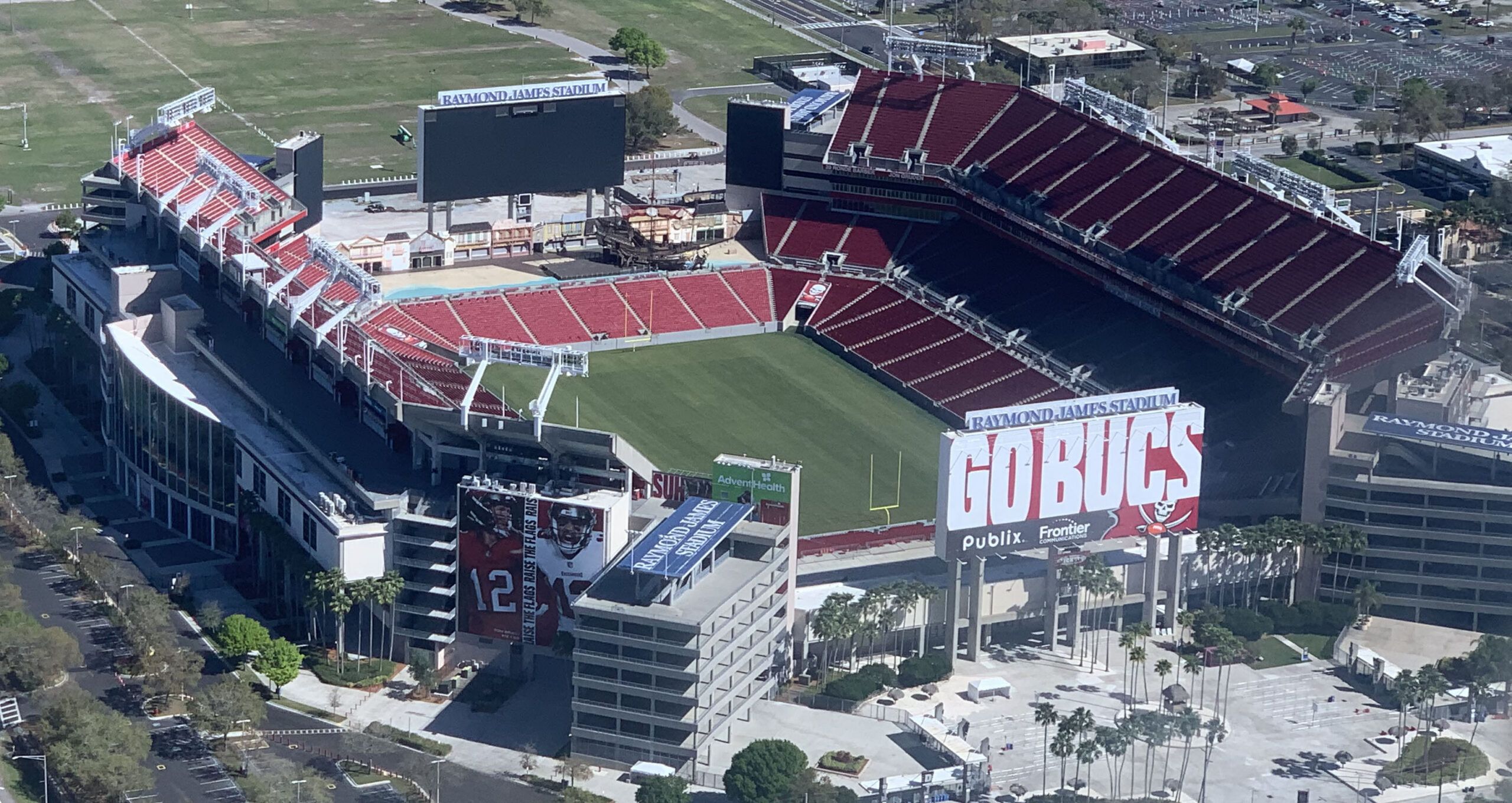
According to the Tampa Sports Authority’s proposed fiscal 2027 budget and fiscal 2028 planning budget, Raymond James Stadium could receive $76.6 million in repairs and upgrades over the next two fiscal years. Tampa and Hillsborough County would be asked to pay for nearly all of it.
The biggest projects are $30 million for new seats and retractable seating in the south end zone, $18 million for elevators and escalators, and $10.6 million to renovate a visiting-team locker room.
The Sports Authority would begin fiscal 2027 with $3.49 million available for capital projects, then request the remaining $73.14 million from Tampa and Hillsborough County, according to the budget.
A separate long-range forecast in the budget projects $378.65 million in city and county contributions for stadium capital projects from 2028 through 2047. It is unclear whether that total includes the $15.5 million planned for fiscal 2028.
The stadium is nearing 30 years old, still needs public help to cover operating costs and will lose USF football as a regular tenant when the university opens its on-campus stadium. Raymond James Stadium hosted its first game Sept. 20, 1998, while USF has scheduled the first game at its new on-campus stadium for Sept. 4, 2027.
The Sports Authority board is scheduled to consider the fiscal 2027 proposed budget and fiscal 2028 planning budget Tuesday, Aug. 4. The board can approve the budget request, but Tampa and Hillsborough County would still have to decide whether to provide the money.
The budget does not say how Tampa and Hillsborough would split the $73.1 million, whether either government has the money set aside or where it would come from.
Most of the work, totaling $61.1 million, is proposed for fiscal 2027, which begins Oct. 1.
The fiscal 2027 capital plan lists a $3 million storage building in the stadium parking lots, physical-security and cybersecurity improvements, cooling-tower repairs and upgrades, and completion of undeveloped space along the south concourse.
The authority would spend $600,000 this year to design the visiting-team locker room, then budget $10 million to build it in 2028.
The documents do not identify which teams or events would use the locker room. They separately anticipate higher consulting and legal expenses associated with a “new tenant” but do not identify the tenant or establish a connection between the two.
Other fiscal 2028 projects include new parking-lot lighting and buried wiring, security improvements, replacement fencing and parking-lot maintenance.
Why stadium revenue does not cover the cost
Raymond James Stadium is projected to generate $48.27 million in gross operating revenue during fiscal 2027, but $8.02 million in budgeted revenue splits would reduce net operating revenue to $40.25 million.
Operating expenses are projected at $45.25 million. After including unrestricted investment income and removing depreciation, the authority projects a cash-basis operating deficit of $4.44 million.
The authority would use $1.86 million left over from a prior operating surplus, reducing its operating subsidy request to $2.58 million. Under the current operating agreement, Hillsborough County would pay $1.72 million and Tampa would pay $859,084. That split does not necessarily apply to the separate capital request.
Including operations and capital projects, the authority is requesting $60.17 million from the city and county for fiscal 2027. Its fiscal 2028 planning figures identify another $19.16 million in requested contributions.
Where the stadium’s money goes
The fiscal 2027 budget assumes seven concerts, 12 Tampa Bay Buccaneers games, five USF football games and several motorsports and postseason college-football events.
Concerts and motorsports are projected to generate $23.91 million in gross revenue, but the stadium does not retain all the money associated with those events.
Under the stadium agreement, the Buccaneers receive a share of certain event revenue after taxes and direct event costs are paid. Their share increases as that revenue rises.
The team also retains admissions, concessions, parking and advertising revenue generated by Buccaneers events, along with suite-lease and stadium advertising revenue.
In return, the Buccaneers pay an annual stadium license fee budgeted at $3.5 million in fiscal 2027 and $5.83 million in the fiscal 2028 planning budget. The budget states that the annual fee would increase to $7 million if the team’s stadium agreement is renewed but does not expressly explain the $5.83 million fiscal 2028 calculation.
USF’s move changes the revenue picture
USF’s new on-campus stadium is scheduled to host its first football game in fall 2027, ending Raymond James Stadium’s role as the program’s regular home venue if construction remains on schedule.
Total college-football revenue at Raymond James Stadium is projected to decline from $6.23 million in fiscal 2026 to $4.67 million in fiscal 2027 and $3.73 million in fiscal 2028. That category includes postseason games as well as USF football, and the budget documents do not attribute the entire decline to the university’s departure.
The Sports Authority board will decide Tuesday whether to approve the spending plans. Tampa and Hillsborough County would then face separate decisions over whether to provide the requested money, where it would come from and how long the public commitment should continue when projected city and county capital contributions already approach $379 million.
View the Sports Authority’s proposed 2027-2028 budget here.