
Kal Gullapalli was in eighth grade when he told his mother he wasn’t going to medical school because he had already decided he wanted to become an investment banker, even though nearly every adult in his family practiced medicine.
His parents immigrated from India in the early 1970s, recruited by American hospitals during a nationwide doctor shortage, and settled in suburban Detroit, where both built medical careers. Gullapalli visited India only twice before turning 18 because most of his extended family had already settled in the United States and after his grandparents died young, there was little reason to return regularly.
“When you’re in that type of ecosystem, my uncles, my aunts, everybody is a doctor. My cousins are all doctors,” he said. “So I was kind of the black sheep.”
His mother was distraught when he told her he wanted to become an investment banker instead, then spent years asking whether he might still change his mind. “For like 10 years,” Gullapalli said. “But I think over time she’s like, ‘All right, he’s doing what he loves.’”
Gullapalli now runs Tampa-based Built Different Brands, which generates about $120 million in revenue from more than 80 locations across several states through a portfolio that includes Marco’s Pizza, Dave’s Hot Chicken, PopUp Bagels, Restore Hyper Wellness, VIO Med Spa, Sandbox VR and Hand & Stone Massage. The company plans to open 15 to 17 locations this year and as many as 24 next year as Gullapalli pursues $500 million in annual revenue within five years.
His parents left for work around eight every morning, returned home for dinner and expected their children to finish whatever they started, whether that meant homework, basketball practice or another commitment. His mother often reminded him, “If you’re sick, just go to work. Work as hard as possible because that’s how you’re going to get ahead in life.”
“They had that immigrant mentality that, ‘We’re blessed to be here, and you’ve got to work as hard as possible because you’ve got to prove you deserve to be here,’” Gullapalli said. “But they also believed we had to assimilate to the culture. They didn’t just hang out with the folks that came over.”
His parents spent time with doctors from their hospitals and private practices because, as he put it, “We’re going to be here forever. We’re going to have our lineage here.”
“I’ve always been kind of a reserved person, shy,” Gullapalli said. Basketball and golf introduced him to people beyond his immediate circle, and more than 25 years after graduating from high school, six classmates from the Class of 2000 still take the same annual golf trip together. Many of the people he considers his closest friends are former high school teammates. “As I played sports and met a lot of people, it helped me build confidence and talk to different people.”
After he was caught using a fake ID to gamble at Windsor Casino during his freshman year of college, his parents gave him what he remembers as a serious lecture and responded similarly when his grades slipped. “I’ve always been a pretty responsible kid,” he said. “They always saw that I’d get back in line.”
Gullapalli graduated from high school with a 3.6 GPA, earned varsity letters in basketball and golf and enrolled at the University of Michigan, where investment banking remained the only career he had seriously considered. “Too much fun,” he said with a laugh. “A lot of drinking and other extracurriculars.”
His grades kept him out of Michigan’s Ross School of Business, where investment banks recruited heavily and students spent months preparing for technical interviews together, so he remained in the College of Literature, Science and the Arts as an economics major.
“I realized that if I’m actually going to become the investment banker I told my mom I was going to become, I had to fi gure out how to get better grades and at least create a better résumé so people would actually interview me.”
His parents paid tuition and living expenses but encouraged him to get hourly jobs to understand the value of a dollar. While classmates drove luxury cars around Ann Arbor, Gullapalli drove a Toyota Camry. “They said, “but they didn’t give me so much that I lost my hunger.”
While he was at Michigan, he began dating his now-wife, Krishna, whom he had known for years as the cousin of his best friend and college roommate and who arrived at Michigan as a freshman while he was a sophomore.
His fi rst interview for a Merrill Lynch investment banking internship went badly because Ross students had spent months practicing technical questions together while Gullapalli arrived without that preparation and left without an offer. He found someone inside the firm, volunteered to work for free if necessary and earned another opportunity.
Once he arrived, he walked from associate to associate and vice president to vice president each day asking for more work. “I’d go to every associate and every vice president every day and say, ‘What can I do for you?’” he said. “I’d stay as late as possible because I really wanted that job.”
By the end of the summer, Merrill Lynch had offered him a full-time position after graduation.
Merrill Lynch’s investment banking analysts rarely left the office before midnight. Client meetings filled the daytime hours, but the work usually arrived after 6 p.m., leaving analysts to rebuild financial models, revise pitch books and prepare presentations before the next morning. For two years after graduating from Michigan in 2004, Gullapalli worked those hours six days a week.
“You work your butt off,” he said. “Sometimes you’re just doing face time. But the work always comes at 6 p.m., and you’ve got to stay until you finish it.”
He regarded Wall Street as “a means to the end” and a vehicle for learning how businesses were financed and building relationships he could carry into ownership. “I really enjoyed the people I worked with. I mean, still to this day, friends of mine,” he said. “I never enjoyed the work.”
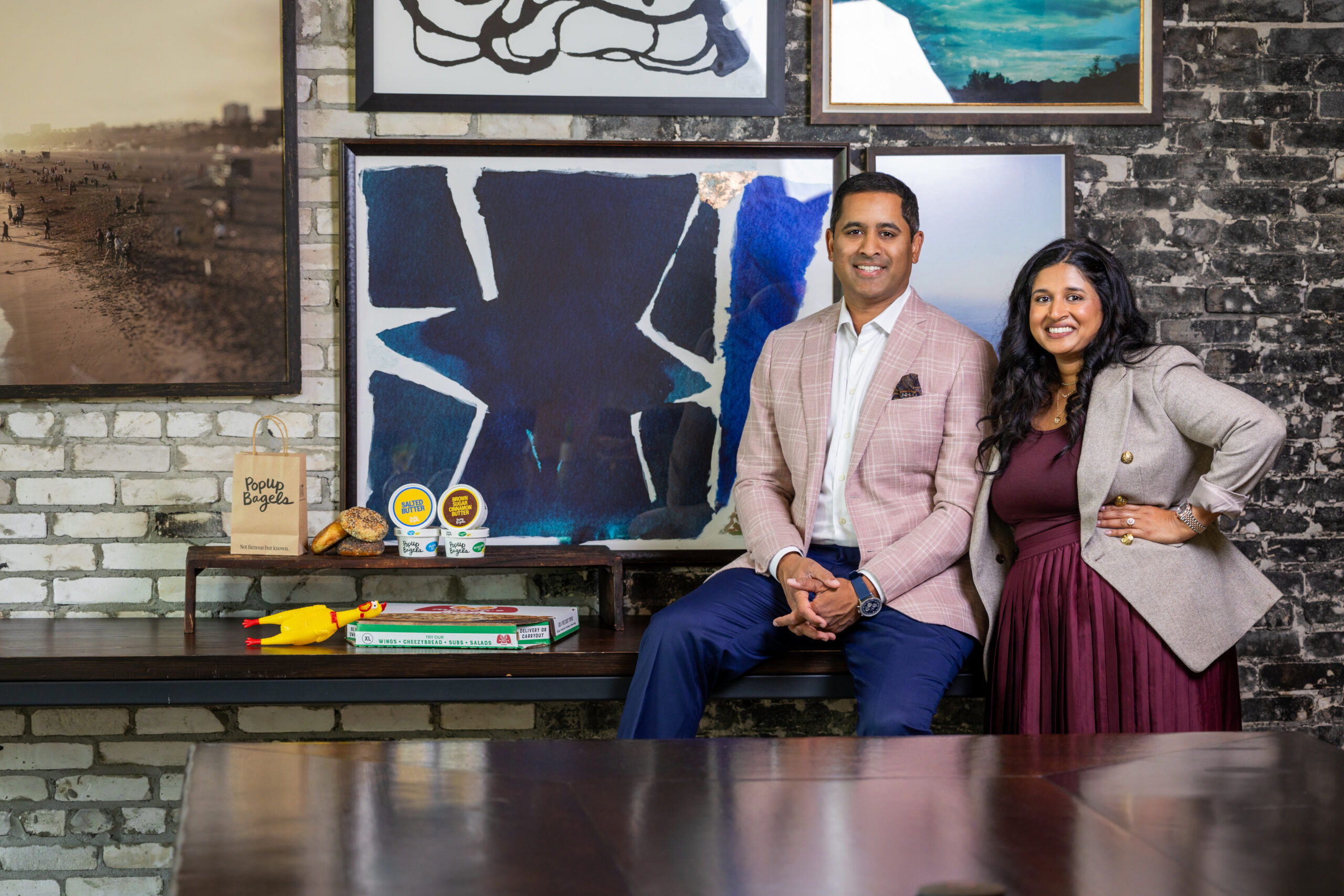
His wife joined him in New York after graduating from Michigan a year later and began her own investment banking career at Jefferies while Gullapalli continued building relationships inside Merrill Lynch.
Those relationships led him to the firm’s internal hedge fund in 2006, where Merrill Lynch invested its own capital instead of advising clients. Portfolio managers handed him companies to analyze, sending him through financial statements, debt agreements, legal filings and capital structures before deciding whether the firm should invest. “We were more focused on the credit side, the downside,” he said.
The fund invested in high-yield and distressed companies, where Gullapalli had to understand balance sheets and the legal structures governing how companies were built. “Nothing was learned from school,” he said. “Everything was taught to me by mentors.”
In investment banking, a managing director named Dave Iwan insisted Gullapalli work on his deals, expected him to move quickly and, unlike many senior bankers, tried to get him home before another midnight whenever he could. “He was the guy that was like, ‘I want to get you out of here by 8, so get this done,’” Gullapalli said.
At the hedge fund, he worked under Mike McEvilly, who later left Merrill Lynch with him to launch an independent fund. Nearly two decades later, they still speak.
After Bank of America acquired Merrill Lynch, Gullapalli and McEvilly chose to leave and start an independent hedge fund rather than spend the next two years liquidating Merrill Lynch’s proprietary trading portfolio. McEvilly’s reputation helped the group raise roughly $40 million to $50 million, but institutions had little appetite for a new fund in 2009 and 2010.
Gullapalli said their returns from Merrill Lynch’s proprietary trading desk were harder to document than those of traditional hedge funds with audited records. “Given the housing crisis of 2008, capital was just harder to raise,” he said.
After about a year and a half, Gullapalli decided to move on. He evaluated everything from gas stations to other Main Street businesses before buying a 50-year-old butcher shop on Long Island. “This just was a value play,” Gullapalli said. “The perception of that probably didn’t look great to Indian parents. But I bought a butcher shop.”
The previous owner, John Guardino, stayed for roughly two months after the sale, introducing him to suppliers, customers and employees who had spent decades behind the counter, while experienced butchers taught him the trade until, as he put it, “I became an intermediate butcher.”
Many employees had worked in butcher shops longer than Gullapalli had been alive. “I learned how to manage people that were much older than me,” he said. “Made a ton of mistakes. But I really enjoyed the process.”
The shop had belonged to Guardino’s family for decades, and employees relayed the questions longtime customers asked after the sale, including whether the new owner was “going to put curry in the marinades.” Gullapalli said the hardest part was convincing people he wasn’t going to change the business. He introduced himself to customers, explained why he had bought the shop and spent time visiting neighboring businesses throughout Malverne because, as he put it, “I got to get to know the community just like John did.”
Gullapalli added a prime beef selection and acquired a second butcher shop in nearby New Hyde Park. “That’s probably my first mistake,” he said. “It wasn’t a scalable concept.”
The average butcher was about 55 or 60 years old, apprentices were scarce, and replacing one employee often meant poaching an experienced butcher from another shop. The second location also lost much of its catering business during the ownership transition because it lacked experienced management. “I’m not a two-store butcher shop guy,” he said. “We had to find a way to get to 500.”
After his wife accepted a job with Converse, the couple moved to Boston, where Gullapalli sold the butcher shops and bought Lisa’s Family Pizzeria in Woburn, Massachusetts. He worked six and sometimes seven days a week across the front and back of the house. Unlike the butcher shops, where replacing a skilled employee could take months, most pizzeria jobs could be learned quickly. “I could see the scaling nature of it,” he said.
He and a childhood friend opened a smash burger concept called WuBurger across the street from the pizzeria before opening a second location in Cambridge. The Cambridge restaurant opened in Inman Square, farther from Harvard and MIT than Gullapalli had expected and without a nearby train stop, leaving it with too little customer traffic to remain open. “Real estate is 80% of the game,” Gullapalli said.
“The most important thing for all these local businesses,” Gullapalli said, “is being part of the community.” He joined chamber events, donated pizzas to schools and police departments, and supported neighborhood organizations when they asked for help. “When people in schools come for donations, make sure you take care of them,” he said. “Just taking care of everyone possible in the community.”
After gaining weight in the food business, Gullapalli joined an OrangeTheory Fitness studio, where after every workout he stopped in owner Paul’s office to ask about memberships, operations and financial performance until Paul began sharing the studio’s financial statements.
“Every time I went to class,” Gullapalli said, “I’d stop by Paul’s office and ask him a bunch of questions. He started showing me his financials and being very transparent about everything. Memberships generated recurring revenue. Labor was predictable. Every studio looked the same. I’m like, ‘Shit, I’ve got to get into this. This is crazy.’”
Paul introduced Gullapalli to OrangeTheory’s leadership, and after securing development rights in the Boston area, Gullapalli sold Lisa’s Family Pizzeria, WuBurger and his remaining restaurant businesses before opening studios in Westford and Saugus in 2017.
“At first I thought franchising was weird because you’re giving someone else so much control,” Gullapalli said. “Then I realized I’m actually not a brand builder. Give me a playbook and let me just scale it.”
“If I can have all my concepts that simple and do that type of volume, I’d love it,” Gullapalli said. “The franchisor sets the menu. They set how you create the products. They set how you serve them. We take their playbook and implement it.”
OrangeTheory was already in what Gullapalli described as the seventh inning of its national expansion, with only two development territories remaining in the Boston market. Gullapalli acquired both licenses and sold the two studios in December 2019, a few months before Covid shut down gyms across the country. “Thank God we sold when we did,” he said. “The behavior of the consumer, particularly in the Northeast, really changed. They left OrangeTheory and never came back.”
Before the OrangeTheory sale closed, Gullapalli acquired four struggling European Wax Center locations around Boston that shared one manager, where one manager oversaw all four stores and left him responsible for payroll, operations and nearly every other function. “The first couple months I was drowning,” he said. “It was just me doing payroll, doing ops, doing everything.”
He called the company’s COO, who told him to hire managers for every store, close each location for three days, and that Corporate would help retrain the staff. His portfolio expanded to 50 stores across multiple states, where he learned how to build a corporate team, integrate acquisitions and work with private equity.
The private equity investment closed in March 2020, when fear surrounding the emerging pandemic had reached what Gullapalli called “an all-time high.” European Wax Center closed its stores until June, and the private equity firm had to contribute additional capital almost immediately after completing the investment. “I wasn’t scared for myself,” he said. “I was scared that people would not come back to work after COVID.”
Gullapalli created a Facebook group and held video calls to keep employees connected while the stores remained closed. After the company received Paycheck Protection Program funding, it used the money to keep employees on payroll. “We followed the rules from day one,” he said. “In hindsight, we probably should have furloughed the team, let them collect government assistance and kept the company better capitalized.”
“The same thing that happened in fitness happened in waxing,” Gullapalli said. “People went to laser. They tried different things. The routine changed. The demand didn’t come back the way people thought it would.”
Additional investment rounds reduced his ownership stake. “I realized my personal upside for my family wasn’t there anymore,” he said. “The opportunity cost was too high.” He gave the company six months’ notice, remained on the board and began investing in other franchises.
Gullapalli bought 17 Marco’s Pizza restaurants in South Carolina while he was still living in Boston. Much of the country’s population growth was shifting toward the Southeast, where rents were lower than in the Northeast, and, as he put it, “we wanted to make sure that when we deployed capital, there was a better return.”
As the portfolio expanded, he and his wife moved their family to Tampa in 2022. “The kids weren’t seeing their grandparents, and both sets live in Orlando,” Gullapalli recalled telling his wife. “I think it’s time to get closer to our assets, since most of our growth is down there.”
Marco’s ranked fifth among the country’s largest pizza chains, behind Domino’s, Pizza Hut, Little Caesars and Papa John’s, and the South Carolina restaurants generated more than $1 million in annual sales apiece with about 15% store-level profit before corporate expenses. The restaurants made dough in-house and used freshly cut vegetables, giving Marco’s, in Gullapalli’s view, “the best of the five in terms of quality.”
On his first day, Gullapalli learned that some managers were drinking on the job, others faced sexual harassment allegations, and the restaurants had far fewer operating procedures than he expected. “There was a lot that I had to clean up,” he said.
The company added 10 to 15 restaurants a year through acquisitions and new construction until the portfolio approached 50 locations. Gullapalli later called that pace his biggest mistake because it stretched both the balance sheet and the organization. A chief financial officer urged him to stop acquisitions for nine to 12 months and rebuild the operating structure. “We had to stop,” Gullapalli said. “We had to rightsize the business.”
Marco’s same-store sales fell about 10% in 2025 as consumer spending weakened and competitors leaned harder into value promotions. Gullapalli said the pullback also underscored how much of the pizza business now runs through digital ordering, an area in which every major chain has had to keep investing to compete. “Marco’s.com or Domino’s.com is Amazon.com, and the stores are the Amazon delivery trucks,” he said. “You have to be so good at capturing orders.”
Over the following year, the company raised pay in some positions, revised incentives, made changes to its operating team and sharpened its own digital ordering execution. By mid-2026, same-store sales had rebounded about 6% to 7%, Gullapalli said, putting the company in position to resume expansion in 2027 if the improvement held.
Gullapalli signed with Dave’s Hot Chicken in 2022 and opened his first restaurant the following year. The company now operates eight locations and expects to open about seven annually across South Carolina, parts of North Carolina and the Savannah and Augusta markets in Georgia.
He said he was drawn to what he called chicken’s “crazy renaissance,” pointing to Chick-fil-A’s growth and the attention Popeyes generated with its chicken sandwich, while also wondering whether higher beef prices and changing attitudes toward beef helped push customers toward chicken. Dave’s narrower menu, he said, also made the restaurants easier to operate.
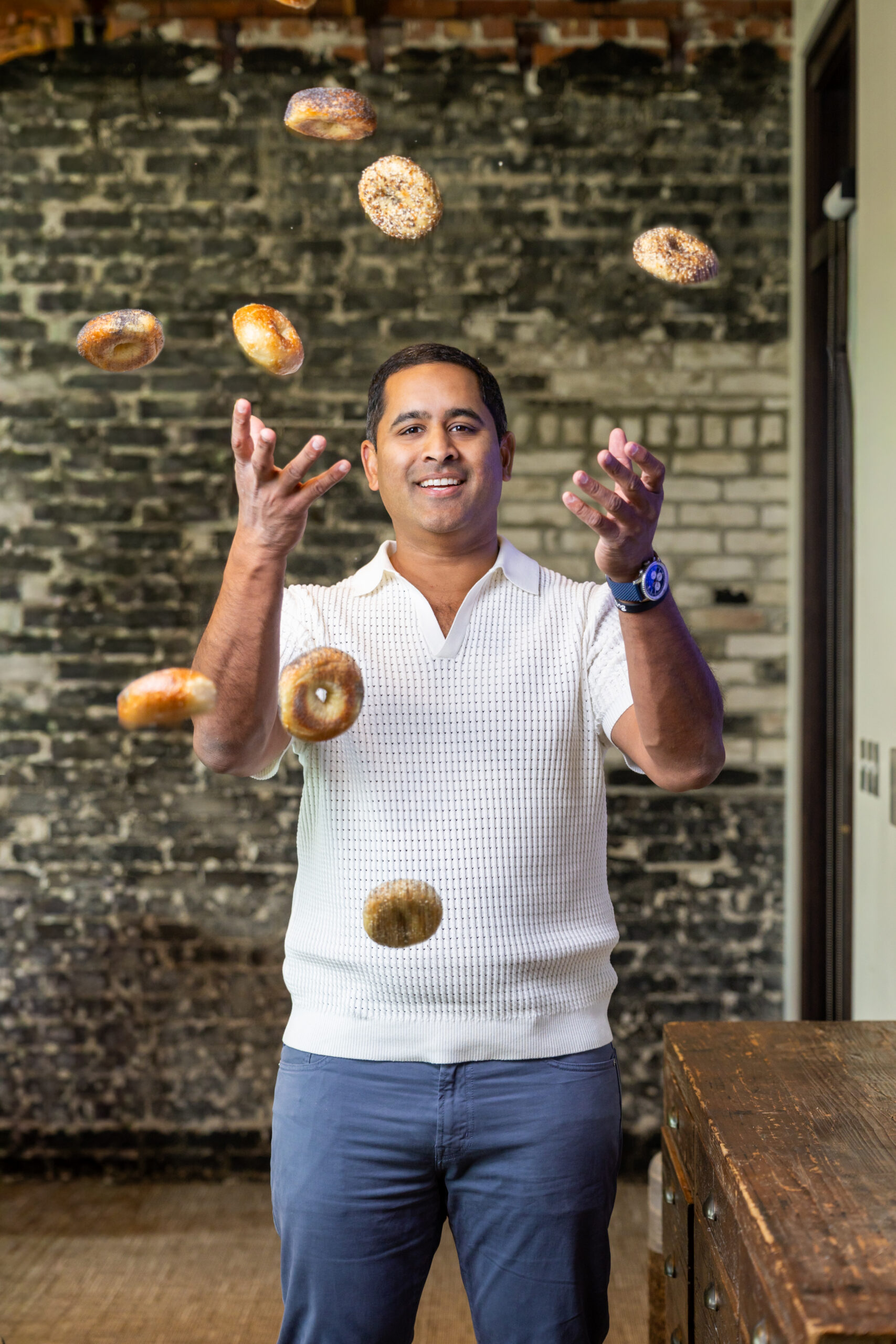
Customers were waiting outside PopUp Bagels’ Thompson Street shop in Manhattan when Gullapalli visited after an investor suggested he stop there. “I was thinking to myself, ‘This is ridiculous,’” he said. “They were able to open up a bagel shop in the bagel capital of the world and have these types of lines.”
He acquired development rights in December 2024 for Florida outside South Florida before later adding Ohio and Michigan. The agreements call for 45 locations, including 30 in Florida, eight in Ohio and seven in Michigan, with about seven openings required each year.
The first Tampa location opened on Kennedy Boulevard in September 2025, followed by Carrollwood, Jacksonville, Viera and Winter Park. Strong opening sales persuaded Gullapalli to acquire development rights in Michigan and Ohio, although he expects subsequent restaurants in each market to generate less revenue than the first.
“When you’re in that euphoric first two weeks, you’re like, ‘This is unbelievable,’” he said. “I don’t want to fall into the trap that we found at Orangetheory where we couldn’t expand.”
Even with that caution, he said, “It’s clear as day that in fi ve years we’ll have a $500 million company in franchising.”
Each concept chases a different customer, and Gullapalli tailors both real estate and local marketing to match. Dave’s Hot Chicken looks for end-cap and freestanding sites and leans into high school athletics, betting on customers who will pay a few extra dollars for higher-quality chicken. PopUp Bagels clusters near Whole Foods, Life Time and boutique fitness studios and partners with running clubs, chasing a health-minded, higher-income shopper. Marco’s builds around families, sponsoring elementary schools because, as he put it, “Elementary kids are the ones who decide, ‘I want pizza on Friday.’”
“The food business is a game of pennies that add up to nickels,” Gullapalli said. “You have to be hypervigilant on every single cost.”
He said he does not naturally watch those pennies, preferring to hire executives who focus on the details. He has also turned to artificial intelligence to catch details people might miss.
Built Different Brands now uses AI to review leases, monitor construction and analyze operations across its portfolio. The company signs 25 to 30 leases a year, and the company uses AI to compare each lease against its letter of intent before attorneys begin their review.
“I’ll take the LOI, and then I’ll take the lease, and I’ll say, ‘Hey Claude, figure out what’s wrong with this based on all the leases that you’ve already worked on for me,’” he said. “Then it’ll create an issue list.”
Instead of replacing employees, he expects the technology to let the company keep growing without expanding its corporate staff at the same pace. “We’re a $120 million company now. When we grow to $300 million … we do not expect to triple our headcount,” he said.
The opening schedule places more pressure on his team. “Right now we’re opening up 15 or 17 locations,” Gullapalli said. “Next year, we’re probably going to get to 22, 24. It’s making sure that I have the right team always to do it because it’s a lot of stress.”
The finance team is “always grinding,” he said, while the operations team is “pulling their hair out.” “When you scale this fast, it’s hard,” he said. “It’s really hard.”
“I’m naturally a cowboy,” Gullapalli said. “I love risk.” He and his wife personally guarantee much of the company’s debt, a level of leverage that still worries his parents. “They figured out that I am a bit crazy,” he said.