
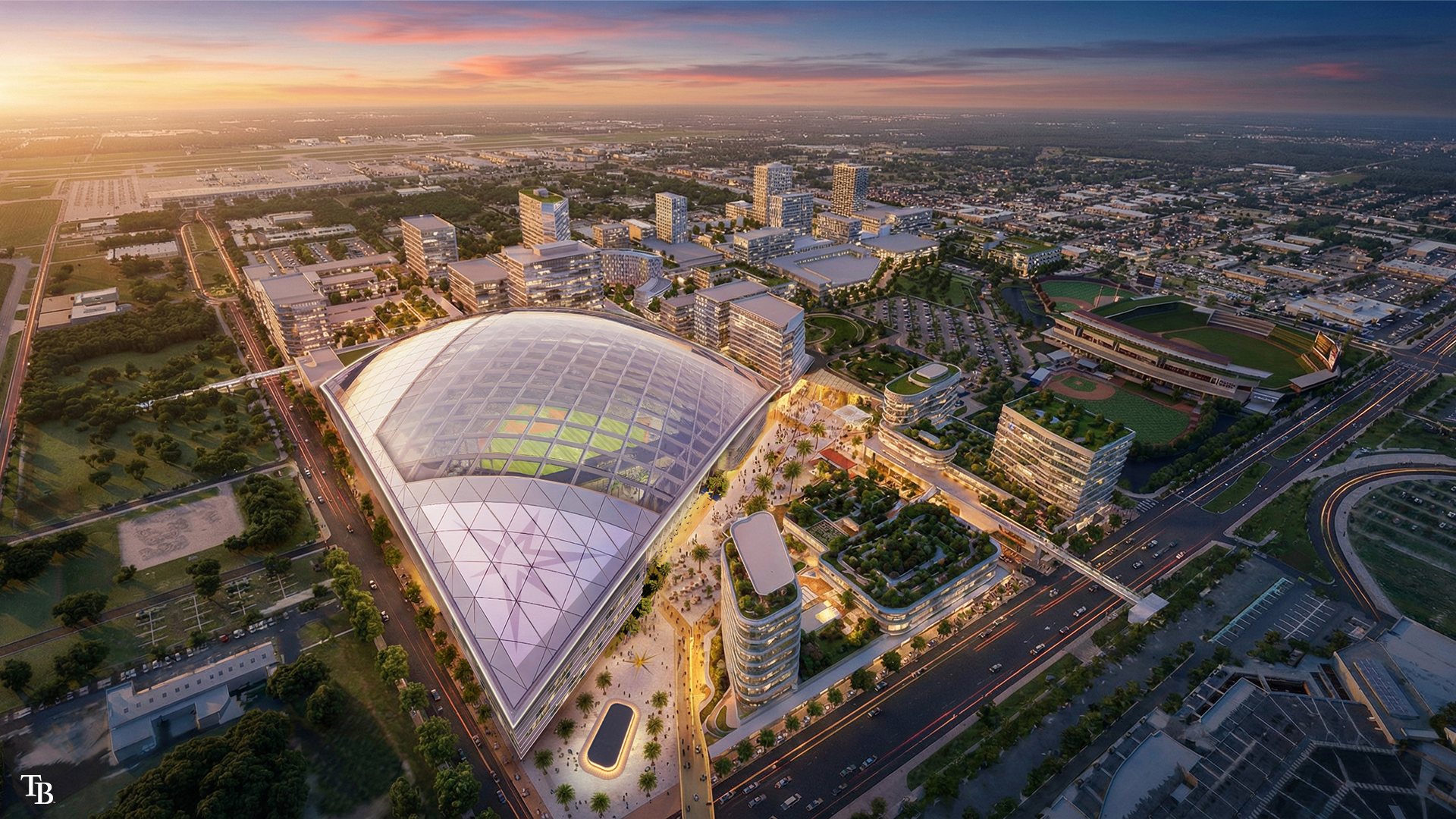
The Tampa Bay Rays and local governments have reached definitive agreements for a proposed $2.3 billion Tampa ballpark, with the team committing about $1.37 billion and taking responsibility for construction overruns.
The agreements, released Friday after months of negotiations, raise the Rays’ stated share of the project to about 60% from 55% under a memorandum of understanding approved earlier this year and reduce the direct public contribution by $100 million. Hillsborough County’s investment is listed at about $796 million and Tampa’s at $80 million, while the financing table separately identifies about $54 million in other public funds and investment earnings.
The deal still requires approval from the Hillsborough County Commission and Tampa City Council, and the Rays haven’t said whether they have enough votes in either body. Chief Executive Ken Babby said Friday that the team would continue discussions with stakeholders ahead of the votes.
The planned $100 million contribution tied to the Drew Park Community Redevelopment Area would be removed and replaced with $100 million in privately placed debt. A special-purpose entity formed by the Rays would place the taxable debt and establish a Community Development District around the ballpark and surrounding development.
Tampa and Hillsborough County would enact a Home Rule Tax Increment, allowing part of the property-tax growth generated by new development to pay debt service and fund public infrastructure. The privately placed debt is structured so it wouldn’t affect either government’s credit rating, according to the Rays’ summary.
Tampa’s $80 million would also change from the May framework, which allowed the city to use as much as $80 million in Community Investment Tax money without repayment. Under the new structure, Tampa would instead advance four annual payments of $20 million and recover them from its share of property-tax growth generated by the project, with no city CIT money used.
The summary doesn’t disclose how the tax increment would be divided among Tampa, Hillsborough County and the CDD, how long repayment could take or where the city would get the upfront cash.
That structure closely resembles an alternative Council Member Bill Carlson outlined Aug. 12, although Friday’s summary differs on one important point. Carlson said then that Tampa would be repaid from the CDD’s share of the tax stream, while the new summary says the city would recoup its advances through its own share of the tax increment.
Carlson previously said the revised financing had addressed his main objection to the May agreement and that the Rays had agreed Tampa could recover any interest on the advances, but he said his vote would depend on the final terms. He wasn’t immediately available Friday to say whether the agreements satisfied those conditions.
The Rays would oversee the stadium’s design and construction and cover any cost overruns. About $120 million of their investment would come from ticket-surcharge revenue, while the team’s parent company would guarantee its payment and performance obligations. The 12-page public summary doesn’t provide the detailed terms of that guaranty.
Hillsborough County’s investment is listed at about $796 million. The financing table includes roughly $303 million in Tourist Development Tax bonds and reserves, $360 million from the county’s Community Investment Tax and $103 million labeled “Other County Resources,” with those sources to be determined by the county.
It separately lists about $30 million in federal disaster-recovery reimbursements for stormwater work; those four amounts total $796 million, although the summary doesn’t explicitly say whether the federal reimbursement is included in the county’s stated contribution. The table also lists about $54 million in other public funds and investment earnings, while the Rays say the financing structure would protect funding allocated for public safety and infrastructure.
The roughly 120-acre district would include seven acres for a reimagined Hillsborough College campus, while the Rays envision about 8 million square feet of office and mixed-use space whose taxable value would help support the financing. Babby has said the ballpark and rebuilt college campus could open before much of that private development is finished, with first-phase hotel, retail and multifamily projects still being built in 2029.
The agreements also call for extensions of the West Tampa, East Tampa and Drew Park CRAs, though the summary doesn’t say how long they would run or quantify their financial effect. Carlson had proposed removing the Rays site from the Drew Park CRA, placing it in a separate tax-increment district and extending the remaining Drew Park district, along with East Tampa. Friday’s summary adds West Tampa to the proposed extensions. It also doesn’t give a dollar value for the Community Benefits Agreement, which would direct at least 65% of its commitment to Hillsborough County and 35% to Tampa.
Hillsborough County would own the ballpark, with the Rays paying $4 million in annual rent under a 35-year agreement. A separate non-relocation agreement would require the team to remain in Tampa Bay and play its home games at the stadium for the same period, with limited exceptions for MLB-designated special or international games.
Tampa’s Community Redevelopment Agency board is scheduled to meet Aug. 27 to consider an agreement involving the Rays, ahead of broader city and county approvals.
The special meeting stems from an Aug. 20 motion by Council Members Alan Clendenin and Luis Viera. If both governments approve the agreements, the project would move into bond and funding validation before construction, with the Rays targeting Opening Day 2029.