
Tampa Takes Up Its Piece of the $2.3 Billion Rays Stadium Deal
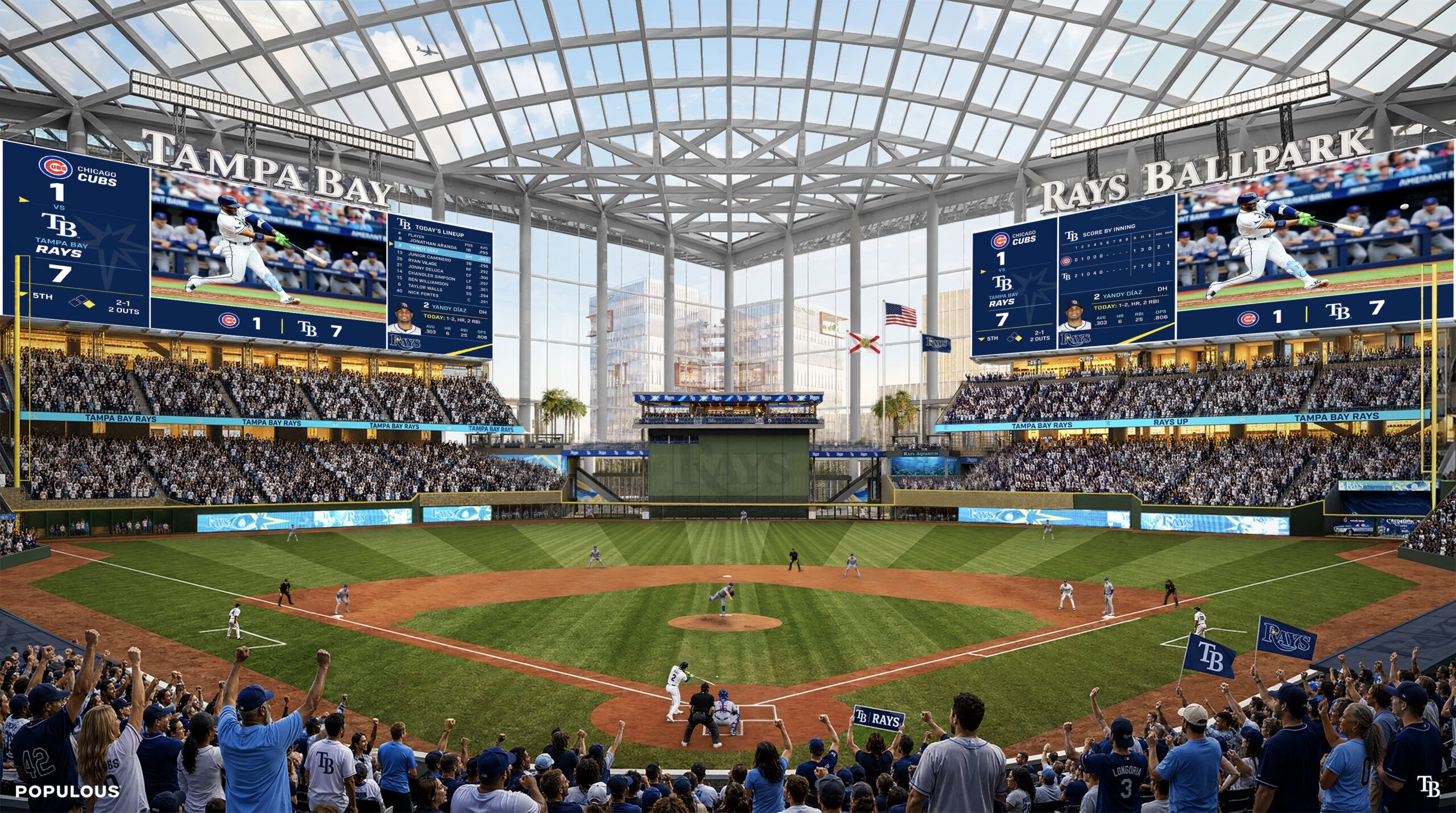
Tampa’s proposed $2.3 billion Rays stadium reaches its first public vote Thursday, when the Tampa Community Redevelopment Agency considers its participation in a financing package that would put about $1.37 billion of the stadium cost on the Rays, approximately $796 million on Hillsborough County and $80 million on Tampa. The seven-member CRA board, composed of Tampa City Council members, can act on funding, tax increment revenue and other commitments tied to the deal.
Tampa’s $80 million comes with a repayment plan whose timing remains unwritten. The city would advance the money in four annual $20 million payments, then recover it from its share of future property-tax growth generated by the development. The agreements do not specify that share or how long repayment could take, while also calling for extensions of the West Tampa, East Tampa and Drew Park redevelopment districts without stating their length or financial effect. The CRA takes up those commitments at 10 a.m. Thursday at Old City Hall, with separate Tampa City Council and Hillsborough County actions still ahead.
Tampa Bay Rays News
The Rays’ Trials and Tribulations in Tampa Bay

Before the Rays
Baseball Takes Root
Tampa Bay’s major-league baseball history began generations before it had a permanent team. The Chicago Cubs brought spring training to Tampa in 1913, and St. Petersburg became a spring destination the following year.
Spring training, minor-league baseball and exhibition games made the sport a regular part of the region long before Tampa Bay had a franchise of its own.
Tampa Bay Chases the Major Leagues
Local groups spent years pursuing existing Major League clubs and an expansion franchise. Tampa Bay was linked to possible moves involving the Twins, Athletics, White Sox, Royals, Giants and other clubs.
St. Petersburg decided it could strengthen its case by building a baseball stadium before it had a team, turning the region’s long pursuit into an unusually large civic gamble.
St. Petersburg Builds a Ballpark Without a Team
St. Petersburg opened the Florida Suncoast Dome on March 3, 1990, after building the $138 million stadium as part of its pursuit of Major League Baseball. The city still did not have a team.
The building instead hosted other sports and events while Tampa Bay continued chasing a franchise. It became the ThunderDome after the Tampa Bay Lightning arrived in 1993 and was renamed Tropicana Field in 1996, two years before the Devil Rays played their first game there.
Expansion & Early Years

Tampa Bay Finally Gets Its Team
Major League Baseball owners voted 28-0 on March 9, 1995, to award expansion franchises to Tampa Bay and Arizona. Vince Naimoli led the local ownership group. The Devil Rays signed a 30-year agreement with St. Petersburg and prepared to begin Major League play in 1998.
The Devil Rays Take the Field
The Tampa Bay Devil Rays played their first regular-season game March 31, 1998, before a crowd of 45,369 at Tropicana Field. Detroit won 11-6. Tampa Bay earned the first victory in franchise history the next day.
The franchise spent much of its first decade near the bottom of the American League East.
Wade Boggs Reaches 3,000 Hits
Wade Boggs recorded the 3,000th hit of his career at Tropicana Field on Aug. 7, 1999, becoming the first Major League player to reach the milestone with a home run.
Sternberg Takes Control and the Rebuild Begins
Stuart Sternberg became principal owner after the 2005 season. The organization rebuilt its baseball operations under manager Joe Maddon and executive Andrew Friedman while assembling a young, inexpensive core through the draft and player development.
Tampa Bay selected Evan Longoria third overall in 2006 and David Price first overall in 2007, adding them to a system that had already produced players including Carl Crawford and James Shields.
The Breakthrough
The Rays Break Through
Three years after Sternberg took control, the rebuild produced one of baseball’s most dramatic turnarounds. The franchise dropped “Devil” from its name, went from worst to first and posted the first winning season in team history.
Tampa Bay won 97 games, captured the American League East and defeated the White Sox and Red Sox to reach its first World Series. Rookie Evan Longoria became a centerpiece of the new roster and won the American League Rookie of the Year Award.
Philadelphia won the World Series in five games, but Tampa Bay finished the year with its first division title and first American League pennant.
Game 162
Tampa Bay entered September nine games out of a playoff spot. On the final night of the regular season, the Rays erased a 7-0 deficit against the Yankees before Evan Longoria’s 12th-inning home run sent them into the postseason.
The comeback became one of the defining games of the franchise and reinforced a reputation the Rays had begun building: winning without operating like baseball’s biggest spenders.
The Rays Keep Winning
David Price won the American League Cy Young Award in 2012, becoming the first Rays pitcher to win the honor. A year later, he threw a complete game against Texas in Game 163 to send Tampa Bay back to the postseason.
By then, the 2008 breakthrough had become something larger. The Rays had reached the postseason four times in six seasons despite operating with one of baseball’s smaller payrolls.
A Second American League Pennant
The Rays finished the pandemic-shortened season with the best record in the American League and beat Toronto, New York and Houston in the postseason.
Los Angeles defeated Tampa Bay in six games in the World Series, leaving the Rays with two American League pennants.
A 100-Win Season
Tampa Bay won a franchise-record 100 games and captured the American League East for the second consecutive season. Boston eliminated the Rays in the American League Division Series.
On July 12, 2026, the Rays retired Evan Longoria’s No. 3, honoring the player who became the public face of the franchise’s transformation into a perennial contender.
The Stadium Search
A Waterfront St. Petersburg Plan Fails
The Rays proposed replacing Tropicana Field with a waterfront ballpark near the Al Lang Stadium site in downtown St. Petersburg. The proposal did not advance to construction, keeping the franchise at Tropicana Field and the stadium question unresolved.
The Ybor City Plan Falls Apart
The search moved across Tampa Bay to Ybor City, where the Rays pursued a new ballpark near the Channel District and downtown Tampa.
The team and Hillsborough County failed to assemble a financing agreement, ending the Tampa proposal then on the table.
Montreal Becomes the Alternative
Without a new full-time ballpark agreement in Tampa Bay, the Rays pursued a “Sister City” concept that would have divided future seasons between Tampa Bay and Montreal, with new open-air ballparks contemplated in both markets.
Major League Baseball rejected the split-season concept in January 2022, removing that option and returning the stadium search to a full-time home in Tampa Bay.
The Deal That Got Approved
Back to St. Petersburg
After Major League Baseball rejected the Montreal plan, the Rays returned to the Tropicana Field site and reached an agreement with St. Petersburg and Hines for a new ballpark within redevelopment of the 86-acre Historic Gas Plant District.
St. Petersburg and Pinellas County approved the project in 2024, giving the franchise the local government approvals necessary to move toward replacing Tropicana Field.
An Approved Stadium Falls Apart
Hurricane Milton ripped apart Tropicana Field’s roof in October 2024, leaving the stadium unusable as the replacement project entered a critical financing period. Pinellas County then delayed bond action for the new ballpark.
The city and county ultimately approved their financing, but the Rays said the delay pushed the planned stadium opening back and increased construction costs. On March 13, 2025, Stuart Sternberg announced the franchise would not proceed with the approved St. Petersburg ballpark and Historic Gas Plant District project.
The Rays Cross the Bay
Hurricane Milton’s damage left Tropicana Field unusable for the 2025 season, sending the Rays across Tampa Bay to George M. Steinbrenner Field, the New York Yankees’ spring-training home in Tampa.
The stay lasted one season. After St. Petersburg repaired Tropicana Field, the Rays returned to the dome in 2026 while the franchise’s new owners pursued a permanent stadium elsewhere in the region.
A New Ownership Era

A Third Ownership Group Takes Over
Patrick Zalupski led a group that completed its purchase of the Rays Sept. 30, 2025. Bill Cosgrove became co-chair and Ken Babby chief executive officer.
The sale created the third ownership group in franchise history after Vince Naimoli and Stuart Sternberg. Its first major challenge was the same one that had followed the club for nearly two decades: finding a permanent long-term ballpark in Tampa Bay.
The Stadium Search Moves to Tampa
Under the new ownership group, the Rays shifted their stadium effort across the bay. In August, the team reached definitive agreements with Tampa and Hillsborough County for a proposed $2.3 billion ballpark, with the Rays committing about $1.37 billion and assuming responsibility for construction overruns.
Hillsborough County’s proposed contribution is about $796 million and Tampa’s is about $80 million. The agreements still require approval from the Tampa City Council and Hillsborough County Commission.
If approved and completed, the project would end a stadium search that has carried the franchise from St. Petersburg to Ybor City, through the proposed Montreal split-season plan, back to St. Petersburg and finally across Tampa Bay again.
Follow the Current Rays Stadium Deal
The latest Tampa ballpark proposal is still moving through the approval process. Follow the financing, development agreements, government votes and construction plans in TBBW Magazine’s current Rays coverage above.