
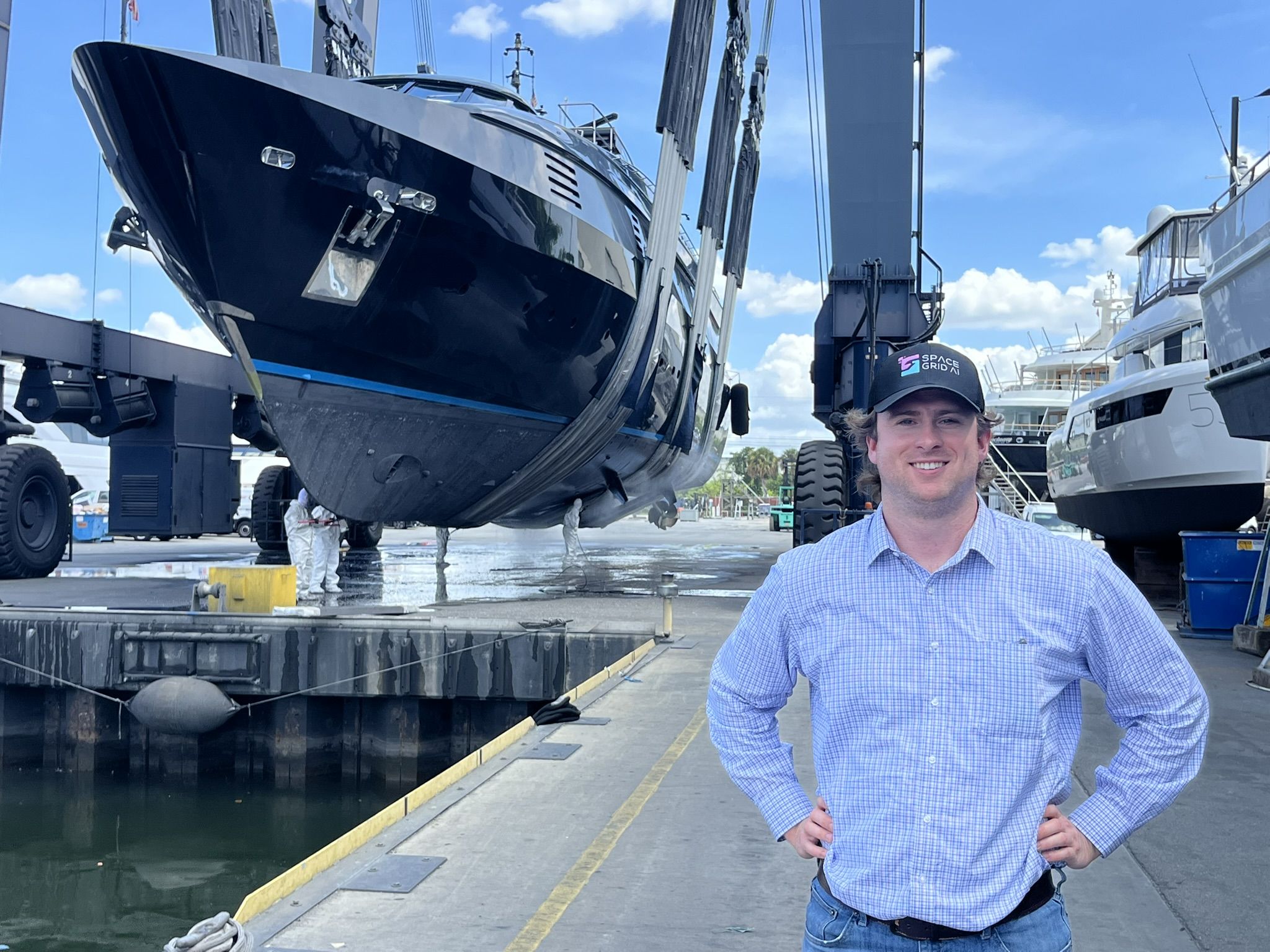
When Alex Hilger tries to explain Space Grid AI, he sometimes starts with James Cameron’s Avatar, his shorthand for a world where physical places and digital information converge. His St. Petersburg startup applies that idea to shipyards, building three-dimensional models that let planners move vessels and equipment through the yard, push the calendar forward and watch one decision reshape the space weeks or months later. Hilger eventually wants to use that view of future capacity to match vessels needing work with yards that have room.
That room has acquired new strategic value as the United States tries to rebuild a maritime industry that atrophied over decades. The country now constructs less than 1% of the world’s commercial ships, compared with roughly half built by China, and Washington is marshaling federal money and policy to expand U.S. shipbuilding and repair capacity. A 2025 executive order made rebuilding the maritime industrial base a national policy, while the Transportation Department has since announced nearly $489 million for port projects, $35 million for small shipyards and, in July, $2 billion for two military vessels to be built at Hanwha Philly Shipyard.
That new capacity will take time to build. Existing yards are already under pressure as vessels in service compete for dry docks, lifts, cranes, workers and physical space when they return for maintenance and repairs. The Government Accountability Office has documented those bottlenecks as Navy repair jobs miss schedules and some new ships run years late, despite a shipbuilding budget that has nearly doubled over roughly two decades without producing a larger fleet.
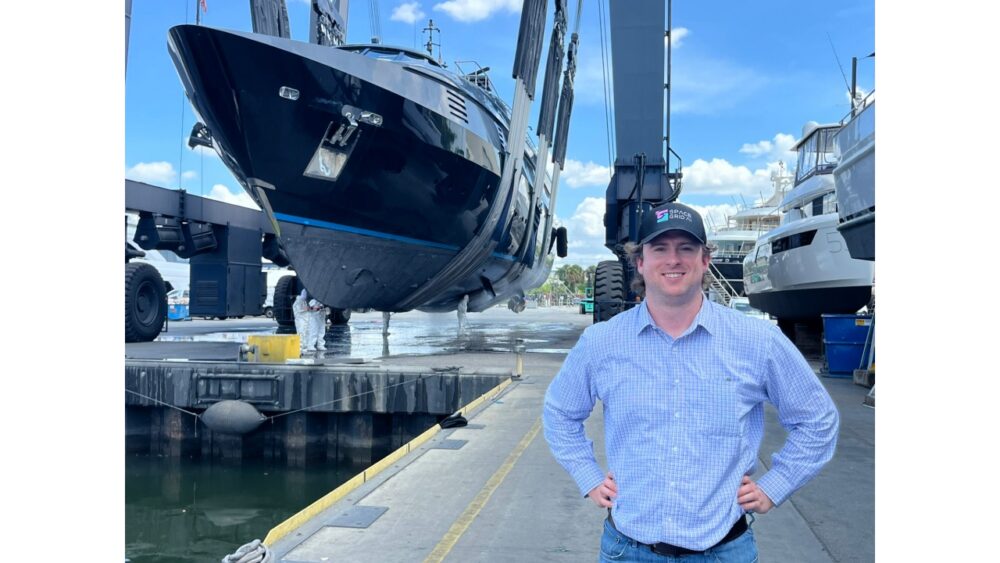
Those bottlenecks suggest a scarcity of yard capacity, but Hilger found a different problem inside some of the yards themselves. He estimates that roughly 500,000 vessels operate worldwide, served by about 5,500 shipyards, yet after Space Grid began working with yards, he found some struggling to secure enough work to retain workers. “It makes sense why a ship has trouble getting into a shipyard,” Hilger said. “What makes no sense is that the shipyards struggle to get the ships in.”
When the ships do not come in steadily, the workforce moves with them. At large U.S. shipyard companies, Hilger said, headcounts can contract from roughly 300 workers to 100 as work ebbs and flows. At Derecktor Shipyards, the family-owned shipbuilder and repair company with yards in New York, Florida and Maine, the problem reached one planner whose time the company was trying to free so he could spend more of it pursuing the next job.
The planner’s problem was one Hilger had encountered before, although on a very different floor. While working on the first stage of New Glenn at Kennedy Space Center, he watched more than $1 billion in Blue Origin hardware and machinery vie for floor space and time on two gantry cranes that could be booked three to six months ahead. The high bay changed almost daily, he said, with larger reconfigurations six to eight times a year.
Those continual reconfigurations were still being planned in PowerPoint. New Glenn was tied to what Hilger described as a $10 billion launch contract with Amazon’s Project Kuiper, yet engineers choreographed movements inside the high bay by moving shapes across slides. The limitations of that system became tangible when an engine-installation tool arrived on eight 53-foot flatbed trucks. Hilger needed room for all eight, space to assemble what they carried and an opening on a gantry crane to unload it. “You put a date on that slide and you copy-paste it to tomorrow, and you move the shapes around again,” Hilger said. “And where the shapes are placed, you’re literally taking hand measurements to figure out.”
Even a carefully measured plan could be obsolete before the work began. Floor space and heavy equipment reserved weeks ahead could be reallocated when trouble elsewhere on the rocket took priority. “Oh, we caught something on fire. Alex, you’ve lost your allocation. Better luck next time,” Hilger remembers being told.
The same loss of time could begin with something far more ordinary. One Sunday, Hilger arrived for a 12-hour shift to find that a bad sealant job elsewhere on the rocket had upended the schedule. Because that work sat on the critical path, its crew commandeered equipment Hilger’s team had reserved, reducing his shift to three or four productive hours. By Monday morning, managers from eight or nine work centers were fighting over floor space and equipment on Teams, with critical-path work getting first claim. Hilger called it “a pure political dogfight for resources.” “The moment that plan breaks, throw away your whole PowerPoint and just let’s all get on a call and argue for the next hour and a half,” he said.
Modeling that contested space drew on an expertise Hilger had been developing since high school. At Baltimore Polytechnic Institute, a public math and science school in Baltimore, he mounted a LiDAR scanner on a drone and built a system that produced survey-grade models. The project took him from the Maryland State Science Fair to an international science fair in Arizona in 2016 and, after graduation, to San Francisco, where he worked with LiDAR used in autonomous vehicles, including projects for Mercedes and Hyundai.

That LiDAR experience gave Hilger a way to map the high bay. At Blue Origin, he scanned the space only to find that the models quickly became outdated as the physical environment kept changing around them. “The number one question I got when I would show the finished product to these different groups was, ‘Well, when are you going to do it again? That’s out of date.’”
The models’ short shelf life followed him out of Blue Origin around Christmas 2023, when Hilger moved in with his girlfriend and her roommates and took a job at Home Depot in Clearwater. For roughly five months, he rebuilt the software four times in his off-hours in Unity, the engine behind games including Pokémon Go, until every object in the model had a date as well as a place. The software could now show how the space would change rather than simply record how it looked.
Once the model could move through time, Hilger had to decide where to deploy it. He saw prospective markets almost everywhere he looked: aerospace, aviation, oil and gas, mining. His father kept telling him he was looking in the wrong places. A former oil tanker captain who had spent as long as a month anchored outside a dry dock waiting for room, he recognized the problem immediately. “Alex, you have to go after maritime,” Hilger remembers him saying.
When Hilger followed his father’s advice, he found shipyard owners already investing heavily to digitize operations that had long remained analog. Nearly every yard Space Grid talks with, Hilger said, is installing or upgrading systems for customer relationship management (CRM), enterprise resource planning (ERP) and product lifecycle management (PLM). “It’s an alphabet soup,” he said. “The folks who own the shipyards are pulling their heads out of the sand, yanking them out by the collar and giving them the directive to modernize, dumping money on their head.”
All of that digitization still confronts the physical constraints of the yard. Before accepting another vessel, a yard has to determine whether the ship can get in, whether it can be lifted and whether the yard can provide the power the job requires. Space Grid translates those constraints into a three-dimensional model, much like Google Earth, except planners can move the yard through time and see how today’s placement affects the space available months later.One planner made those future constraints tangible while trying to make room for a vessel roughly 300 feet long. Putting it into Slip 21 meant moving the vessel already there to Slip 20, which pushed the vessel in 20 to 19 and forced him to find another berth for the ship occupying 19. “It’s a giant living resource puzzle,” Hilger said.
A delay in any one of those moves can change the ones behind it, and Space Grid shows the planner when and where those conflicts appear. “We can show you when in time and where in the space the plan has issues so you can resolve them,” Hilger said. The planner still has to decide what moves and test different configurations in the software. Hilger eventually wants Space Grid to recommend the solution itself, much as Google Maps can find a 7-Eleven along a route.
Space Grid can show the conflict, but it cannot yet choose the move. Its AI currently handles more limited applications, including creating three-dimensional vessel models from photographs. Hilger describes the progression as “crawl, walk, run”: digitize the whiteboard, compare the plan with actual yard activity and eventually recommend how to resolve conflicts.
Choosing the move will require Space Grid to learn from the decisions yards have already made. At its two larger yards, Hilger said, the company has loaded roughly a year of historical data and about three months of forward-looking plans, giving it a record of where vessels have been and how actual yard activity deviates from the schedule. “As we’re aggregating all of this data, the value in the company is the intelligence you can pull from that data,” Hilger said. “This first product is really valuable to the shipyards. But there’s so much room to run.”
That first product is also the one customers currently pay for. Space Grid makes money through software subscriptions and implementation fees, Hilger said, while seeking patent protection for the planning technology after winning legal assistance through a pitch competition. At the time of the interview, Hilger was working through a 97-page draft from patent attorneys. The application has since been submitted, making Space Grid officially patent pending.
Whatever the eventual market, the product still has to survive daily yard operations. At Derecktor, the immediate test was whether the software could run for two or three weeks without a major error before the yard completed its trial and began onboarding hundreds of users. During its first week, two catamarans and a variety of other vessels arrived around the same time, when Hilger said Derecktor set a company record for the number of vessels in one of its yards.
A record number of vessels also meant more schedules susceptible to disruption. Hilger pointed to another Space Grid customer with a vessel carrying an 18-month, $9 million work package, roughly $16,000 of work for every day it remains in the yard. A job expected to take a month can stretch to four, he said, while an 18-month stay can suddenly contract if the owner lands a lucrative charter. “They’ll say to the shipyard, ‘Hey, we’re 13 months in, but we just got a lucrative charter. Get us out right now, and we’ll do the last five months of service when we come back in a year.’”
Those early departures are the capacity Hilger wants Space Grid to see before anyone else does. He argues that detecting schedule changes early could return months of usable capacity to large yards each year, although Space Grid has not yet demonstrated that projection. When a vessel leaves early, the yard suddenly has space and revenue-producing work to replace. “If that big 250-foot vessel leaves, you have a hole, and you could fill it with four small sailboats and a barge, or you could fill it with one identical-sized vessel, or you could fill it with two medium [vessels],” Hilger said.
Seeing the hole is only useful if the yard can fill it. Owners and managers still do that largely through phone calls to agents, brokers and other shipyards until someone finds a vessel that needs service and a yard capable of taking it. Hilger likens that fragmented network to a human switchboard. Space Grid has begun talking with agents, brokers, vessel operators and large U.S. tugboat companies about building a marketplace that could match those vessels with open capacity.
Finding a vessel is only half the match because the yard still has to be able to take it. Military vessels generally require appropriately certified yards, while commercial vessels still need a yard that can physically accommodate the ship and integrate the job with work already underway. Hilger therefore expects the marketplace to begin with commercial and pleasure vessels, where a broader pool of yards can compete for the work.
Those constraints leave Hilger with a much narrower first test. With two large yards and several smaller operations in Space Grid’s network, he wants to find one vessel that needs service, place it into one open slot and collect a commission. “What we want to do is a proof of concept, just taking one of these vessels that needs service and manually routing it to one of our yards that’s in the network and proving that we can collect the commission on it,” Hilger said.