

Denser housing, larger mixed-use projects and lower parking requirements could reshape redevelopment along Central Avenue after approval of optional new zoning rules tied to SunRunner stations, creating a new development framework stretching from downtown St. Petersburg west toward the beaches.
Property owners can continue building under existing zoning rules or opt into the overlay standards for greater density and redevelopment flexibility.
City officials have increasingly aligned zoning policy around the SunRunner since the service launched in 2022, viewing the transit investment as a catalyst for additional housing and redevelopment along Central Avenue.
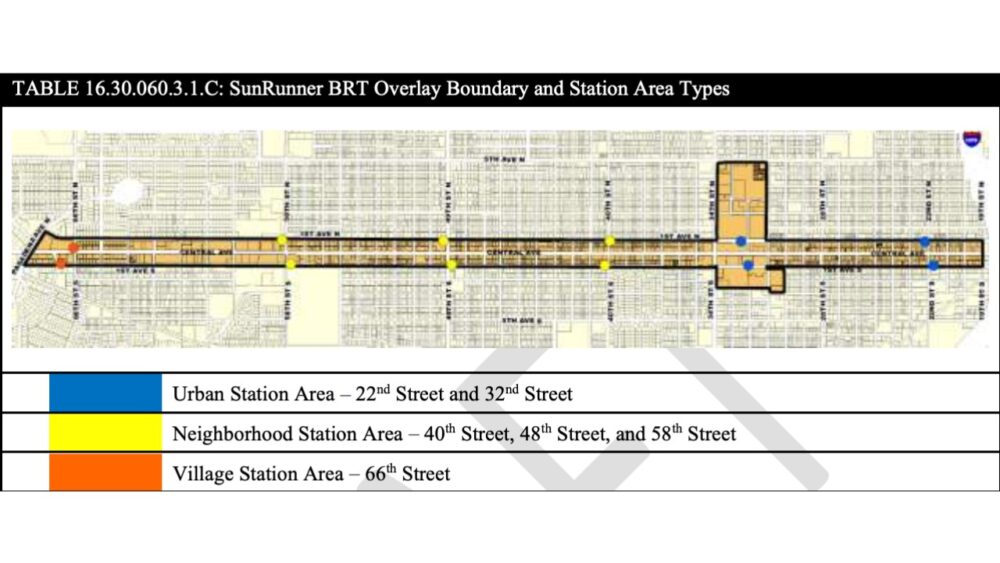
The framework concentrates the highest development intensity around the 22nd Street South and 32nd Street stations, where the city envisions medium- to high-rise buildings, mixed-use projects and stronger pedestrian and bicycle connections, while lower-density “Neighborhood” and “Village” station areas apply farther west along the corridor. That station-area approach grew out of the city’s SunRunner Rising planning effort, which began in 2020 and later became part of St. Petersburg’s long-term development strategy.
Much of the debate centered on parking requirements.
Business groups, transit advocates and community organizations pushed city leaders to eliminate minimum parking requirements throughout the corridor, arguing that mandatory parking increases housing costs, limits redevelopment opportunities and discourages walkable development near transit stations by forcing projects to devote large portions of valuable land to garages or surface lots. Developers and urban planners also argued that structured parking can add tens of thousands of dollars per space to project costs, making some infill developments financially unworkable.
Leading that push was Activate St. Pete, led by Max McCann, along with the St. Petersburg Area Chamber of Commerce, which formally backed the overlay and urged City Council to adopt zero parking minimums across the district rather than limiting them to select station areas.
“We also appreciate the City’s Floor Area Ratio (FAR) approach to increasing density within the SunRunner Overlay, which provides property owners and businesses the flexibility to make the most efficient use of space to achieve the City’s commercial and housing objectives,” Chamber President and CEO Chris Steinocher wrote in a letter submitted to council members.
The Chamber also backed the overlay’s floor-area-ratio incentives, which allow larger buildings on qualifying sites and, supporters argue, give developers greater ability to add housing and commercial space near transit stations.
Feldman Equities Vice President Mack Feldman, who also serves with YIMBY St. Pete, described the changes as a major shift in how the city approaches transit-oriented growth.
“We’ve had some really fun recent successes over here in St. Pete implementing a big zoning reform covering Central Avenue along the SunRunner stops,” Feldman said during an interview with Tampa Bay Business and Wealth conducted before the final vote. “City Council voted unanimously to support the reform two weeks ago, including removing all parking minimums throughout the overlay, which was really exciting.”
Deuces Live, which represents the historic 22nd Street South corridor, argued the mandates particularly burden older commercial buildings and small business districts where redevelopment sites are constrained.
“Allowing flexibility in parking requirements will help reduce costs, support walkability, and strengthen the success of the SunRunner as a major transportation asset for our city,” Executive Director Latorra Bowles wrote in a support letter submitted to the city.
Supporters argued the overlay could reshape redevelopment patterns along Central Avenue by encouraging denser residential and mixed-use construction while reducing the amount of land devoted to surface parking. They also said the changes could unlock redevelopment opportunities on smaller or irregular parcels along older commercial stretches of the corridor still dominated by one-story buildings and surface parking lots.
Read More Tampa Bay Business News
Explore the latest Tampa Bay business news, real estate deals, development projects, executive moves and company updates shaping the region.