
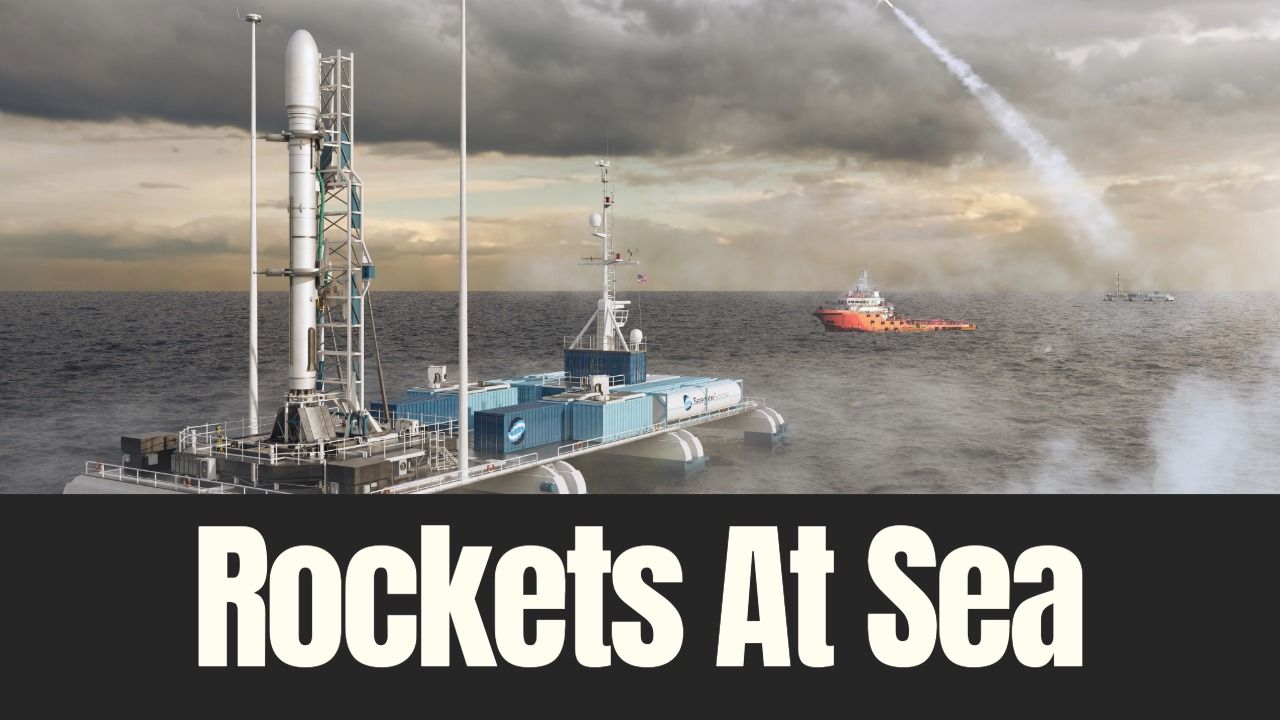
Seagate Space is building a launch site that does not stay put.
From its base in St. Petersburg, the company is designing a mobile offshore platform to launch rockets into orbit from the open ocean.
Engineers are being hired and model testing is underway, reflecting a simple belief that the way the U.S. launches into space no longer matches how space is actually used.
The gap between demand and infrastructure is widening.
Why offshore launch is no longer optional
Michael Anderson, co-founder of Seagate Space, traces the company’s origins to a simple observation.
Space activity is accelerating. Infrastructure is not.
“We felt that there were opportunities to innovate and do things differently in the maritime space,” Anderson said, describing his decision to leave a large U.S. vessel operator and start the company about a year ago.
Launch demand has accelerated as satellite constellations and government missions push cadence higher.
Communications led the shift, Anderson said, but other industries are lining up behind it.
READ: TAMPA BAY REAL ESTATE NEWS
He pointed to data processing and energy as the next waves that depend on steady access to orbit. Each new use case tightens pressure on a launch system built for another era.
“We’ve got two, two launch sites in the US,” Anderson said. “They’re built for a different time period.”
Those sites, he said, were designed for a single government customer and long timelines, not for a crowded commercial market with many independent operators.
Geography compounds the problem, with some orbits harder to reach from fixed coastal pads and redundancy limited.
“You can’t really have two launch sites that are your only gateway points to get to space,” Anderson said.
A platform built to move
Seagate Space’s answer is mobility.
The company is designing a modular platform made from container-sized units that can be staged, shipped and assembled faster than a new onshore spaceport.
“Our platforms can be mobilized so they’re not tied to one specific geographical location,” Anderson said. “They can be moved. They can be repositioned to hit multiple orbits.”
Once deployed, the platform can operate away from dense coastal areas. That flexibility changes both logistics and risk.
“Right now, the ocean is the predominant opportunity for us to launch,” Anderson said. “And I don’t see that changing.”
The concept recently cleared a key early hurdle.
READ: TAMPA BAY BUSINESS NEWS
Seagate Space received an Approval in Principle from the American Bureau of Shipping under new offshore spaceport guidelines, an initial regulatory milestone.
“We have matured that design to the state where it has now received approval in principle,” Anderson said. “We’re actually the first design and the first company to ever achieve that milestone with their offshore spaceport guidelines.”
The work remains in the design phase.
“We’re hiring some new engineers there, this month, actually,” Anderson said.
Model testing is being conducted at MIT, which Anderson described as the maritime equivalent of a wind tunnel.
“We are departing tonight, heading up to MIT, to do some coding testing, which is the equivalent of a wind tunnel test in the maritime space,” he said.
From interest to contracts
The hardest part is not attention.
Seagate Space has worked with launch companies through collaboration and co-design agreements to shape the platform around real needs.
Turning that interest into binding commitments is the challenge.
“The challenge will be going from collaborative co-design, working together type of relationships to hard commitment and commercialization,” Anderson said.
READ: TAMPA RETAIL & HOSPITALITY NEWS
Many rocket companies explored offshore launch on their own, he said, then pulled back when it stretched beyond their core mission.
“We realized it was difficult and outside of our core competency,” Anderson said, describing feedback he heard from launch companies. “We need to figure out how to get our rocket to fly.”
Others approached traditional maritime operators and stalled when space failed to rank as a priority.
“They didn’t seem to care too much about space as a vertical or as an opportunity,” Anderson said.
That gap is where Seagate Space is positioning itself.
A Gulf opportunity with Tampa Bay roots
Seagate Space is exploring Gulf-based launch concepts to supplement the Space Coast.
The platform is not tied to one location. Mobility is central to the philosophy.
“The motto for us is kind of have a platform will travel,” Anderson said. “We’re not dictating where launches need to occur.”
That mobility links Tampa Bay’s maritime base to the space economy without requiring launches to originate near Cape Canaveral.
The company’s participation in Tampa Bay Wave and its decision to locate at spARK Labs reflect that strategy.
READ: ST. PETERSBURG BUSINESS NEWS
Anderson also pointed to Tampa’s shipyards as potential construction partners as the platform moves closer to deployment.
“We’re looking to work with the various shipyards here in Tampa as potential construction partners,” he said.
He described the region’s maritime base as more than legacy.
“We just see this really great emerging ecosystem in the maritime space here in Tampa,” Anderson said.
Competition and resilience
China currently leads in offshore launch infrastructure, Anderson said, with multiple vessels and plans for larger semi-fixed platforms.
“The leader in offshore launch, unfortunately, right now, is China,” Anderson said. “China is investing heavily in offshore launch.”
Earlier efforts, such as Sea Launch, showed that offshore launch was possible, but demand at the time was limited.
“It’s been done before in different instances,” Anderson said. “And we’ve basically taken that concept and modernized it for the rockets that are coming online today.”
From Anderson’s perspective, offshore launch is no longer an experiment. It is an infrastructure question.
“We’re an enabling force,” he said. “We’re the roads and bridges for launch.”
A longer view of launch infrastructure
Asked what success looks like a decade out, Anderson did not describe a single facility or company.
He described normalization.
“It’s about enabling a future where offshore launch activity is on par with the existing infrastructure we have today,” Anderson said.
In his view, offshore launch should sit alongside coastal sites the way offshore energy sits alongside onshore production. Each expands the system’s options.
“We want to provide the space industry that same level of flexibility,” Anderson said.
If offshore platforms become routine, Florida’s space economy stops being defined by a single coastline. It becomes distributed.
That shift would change how Florida participates in the next phase of space growth.