
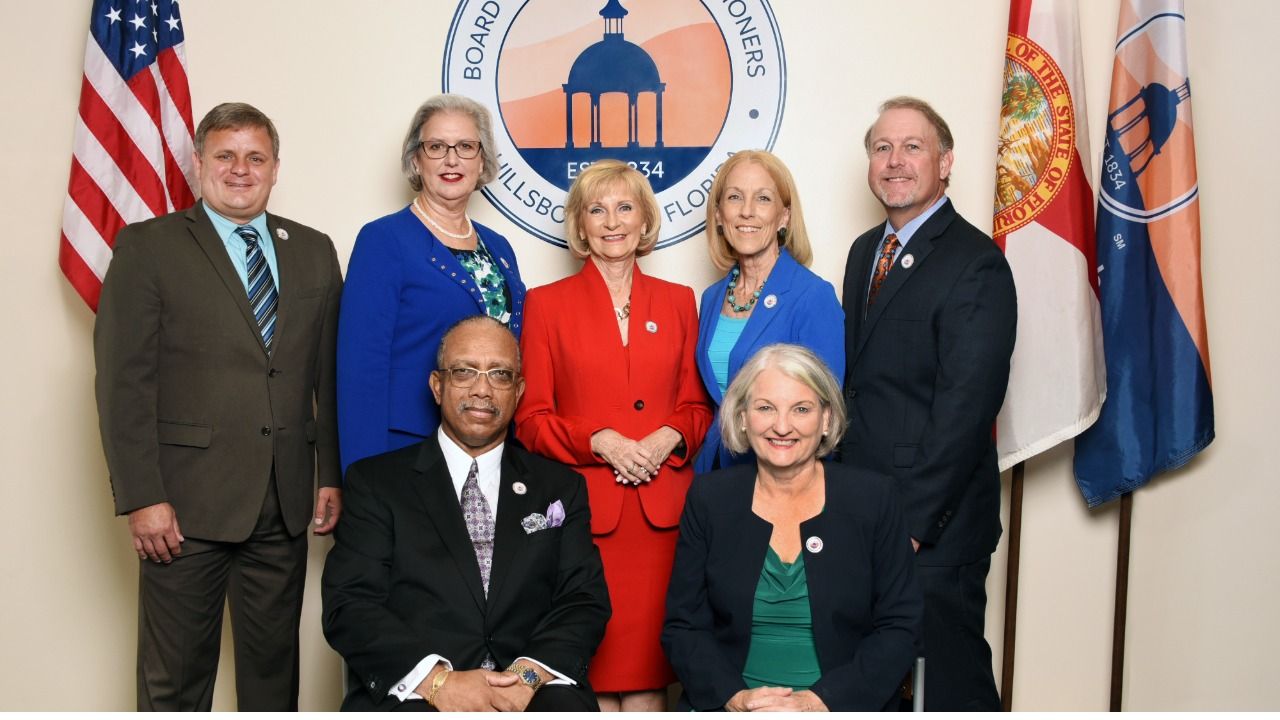
Hillsborough County commissioners voted 7-0 Wednesday to keep the Tampa Bay Rays stadium talks alive, advancing a process that now shifts from public positioning to technical review.
The vote authorizes county staff to continue discussions with the Rays on a proposed stadium and mixed-use redevelopment at the Hillsborough College Dale Mabry campus. It does not approve funding, commit public dollars or lock in a site. It establishes the conditions under which any future proposal will be judged.
Those conditions were the substance of the meeting.
Chair Ken Hagan framed the agenda item as a marker, not a milestone. The purpose, he said, was to place the status of talks on the public record and define how the next phase will proceed.
“For the purpose of today is just to continue our discussions with the Rays in an effort to determine if a framework and partnership can be agreed upon,” Hagan said.
If a framework emerges, staff will return to the board. If it does not, the process stops.
The site and the clock
County officials confirmed that the Dale Mabry campus has emerged as the Rays’ preferred site after an evaluation of multiple locations across the region.
The property offers enough land to support a ballpark and a larger mixed-use district tied to it. The Rays are targeting a 2029 opening.
Hagan acknowledged that other locations were considered, including Ybor City, which he said would have been his preferred option. He said the Dale Mabry site ultimately met the team’s full criteria.
READ: TAMPA BAY BUSINESS NEWS
County staff have been meeting regularly with the Rays since the team’s sale to a new ownership group. Officials emphasized that discussions have moved quickly but remain preliminary.
“There have not been any formal negotiations up to this point,” Hagan said.
The timeline is a factor. County leaders said the Rays are operating with urgency tied to the 2029 target, a pace that shapes how quickly information must be gathered and evaluated.
Cost and scale
The Rays have discussed a preliminary ballpark cost in the $2.3 billion range.
County officials described the figure as an early estimate subject to refinement through design review and value engineering.
The stadium would anchor a broader redevelopment that the Rays have described as an $8 billion to $10 billion private investment.
READ: TAMPA BAY REAL ESTATE NEWS
The surrounding district would span roughly 120 acres, with a development program of about 6 million to 8 million square feet and projections approaching 10 million unique visitors annually.
Those numbers are now being tested.
Independent analysis
The county has retained Aecom to conduct an independent economic study, following the same approach used in prior stadium efforts.
The analysis includes fiscal impacts, market demand for the ballpark, demand for surrounding development and stress-testing of key assumptions.
READ: TAMPA BAY RAYS NEWS
Officials said the county will not rely solely on team-provided projections when evaluating public participation.
Funding boundaries
Much of the meeting focused on what public dollars could and could not be used.
Commissioners repeatedly returned to the Community Investment Tax and the commitments made to voters during its renewal.
Several said any proposal must remain consistent with voter-approved priorities, including public safety infrastructure, transportation and existing facilities.
Commissioner Joshua Wostal said long-term revenue projections should not be treated as guarantees and warned against assumptions that bonding would never affect other county obligations.
READ: Channelside Development & Real Estate News
Commissioner Chris Boles raised concerns about the scale of stadium construction costs and the degree to which city funds might be relied upon.
“When voters approve the city, the discussion on language is primarily focused on maintaining existing facilities, strengthening public safety and supporting core infrastructure,” Boles said.
Commissioner Harry Cohen emphasized that the vote does not commit the county to a deal.
He said the principles discussed earlier in the process still apply, including protecting credit ratings and avoiding developer risk associated with the surrounding mixed-use project.
“To get into the weeds of how exactly this would be funded today is probably a little premature,” Cohen said.
Staff confirmed that independent validation of projections is underway.
Administrative coordination
County Administrator Bonnie Wise said the proposal could reshape the Drew Park area surrounding the campus, where the CRA tax base has grown only modestly since its creation.
She said assembling a financing structure will require coordination among the county, the City of Tampa, the Tampa Sports Authority and the Rays.
“The work of assembling a financing structure will be challenging and complicated,” Wise said.
Wise also cited potential benefits tied to job creation, tourist tax revenue, sales tax growth and workforce opportunities connected to Hillsborough College.
Hagan said the county has drawn clear lines around existing stadium funding. Funds set aside for Raymond James Stadium improvements will not be redirected.
“We made it very clear to the Rays that we would not utilize any funding that we had set aside for the Bucs,” Hagan said.
He said negotiations with the Buccaneers have not begun and will proceed separately as that facility approaches 30 years of age.
Hagan also said the Rays have not threatened relocation during discussions. He said Orlando has been publicly cited as a viable alternative if an agreement cannot be reached.
What happens next
The motion directs staff to continue discussions and return to the board only if a potential framework is developed.
An update is expected within 90 days, with the possibility of earlier board action if progress warrants.
The motion passed unanimously.
The vote closes the public phase of positioning and opens a technical phase focused on analysis, modeling and negotiation, with the county’s conditions now firmly on the record.