
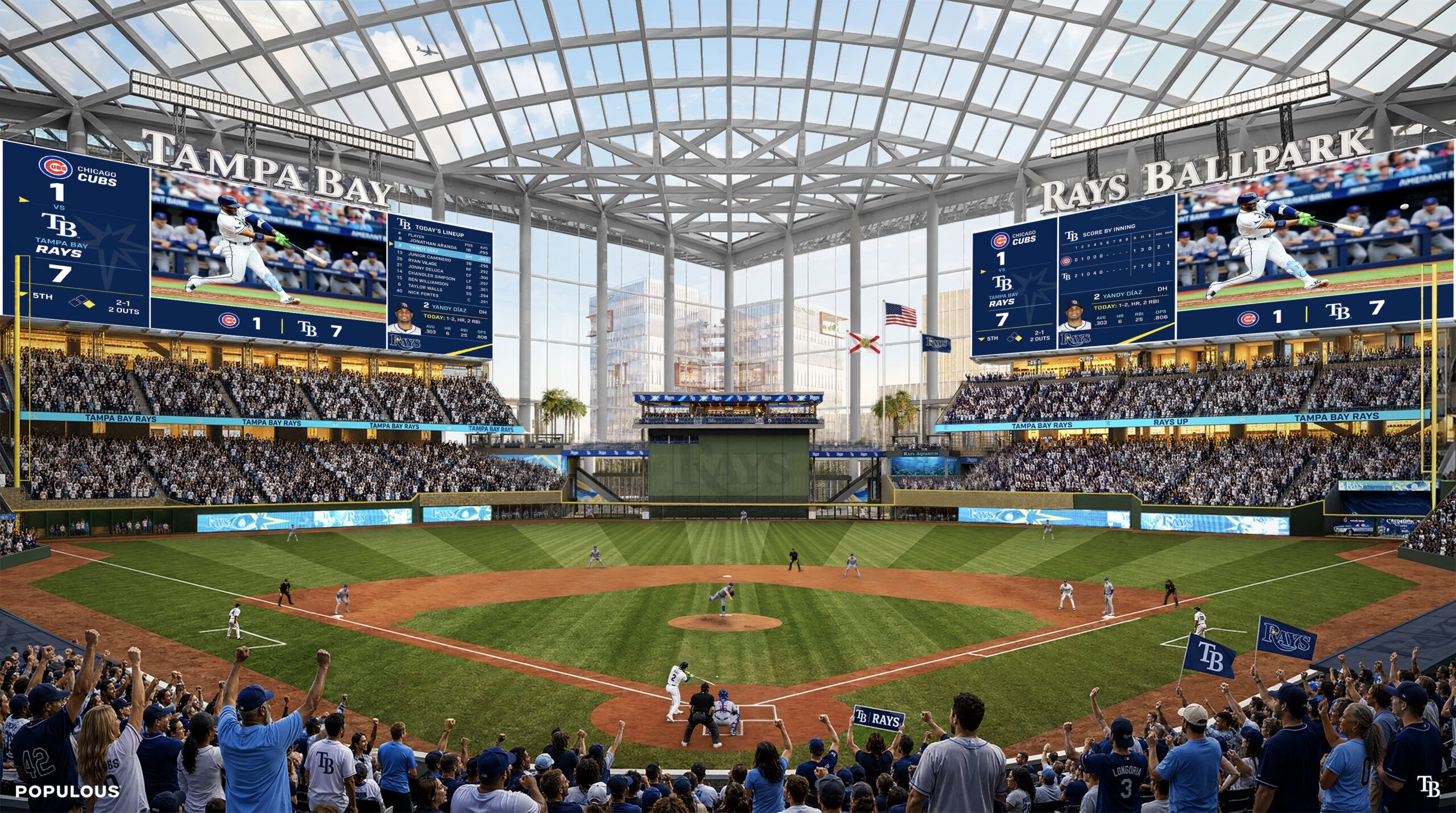
The Tampa Bay Rays have selected AECOM Hunt as the construction manager they intend to hire for their proposed $2.3 billion Tampa ballpark, putting the builder in place as the team works toward a September construction start.
Rays CEO Ken Babby announced the decision Monday following a public selection meeting at Hillsborough College. The choice opens negotiations with AECOM Hunt, which would join Populous and the rest of the design team during preconstruction before the parties establish a guaranteed maximum price for construction.
The selection comes as Tampa officials still negotiate how the city would provide and recover as much as $80 million for the project. Definitive agreements remain unfinished, meaning the Rays are assembling the team needed to start construction while the public financing required to support the project remains unresolved.
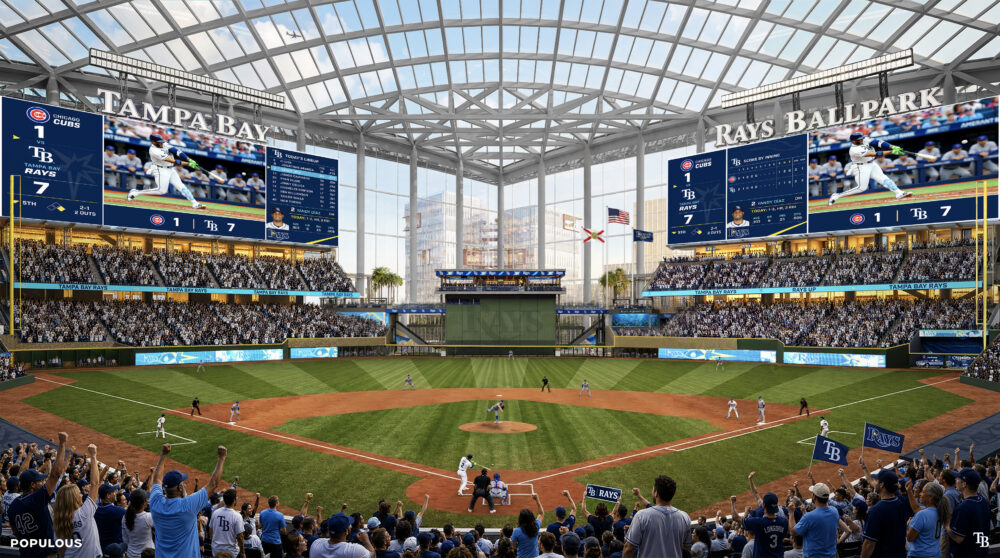
AECOM Hunt would enter a project built around a compressed schedule. The Rays are targeting substantial completion by Dec. 31, 2028, followed by final completion March 1, 2029. Their procurement documents call for construction to begin on portions of the stadium before the full set of construction documents is finished.
Structural design is already the critical path. Foundations, the seating bowl, roof and enclosure are expected to move through fast-track packages, with steel, concrete, foundation and precast contractors brought into the design process early.
The Rays have also applied to the Southwest Florida Water Management District for early site work and said permitting was underway for mobilization and initial construction activity.
Five Hillsborough College buildings within the planned ballpark footprint would have to be demolished, including their foundations. Work can begin after the Rays gain control of the property through a ground lease, with the demolition sequence coordinated among the team, Hillsborough College, Hillsborough County and the construction manager.
What eventually rises on the site is expected to span roughly 1.1 million to 1.4 million square feet and include at least 28,000 fixed seats, premium clubs and suites, restaurants, team offices, training areas, retail and broadcast facilities.
The fixed roof would use a steel gridshell spanning roughly 660 feet after engineers determined conventional trusses would need to be about 45 to 55 feet deep and could interfere with ball trajectories and federal aviation clearances. Preliminary plans estimate about 15,521 tons of structural steel in the roof system.
Those preparations are moving ahead as Tampa negotiates a financing structure that has changed since City Council narrowly allowed stadium talks to continue in May.
The May framework contemplated as much as $80 million in Tampa Community Investment Tax revenue for public improvements serving the ballpark. Council Member Bill Carlson has since proposed replacing that contribution with four annual $20 million advances, repaid from future property-tax growth within a new tax increment financing district surrounding the roughly 130-acre Rays development.
Revenue generated by taxable hotels, apartments, offices and other private development inside the district would be divided among Tampa, Hillsborough County and a community development district. Carlson has said the CDD’s share would reimburse the city, but the allocation percentages, repayment schedule and source of Tampa’s annual advances have not been disclosed.
“What would the source of that money be? That’s what I want to know,” Council Member Lynn Hurtak told TBBW last week. “I don’t have $20 million. I can’t find $20 million. That’s the big crux of it all.”
Hurtak has pointed instead to infrastructure agreements at Ybor Harbor and Gasworx, where developers complete qualifying work before receiving public reimbursement.
Carlson said the Rays agreed Tampa could recover any interest costs associated with the advances. The revised structure removed his principal objection to the May framework, he said, although his vote will depend on the final terms.
Carlson’s movement could alter the council arithmetic. Council Member Alan Clendenin, who supported the May framework, has said he remains prepared to back the project under Carlson’s proposal, while Council Member Luis Viera has welcomed the movement in negotiations and called for council to reach a workable plan.
The repayment mechanism will depend in part on development that arrives after the stadium. The Rays have promoted an eventual $8 billion to $12 billion mixed-use project around the ballpark, although Babby has said the minimum development requirements written into the final agreements will be lower.
“When you look at the site in 2029, when the ballpark opens, you’re going to have a brand new ballpark,” Babby said last week on the Tampa Bay Developer podcast. “You’ll have a rejuvenated new Hillsborough College and we’ll be just on the cusp of phase one of this development, with hotel and retail and mixed use and multifamily housing.”
Tampa could begin advancing $20 million a year before much of the private development expected to generate the property-tax growth used for repayment reaches the tax rolls.
The Rays have said government decisions are needed in August and construction must begin in September to preserve the 2029 opening.
With AECOM Hunt selected, the team has now chosen the builder expected to work against that deadline. Tampa still has to determine where its money would come from and how long it could take to get it back.