

TBBW Magazine
Digital EditionSeptember
The September issue of TBBW Magazine features Bob Clark, longtime Tampa Steel leader and the man behind a weekly Columbia Restaurant lunch that has connected Tampa business leaders for nearly 25 years.
Bob Clark, the Man at Table 100
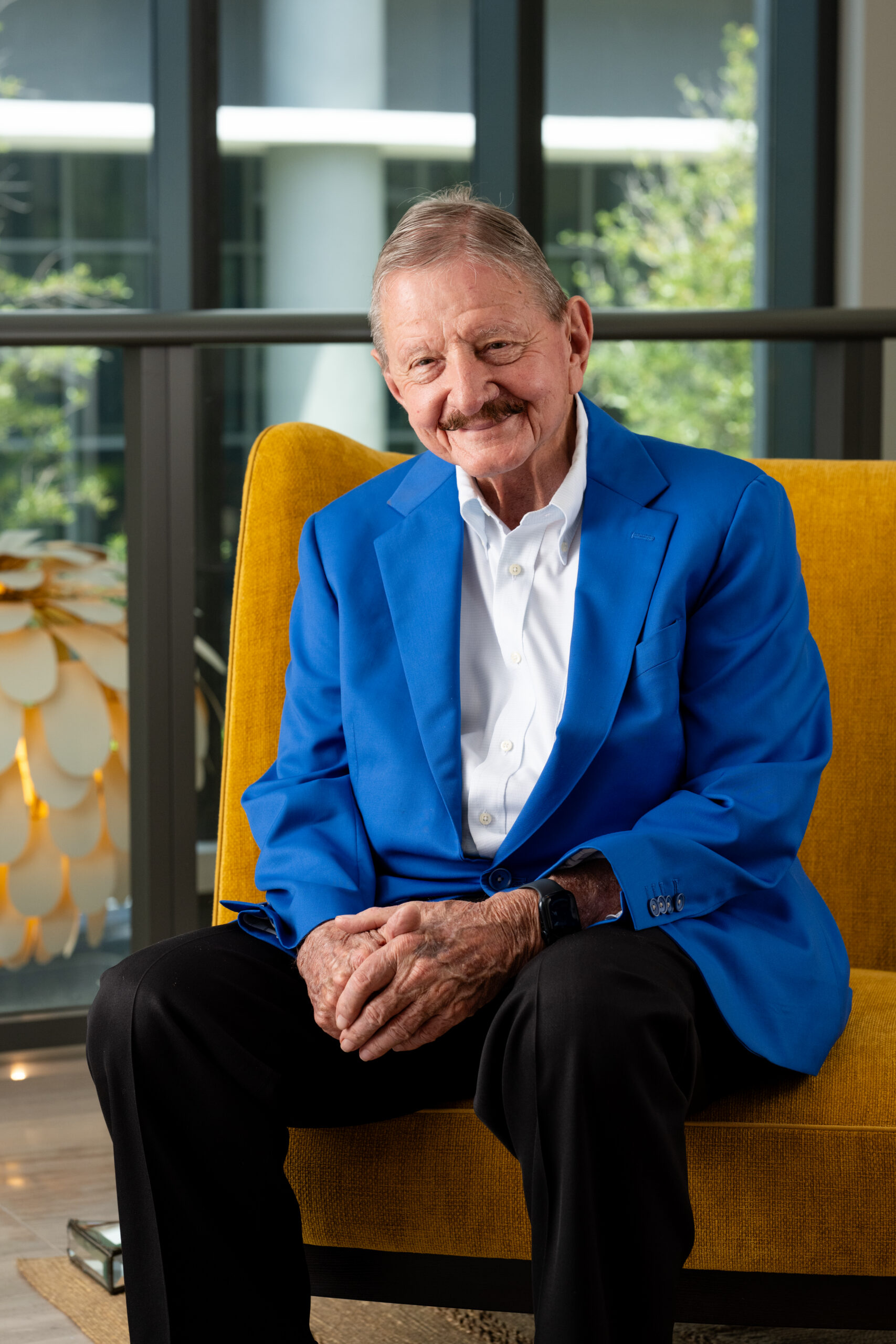
Before Bob Clark’s weekly lunch begins at the Columbia Restaurant in Ybor City, he decides where everyone will sit at Table 100. He may put a university dean beside a medical executive or place somebody looking for work near a guest who is hiring, then direct another guest toward the person three seats away. Business cards pass around the table, and Clark later sends photographs with handwritten notes, continuing conversations he arranged before anyone ordered. He has followed that routine since moving the lunch to the Columbia in November 2001, and this fall the gathering will mark 25 years there. Table 100 now carries a plaque with his name, while the bill Clark still pays has climbed from about $80 to more than $550 a week.
Clark moved the weekly lunch to the Columbia in November 2001, and this fall the gathering will mark 25 years there. Table 100 now carries a plaque with his name. Clark still pays the bill, which has climbed from about $80 to more than $550 a week.
The lunch had begun several years earlier at the Seabreeze Restaurant because Suzy Holley needed a better job. Clark introduced her to Paul Cato, who hired her full time, then introduced her to Jeff Swanigan, who was running the Florida Aquarium. Holley and Swanigan married. “Mission accomplished,” Clark says. The lunch outlasted the problem that started it, and when the Seabreeze closed, Clark moved the original group of about eight people to the Columbia. As he continued bringing people into the room, the gathering required a larger table and eventually made space for 15 or 16 when everyone squeezed together.
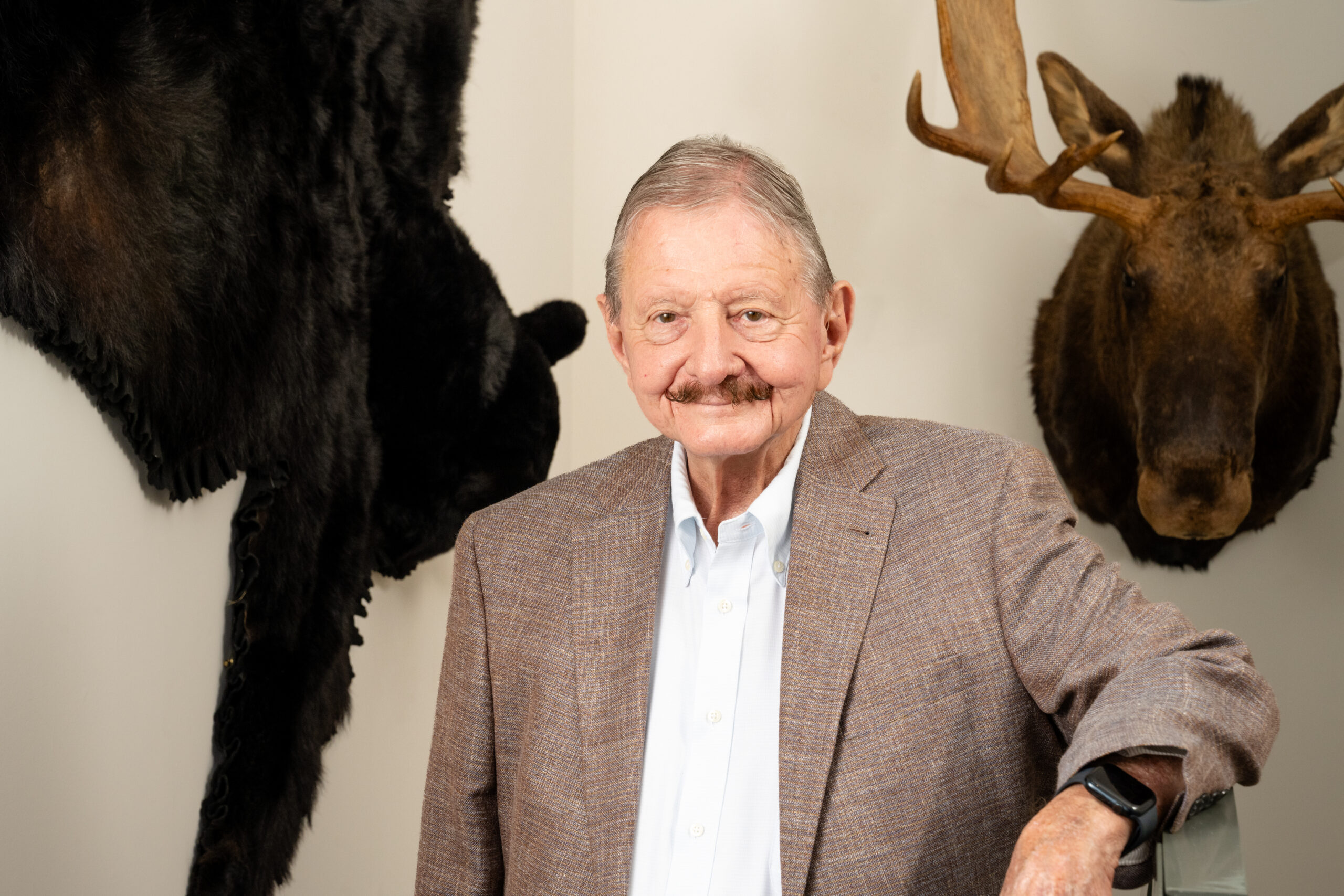
Holley was one of many people whose place in Clark’s life expanded from an introduction. Julie Serovich became a regular while serving as a dean at USF, and Clark encouraged her to join the Tampa Bay Chamber and Leadership Tampa before committing $250,000 to scholarships in USF’s College of Behavioral and Community Sciences. His daughter’s pageant years drew him into Miss Tampa, where he remained involved after she aged out and began bringing young women from the program to lunch so they could meet people in Tampa’s business community. His support also reached the University of Tampa business school, although Clark resists describing any of it as repayment to the city. “I don’t feel like I’m giving back. I feel like I’ve participated in supporting my friends,” he says. “I mean, in Tampa we’re all supporting each other.”
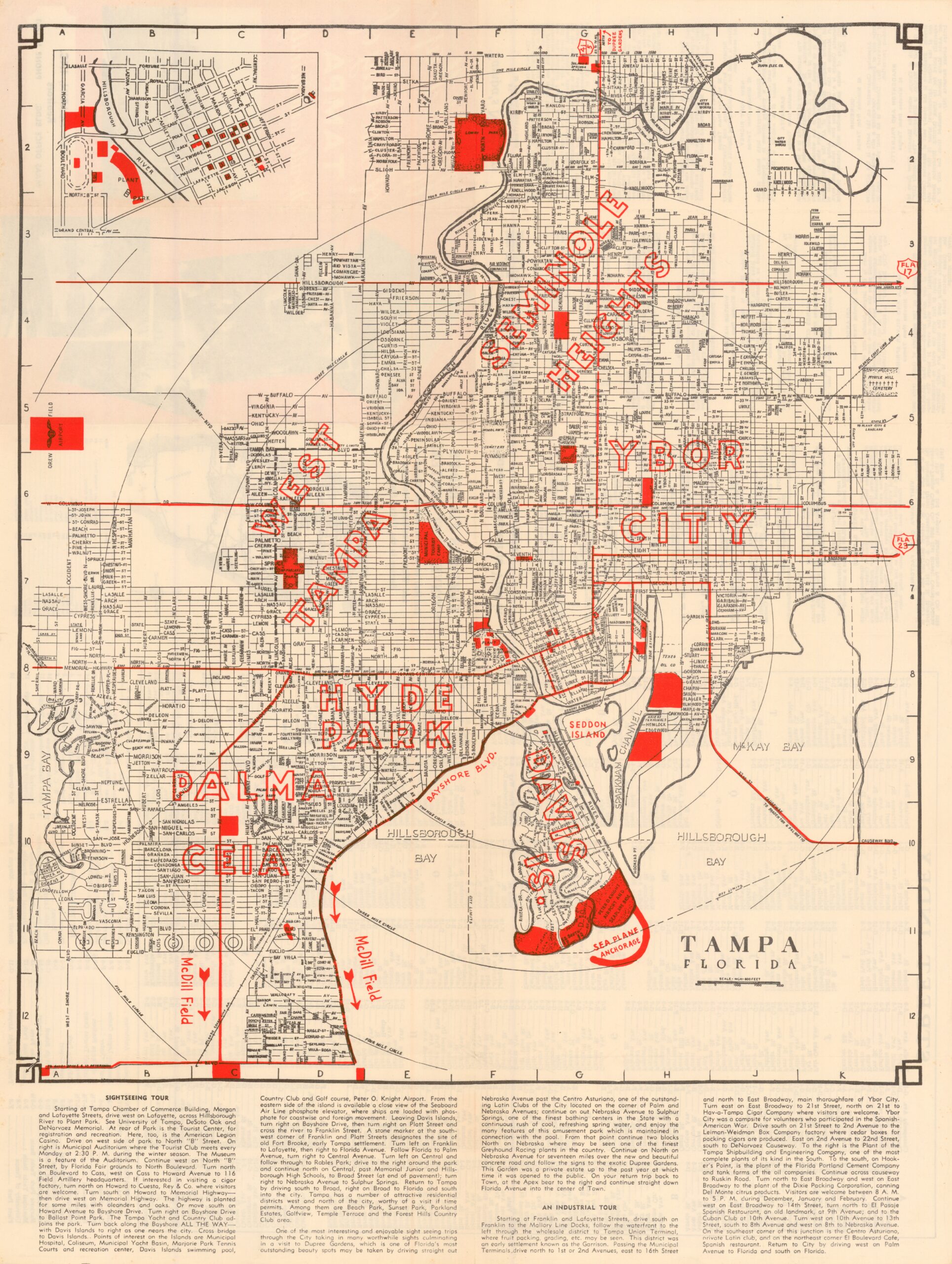
The city Clark first knew had no interstate running through it. Downtown, the port, rail lines and industrial waterfront occupied much of the city’s working geography, while open land remained close to neighborhoods now surrounded by metropolitan Tampa. The 1940 city map measured distance outward from the courthouse; an aerial photograph from the same year shows downtown gathered along the Hillsborough River and Garrison Channel, with Davis Islands filling much of the foreground.
Clark was born in 1936, the son of Robert Julian Clark, who left Georgia during the Depression, worked the Texas oil fields, picked fruit in Florida and operated equipment on the federal levee around Lake Okeechobee before arriving in Tampa around 1941. The family moved enough during those years that some of Clark’s earliest stories sound borrowed from somebody else’s biography. He remembers his parents going to see Gone With the Wind in Palm Beach while he was left with a babysitter whose husband, Clark says, was chauffeur to Joseph Kennedy, father of the future president.
Wartime shipbuilding eventually brought Robert to McCloskey’s Hooker’s Point yard in Tampa, where welders, riggers, machinists, electricians, pipefitters, crane operators and sheet-metal workers built ships for the war. After World War II, Robert bought a welding machine and a used truck, mounted a boom on the back and started erecting steel wherever he could find a job. One early customer paid its final bill with a grocery bag full of half-dollars, quarters, dimes and nickels. Robert brought the bag home, and when his children needed spending money, he sent them to the bag.
Clark’s own memory of that Tampa begins before he was old enough to understand much of it. On Dec. 7, 1941, the family was driving to South Bay for his fifth birthday in a Plymouth without a radio. His father stopped at a service station and returned to the car with the news that Pearl Harbor had been attacked. During air-raid warnings, Clark’s mother covered the windows so no light escaped. Wartime shortages meant some of his toys were made of paper. He and a neighborhood friend wanted bicycles, but before they owned any, they rolled up their pant legs and walked around Tampa pretending to ride. Later came bicycles ridden across Tampa, pickup games around Edison Elementary, cigarettes when somebody had them and uncles only four, eight and 10 years older whom Clark still credits as convenient bad influences. Near the end of the war, he carried a shoeshine box into the Ocean View Bar and Grill looking for customers.
“The only easy money I ever made was this would have been right about the end of the war, or the time the war was over,” Clark says. “I went into the Ocean View Bar and Grill, set my shoeshine box down, and the bartender gave me a nickel to get out. That was the only easy money I ever made.”
By high school, Clark was earning money on his father’s steel jobs, working alongside ironworkers on power plants before he graduated from Hillsborough High. The summer after his freshman year at Georgia Tech, he joined a crew erecting Atlas launch towers at Cape Canaveral. He remembers carrying a powered reaming machine weighing about 90 pounds on his shoulder while the crew enlarged bolt holes in the steel.
By then, his father’s company had become the obvious place to return. Robert Clark, who had come through the Depression without much formal education, nevertheless insisted that all five of his children attend college. Bob and his younger brother went to Georgia Tech. Two sisters graduated from Florida State, and Clark remembers the third coming within a quarter or so of graduating before she married. Robert never gave Bob much explanation for the rule.
“I guess he felt like people with education would have a better opportunity of getting jobs.”
Georgia Tech itself had not initially felt permanent. Clark arrived knowing few people and expected to finish his first year, then transfer to the University of Florida with his friends. “The thing I didn’t factor in was that D’s don’t transfer.”
Robert was similarly spare with affection. Clark says his father rarely told him what he felt about him or what he thought of what Bob was accomplishing with the company. What Bob could see was the work. Robert remained involved with Tampa Steel for decades and was still coming into the shop several times a week late in life. Years earlier, Bob told his father what he expected to do after college.
“I told my dad, ‘I’ll be on the ground with you when I get out of school.’ And he said, ‘No. That’s crowded down there.’ Meaning you better get your degree. That sent cold chills through me.”
Clark stayed at Georgia Tech, finished his civil-engineering degree and returned to Tampa at the end of 1960. The city he came home to was already pushing beyond the one he had crossed by bicycle. Roads and subdivisions were carrying development outward, while the port, phosphate industry, utilities and industrial plants continued generating heavy work closer to the bay. His father’s company was changing with it. Robert had begun with erection work, and around the time Bob returned, a small fabrication operation was working with about half a dozen people in rented space at the shipyard. For much of Clark’s first decade, his own interests pulled toward industrial and general-contracting work in the phosphate business rather than toward steel fabrication itself. “My first six or eight years, my love was not in the steel business, but it was in the general-contractor industrial type of work.”
No one formally put Bob in charge. Robert never announced that his son would take over or gave him a title above the relatives already working at Tampa Steel. Bob began ordering material because he could read the drawings. Knowing when the steel would arrive made him responsible for the schedule, and the schedule determined how many people the company needed. Before long, everyone had to come to him.
“When I came out of school, I could read the drawings, and so I had to order the material. Since I knew when the material was coming in, I had to make up the schedule. And so since I was scheduling, then I had to make up the manpower. Within a year or so, everybody was answering to me. My dad never said, ‘My son is going to be the boss.’ But since I was the information center, everybody had to come to me for information.”
As Robert gradually stepped back from estimating and selling, more of that work fell to Bob. “I was a super salesman.” He says sales became at least a six-day-a-week undertaking, while his father and brother continued carrying substantial pieces of the company. Bob is careful about that distinction. He considers himself instrumental in Tampa Steel’s expansion, but not singularly responsible for it.
The company Clark returned to was crowded with relatives. One aunt managed the office and, as he remembers it, considered part of her job protecting his father from everyone around him, including his own children. Four of Robert’s brothers and two sisters worked in the business, which meant authority and family relationships frequently occupied the same shop. “You put everybody where they can do the most good and the least harm,” Clark says. “Everybody wants authority, but no one wants responsibility.” One of those relatives was Robert’s brother. “Probably one of the hardest parts was my dad had a brother who was 10 years older than me. He was 6-foot-2 and probably weighed 350 pounds, and I had to encourage him to retire. Things like that were a little bit difficult.”
Bob’s younger brother, John, reached Tampa Steel by a different route. Six years younger, John attended Georgia Tech on ROTC, served as an Army officer in Vietnam and returned in 1971. He rarely talked about the war, Bob says, although decades later Bob would mention Agent Orange when discussing John’s military service and the cancer that eventually killed him. Back in Florida, John spent Sundays with their dad, who owned the property. about 200 acres in Pasco County, raising cattle, digging fish ponds and planting fields for hunting.
Bob initially imagined the brothers dividing responsibility evenly. It did not work that way.
“I wanted him to divide responsibility with me, 50% him do half and I do the other half. That wasn’t his makeup. If I had three erection jobs going, he wanted to do one. What I realized was what his forte was. When we build a bridge, we would build one whole damn thing right there and drill the holes and everything. If a guy calls me up and tells me a bridge doesn’t fit, I tell him he screwed up because I had it built. What I learned to do was let him do what he did best.”
John eventually controlled a substantial portion of what happened in the shop, particularly work that benefited from his hands-on attention. Once Bob stopped trying to divide the responsibility evenly between them, he says, John was happier and so were the people around him. The brothers remained close enough that Bob stood beside him at three weddings. “This time he got married, he told his new wife, he said, ‘Look, if this marriage doesn’t work out, next time I’m going to get me a new best man.’”
Clark married his high-school sweetheart in 1961, shortly after returning from Georgia Tech, and remained married for 23 years. He still calls her the most beautiful woman he ever met, but by his own account the marriage had become difficult long before it ended. Clark was drinking heavily, and whatever he once believed he could contain had begun spilling into the rest of his life. “There were a lot of things, and I was no angel, I guess you would say,” he says. “I contributed an awful lot to the demise of the marriage. And drinking did not help in any way.” Looking back, Clark describes the change less as a sudden collapse than as something that gradually stopped holding together. “My wheels came loose and started to wobble,” he says. After the divorce, he says, he spent six years celebrating his freedom with parties, drinking and a social life that increasingly revolved around both.
By Christmas 1990, the celebration had carried him somewhere else. Clark says he drank enough that he missed Christmas altogether, and on Dec. 26 he went into detox, still believing the answer was moderation rather than abstinence. “When I went in there, I felt like I was going to get control of it,” he says. “I was going to learn to drink like a gentleman.” He never drank again, although getting from that decision to the life he has now required more than removing alcohol from the house. For the first four or five years, Clark says, he changed friends, places and routines that had been organized around drinking, gradually replacing a social life built around alcohol with work, meetings, exercise and a different circle of people.
The change showed up inside Tampa Steel as well. Before he stopped drinking, Clark says, he dealt with his father and brother by pushing harder whenever he thought something needed to happen, raising hell and telling them what they should be doing. Afterward, the same disagreements remained, but his way of handling them changed. “What I learned to do was explain where we’re going, what we’re going to do, how things were going to happen rather than push,” he says. “I got to where I was leading them.”
Clark met Patti in 1991, roughly a year after detox, and married her in July 1992. She has never known the drinking version of him. When Clark starts making his own list of the things that changed his life, quitting drinking and marrying Patti arrive close together.
“Patti is a partner. She helped and she participated.”
Patti joined a life already crowded with work, civic organizations, pageants, dinners and people Clark wanted to know or bring together. Years later, the Columbia lunch gave all of that a permanent address, along with one financial advantage he still enjoys pointing out.
“When I started doing it, it was $80 a week. Now it’s up over $550 a week most weeks. But it doesn’t hurt my expense account because there is no booze.”
By 1973, Tampa Steel had reached the point where the family was willing to spend ahead of the work. The company occupied about 11 acres with roughly 40,000 square feet under roof, and its shop could lift about 10 tons at a time. Clark remembers doing roughly $3 million in annual business, much of it within 10 miles of the plant, while the beam line installed a few years earlier had begun changing how efficiently the company could fabricate steel. The numbers encouraged the Clarks to add still more capacity, and over the next several years they expanded the plant and equipment around a Florida construction market that appeared capable of keeping it busy. Then the recession arrived. The new machinery remained on the floor, the additional capacity remained in the plant and the volume of building work that had justified both no longer did. “We were all dressed up with no place to go,” Clark says.
The equipment could not earn its way sitting still, so Clark began looking for work that did not depend on another office building or conventional construction project breaking ground. The answer was already taking shape southeast of Tampa, where phosphate companies were spending money on pollution-control systems and industrial improvements. Tampa Steel had done general-contracting and maintenance work in the phosphate business before, which gave Clark somewhere to turn when the building market weakened. The company began taking on pollution-control work, fabricating pipe and doing the mix of steel, concrete, machinery and industrial work that Clark had preferred during his first years out of Georgia Tech. What started as a way to keep newly expanded capacity occupied eventually became another line of business, including a pipe-fabrication operation at Tampa Steel’s own plant.
By the time Florida construction returned, Tampa Steel had the plant and equipment to pursue work far beyond the small market around its Tampa shop. The company fabricated steel for Tampa City Center, Tampa Electric’s Big Bend Power Station, the Prime Osborn Convention Center in Jacksonville, SeaWorld and Spaceship Earth at Epcot.
The company born in postwar Tampa was no longer confined to it. Tampa Steel moved through some of the projects changing Florida’s physical scale, including Tampa City Center downtown, Tampa Electric’s Big Bend Power Station, the Prime Osborn Convention Center in Jacksonville, SeaWorld and Spaceship Earth at Epcot. Tampa City Center placed the company inside the downtown building cycle Clark was watching at home while Disney carried it into another kind of megaproject. In a photograph from Epcot, Robert and Bob stand beneath the unfinished sphere of Spaceship Earth while its triangular steel frame rises behind them. Robert wears a pale short-sleeved shirt. Bob stands beside him in a white dress shirt and tie. Behind them is work being fabricated by the company Robert had started with a welding machine, a used truck and a homemade boom.
By then Tampa Steel could pursue much larger bonded projects, and the additional capacity came with a personal risk for Bob. His own balance sheet stood behind the company’s promises. “If I couldn’t do it, they were going to take it out of my house.”
Tampa Steel had already begun fabricating the Prime Osborn Convention Center in Jacksonville when the main area of the building grew by two feet. Steel already moving through the shop no longer matched the job, and Clark says Tampa Steel had to wait for revised drawings and additional material before it could resume that portion of the work. The delay created another problem inside the plant because the company could not simply leave its crews and equipment idle until Jacksonville was ready again. Other scheduled work moved into the available production time, including hangars at Warner Robins Air Force Base in Georgia, so by the time the revised Jacksonville drawings and material arrived, Tampa Steel had both the delayed job and the work that had filled its place competing for the same people and equipment. The building had changed, the fabrication sequence had changed and the workload had changed, but the original deadline had not. Clark says the company sometimes went from having too little work for its normal manpower to suddenly needing roughly twice as many people to meet obligations that had converged on the shop at once.
Spaceship Earth created the same problem by another route. Tampa Steel expected certain welds to require X-ray inspection, but Clark says inspectors expanded the testing to joints that had not been included in the company’s understanding of the work, costing the shop about two months of production without adding two months to the schedule. Tampa Steel therefore had to increase manpower to recover the lost time, while the disputed costs became part of a $2.2 million claim that Clark says the company eventually settled for $1 million. By the end of the decade, Tampa Steel had collected roughly $5 million to $6 million on construction claims that Clark believed were worth about twice that amount.
“With construction claims, in the ’80s we collected probably $5 million or $6 million. If we collected that much, they were worth twice that much. On Spaceship Earth, we had a $2.2 million claim. We settled for $1 million. Construction claims and fast-track construction almost put us out of business in the latter part of the ’80s.”
The experience changed what Clark spent his time doing. “I used to be the best steel fabricator around. Now the best letter writer.” Asked decades later what nearly losing the company did to him, Clark gives the experience a different name: “It was all part of the education.”
Workers’ compensation costs gave Tampa Steel another reason to leave building erection behind. Clark says the company’s experience modifier had climbed to 1.9, leaving it paying nearly twice the manual rate. The company had already tried several small bridges around Florida, including a widening job Clark remembers at roughly $150,000, when an extension of Miami’s automated people mover went out for bid. The original system had already developed a reputation inside the steel business because Clark says its construction had contributed to the failure of Bristol Steel, a Virginia fabricator. When the extension came around, that history was still fresh enough that competitors did not need much persuasion to stay away. “Every damn body was afraid of it,” Clark says.
Clark was not operating from a position of abundance when he decided to pursue it. The claims and losses of the previous few years had reduced Tampa Steel’s net worth from a couple million dollars to roughly $500,000, which meant a bad bridge job could compound the damage rather than cure it. Pricing the work also created another problem because Clark did not want his number circulating among competing contractors before the bids were opened. His method was to build the price, then protect it behind what he calls “bullshit and feathers” while deciding which contractors could be trusted with the number that mattered. “I picked out a couple contractors that I trusted and gave them a price,” he says. “The two people I gave the best price to were the low two bidders.” One of those contractors won the work, putting Tampa Steel onto a $15 million job.
The job did more than keep the shop busy. Clark says Tampa Steel made 25% before taxes, a margin large enough to change the calculation about where the company should put its effort next. Bridges also fit the shop differently from the building work that had caused so much trouble. Tampa Steel could assemble an entire bridge section on the floor, drill the connections and know that the pieces fit before they ever left the plant, while John was particularly useful on the heavy, self-contained jobs that could be built and checked in front of him. The Florida Aquarium, completed in the early 1990s, was, in Clark’s telling, the company’s last major building job.
Over roughly the next two to two-and-a-half decades, Clark estimates Tampa Steel put about $19 million into its property and plant as bridge fabrication became a larger part of the business. Equipment that once lifted 10 tons gave way to bridge pieces weighing hundreds, and the property eventually spread across roughly 32 acres with about 250,000 square feet under roof. Tampa had meanwhile filled outward around the roads Clark once remembered as edges of town. Some Tampa Steel loads became so large that they could move through that city only after ordinary traffic had been cleared, leaving the plant during midnight travel windows on their way to bridges somewhere else. On a bridge the company built across Highway 50 for horses, Clark says, material had to be added to control vibration so the movement would not spook the animals.
Clark rarely followed the steel to admire the finished structure. By the time a bridge left the plant, his attention had moved to the next problem. “I just want it marked on the map where it goes.” Then the trucker had to figure out how to get it there.
The bridge business sometimes put Clark himself far from Tampa. In September 2001, he was in the Washington area for a pre-bid meeting on the Woodrow Wilson Bridge and had dinner with his daughter and son-in-law. The next day, Clark remembers driving through the area with the Pentagon burning. His son-in-law, a West Point graduate who had worked in defense, committed within the following year to joining Tampa Steel.
John had worked beside Bob at Tampa Steel for decades and, Bob says, had almost never been sick when he began experiencing discomfort. Doctors found Stage 4 cancer in his liver, lungs and colon, and he died May 12, 2017. For more than a year afterward, Bob spent less time paying attention to what was happening in the shop, trusting the engineers and supervisors already in place to keep the work moving while he dealt with his brother’s death. The arrangement appeared to hold until Clark eventually sat down with the company’s financials and saw numbers he did not like. When he went looking for the reason, he says, he found some of the people responsible for supervising production sitting in their offices instead of staying on top of the work below.
“I tell you what it cost me: a lot of money,” Clark says. “I felt like the engineers and supervision I had were handling things, but I didn’t even think about it. I was just damn depressed. Then one day I looked at my financials and they didn’t look good, and I realized the people that were supposed to be supervising the work were sitting in their offices.”
Clark pushed his attention back into the plant, but what he found also clarified something about the brother who was no longer there. John’s office had occupied a corner of the shop, where he could see the work and the people doing it. “Just his presence in the factory,” Clark says, “kept some people on their toes.”
Clark had confronted another problem he could not solve through work when both of his granddaughters were born with developmental disabilities. Their family eventually found Brookwood, a residential community in the Houston area where adults with disabilities can live and work.
“Naturally I was going to fix these little girls. I went to all the best doctors. We’re going to fix the little girls. They don’t have a fix. It was really hard for me to deal with. It really was. Still bothers me. I cannot change them. What I can do is help plan for their future by legal trusts and make sure they can be there in Brookwood.”
Robert kept coming to Tampa Steel several times a week into old age before dying in 2005. By 2025, John was gone and Bob was 87. In April, the family sold Tampa Steel to Precision Build, preserving the Tampa Steel name and workforce while ending eight decades of Clark ownership. Bob kept his title of president.
“I was 87 years old. I guess that’s the reason. I couldn’t guarantee that I was going to be around forever.”
After eight decades of family ownership, an interviewer offered him the expected word for the sale: bittersweet. “Absolutely not.”
Clark wanted Tampa Steel and its employees to have somewhere to go after he could no longer be there, and Precision Build gave him that answer.
“Monday, Wednesday and Friday I get up at 3. I’m at a personal trainer at 4:50. I leave home around 6, and every morning I go to a 6:30 a.m. meeting. I leave it a few minutes early, around 7:10, 7:15, so I get to my shop at 7:30.”
If lunches, meetings and civic commitments take too much of the week, he sometimes goes back Saturday or Sunday. Clark is approaching 90. Asked how much longer he plans to work, he says, “Three more years. Next year I’ll tell you three more.”
Clark has treated the Tampa Bay Chamber’s term limits much the same way. He has served on the board for roughly 24 years, despite a structure that ordinarily sends members off after two three-year terms. “What you do is you serve two three-year terms, then you’re off a year. What I’ve been able to do is during my off year, I’ve been able to get a presidential appointment. Hopefully in ’27 I get a presidential, so I can keep on board.”
His civic opinions remain similarly practical. Asked about Tampa’s transportation problems, the bridge builder goes first to money: the region needs a gas tax, he says, and rail once discussed between the airport, Westshore and downtown would cost considerably more now because Tampa waited. “We need to do something.” He has spent about 25 years with Visit Tampa Bay, too, and every week the Columbia lunch puts another group of people around Table 100.
Clark can put years on board seats and names on projects, but he has no answer when asked what his legacy will be. Pressed to imagine what somebody might say about Bob Clark 50 years from now, he talks about friends, lunches and the people around him. Then he settles on himself.
“I really enjoy being me.”
When Clark graduated from Hillsborough High in 1956, he remembers the interstate extension ending not far beyond Fowler Avenue, where he and his friends went to drag race. Even decades later, Tampa could still strike outsiders as slow. Clark remembers being in Miami around 2002 while Tampa was competing for the Republican National Convention and seeing an evaluation of the candidate cities in which Tampa’s name was followed by a string of Z’s, shorthand, as he understood it, for a city putting people to sleep. More than six decades after Clark raced on the edge of the interstate, he watched Water Street rise around the arena.
“He hit the gas pedal,” Clark says of Jeff Vinik.
Asked what remains of the city he grew up in, Clark reaches for things he can still name.
“We got a cigar history. We used to have some good breweries here in town. I’m talking about Tropical, Silver Bar and things like that. Culture. I don’t know. We call ourselves the Cigar City, is what we used to call ourselves. But it’s changed. It’s changed so much.”
Near the end of the interview, Clark is asked whether there is anything else he wants to add. There is. In 1955, Hillsborough High was playing undefeated Orlando Edgewater, and with about a minute left Hillsborough turned over the ball and Edgewater drove inside the 20-yard line. Clark was playing safety. He knew the right halfback liked to run left and throw.
“Sure enough, he passed. There was a big scrum in the end zone, and as time was running out, a few seconds left, I intercepted the ball and saved the game. The Tampa Tribune had the five players. I mean, come on. They can identify a man alive in a five-man play.”
Housing Has Become a Workforce Problem
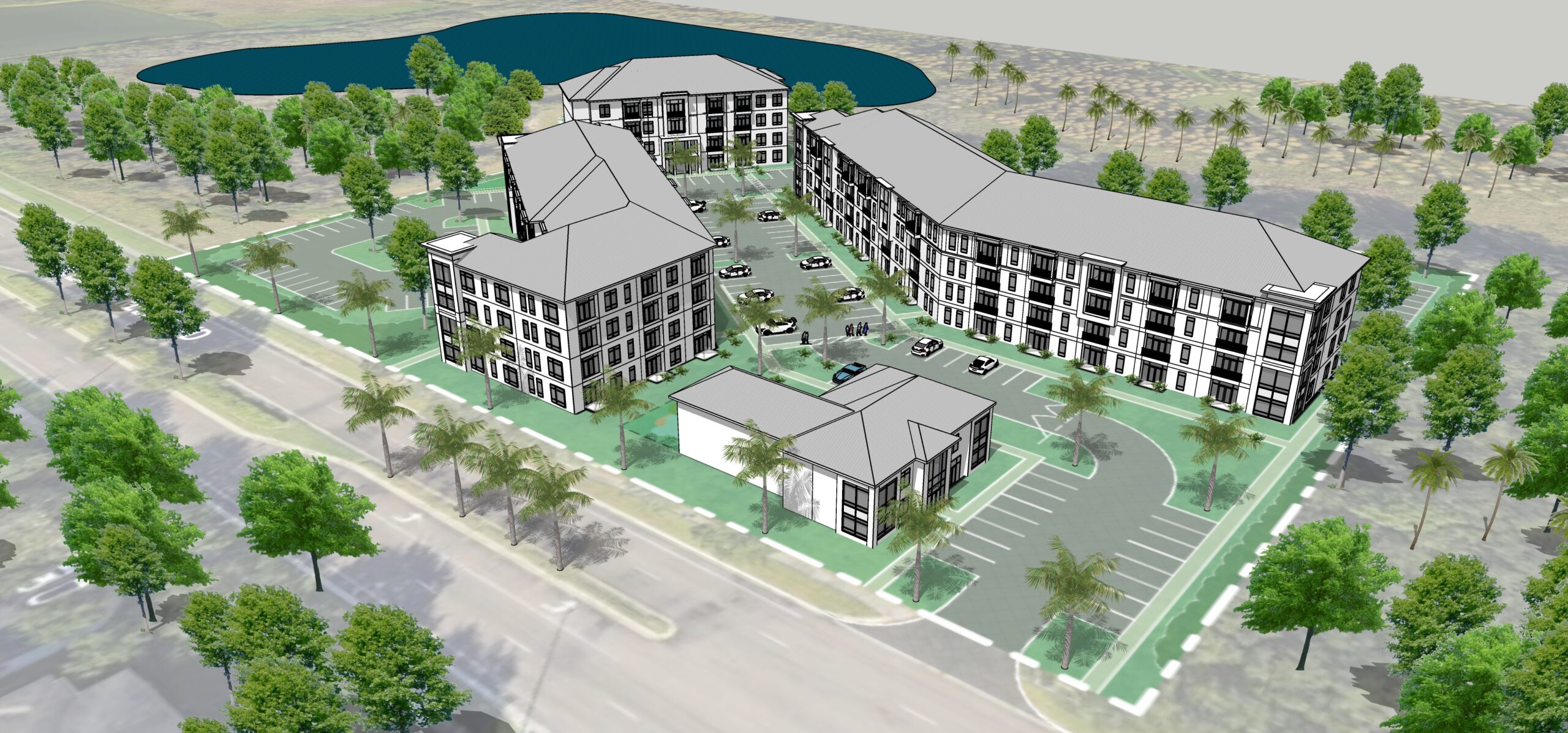
Tampa General Hospital is getting into employee housing, with plans to break ground this fall on 170 one-, two- and three-bedroom apartments near Falkenburg Road and the Selmon Expressway. The health system will contribute five acres it already owns, while $14.5 million in state and Hillsborough County grants will help bring rents within reach of households earning between 80% and 100% of area median income.
Tampa General arrived at the project after housing problems began showing up inside the workplace, as employees reported rent increases of 30% to 40%, evictions and difficulty finding housing after moving to Tampa for a job. Meagan Langdoc, senior vice president of total rewards and shared services, says more workers also turned to Tampa General’s team member emergency fund for help with rent and other housing costs, giving the health system another measure of how quickly the problem was reaching its workforce.
Tampa General responded by studying housing costs around its hospitals and offices and comparing rents and home prices with what employees in different jobs earned. Langdoc says those studies found combinations of job and location in which housing could consume roughly 40% to 60% of income, well above the 30% threshold commonly used to define affordability. A few months after L.J. Tsunis joined Tampa General in January 2023 to oversee strategic assets and real estate, CEO John Couris asked whether the health system could build housing for its own employees, leaving Tsunis to determine where the apartments could go, what they would cost and whether Tampa General could finance rents below the surrounding market.
Making the 170 apartments affordable required Tampa General to remove costs before construction begins. The health system will contribute the land, eliminating what Tsunis estimates could otherwise add $30,000 to $100,000 in acquisition costs for each apartment, while another $14.5 million will come from state and Hillsborough County grants and conventional debt will finance the balance. Tampa General selected the Michaels Organization to develop and manage the property, but Tsunis says the project would not work at its intended rents without the free land and public funding.
“Market rate, conventional debt and equity does not equal affordable housing right now,” Tsunis says, citing interest rates, construction costs and other development expenses that require rents many workers cannot support. Housing development remains outside Tampa General’s core business, and Tsunis says employers would have less reason to enter it if the housing market were producing enough units at workable prices. “If the public and the private sector were doing enough, I don’t think employers would have to do it,” he says, pointing to teachers, firefighters and health care workers whose jobs require them to report in person.
Leroy Moore, senior vice president and chief operating officer of the Tampa Housing Authority, puts numbers around the gap Tsunis describes. A worker earning roughly $48,000 may be able to afford $800 to $1,200 a month, Moore says, while the rent needed to support a heavily financed apartment project can reach $2,400 to $2,500. Developers may assemble land, tax-exempt bonds, tax credits and private capital and still arrive several million dollars short, which is why Moore argues that local public money is most useful when it supplies the final dollars needed to move an otherwise viable project into construction.
Garet Marr, executive managing partner for national multifamily and affordable housing at Franklin Street, and Ian Brown, a multifamily and affordable housing specialist at the firm, add another cost to that equation: time. They say affordable projects can spend years moving through land acquisition, entitlements, financing awards and preconstruction while borrowing and insurance costs continue accumulating. “These things are years in the making,” they said in a joint interview, describing roughly three years of work in some cases before construction can begin.
That time also gives developers more opportunities to move their money elsewhere. Marr and Brown say affordable-housing developers have become more willing since the pandemic to pursue projects outside their home markets, making it easier to abandon or delay a deal when the economics no longer work. Tampa remains attractive to national developers, they say, but scarce sites, high carrying costs and the ability to hold a project for three, four or five years can narrow the field to organizations large enough to survive the process.
The affordability problem reaches beyond Tampa General’s lowest-paid jobs. Langdoc says some professional employees earn too much to qualify for state or federal housing programs while still struggling to afford market-rate housing near work, and Tsunis says Tampa Bay wages remain lower than in some competing parts of the country.
Tampa rents had nearly doubled by the time the city assembled its November 2025 Comprehensive Housing Needs Assessment. Using Zillow data through May 2023, the report found that typical rent reached $2,221, up 98% from May 2014 and 48% from May 2020 alone, while its 2021 baseline showed 52.4% of Tampa renters spending more than one-third of household income on housing, almost unchanged from 53.4% in 2010.
The pressure has changed since the tightest period of the pandemic, when Langdoc says some workers struggled to find housing at all. Units are more available now, but employees may have to search farther from work to find a price they can afford, which is why Tampa General discusses the local housing market with applicants before they relocate. For employees traveling to the health system’s Davis Islands campus, a cheaper home farther away can shift part of the housing burden into gasoline, tolls or hours spent commuting. “You may find a housing unit in the suburbs,” Langdoc says, “but you may then also have gas and tolls.” Employees who rely on transit may need two or three buses to reach the hospital, she says, with trips that can take hours and shifts that sometimes end after bus service stops.
Moore says the Housing Authority can hold a resident’s housing payment to roughly 30% of income through subsidy programs, but it cannot control what that household spends getting to work. A family may save on rent and then spend more on a car payment, insurance and fuel. “We’re just transferring that cost burden away from housing onto that transportation,” Moore says.
Tampa’s housing assessment puts a number on those combined costs through the Housing + Transportation Index, which estimates that an average resident spends 32% of income on housing and another 21% on transportation, or 53% combined.
Those longer commutes enter a labor market in which Tampa General already competes locally and nationally for workers. Langdoc says Tampa Bay hospitals recruit from the same regional talent pool while imaging, surgical services and other specialties face shortages across the country. Tampa General cannot say housing is driving employees to resign because the health system does not track it as a specific reason for leaving, and Langdoc does not describe housing as a major recruiting deterrent today, but the organization can see that lower housing costs increasingly may require a longer and more expensive trip to work.
Moore gives that relationship a broader name. “We’ve got to look at housing as infrastructure,” he says, arguing that affordable housing near major employment centers is part of the system required to keep workers connected to the jobs a region is trying to attract and retain.
The same distinction between theoretical supply and usable housing appears in Tampa’s long-range planning. The city assessment estimates that Tampa must provide capacity for at least 42,165 additional households by 2050 and concludes that enough vacant and redevelopable land exists on paper to accommodate them, shifting the question toward the economics of turning that capacity into housing. Benesch tested those economics across Central Tampa, South Tampa, New Tampa, the USF area and Westshore/Tampa International Airport, using a 6.5% yield on cost as the assumed threshold at which a private project becomes financially viable.
Most of the market-rate scenarios fell below that benchmark, including a Central Tampa garden apartment modeled at 3.9% and a mid-rise project there at 5.1%. None of the five housing types modeled in Westshore/TIA reached 6.5%, while only New Tampa mid-rise development and South Tampa mid- and high-rise projects exceeded the threshold.
Those returns put Tsunis’ earlier land calculation in context. “If your land basis is zero or minimal, then you’re able to underwrite to a more affordable rent,” he says.
Public subsidies face another problem because new affordable units are arriving while restrictions on older ones disappear. Tampa added 1,306 subsidized units from 2014 through 2023, according to the city assessment, while 1,506 units lost affordability through expiring subsidies or planned redevelopment and more than 1,000 additional units were scheduled to lose restrictions over the following decade. The assessment separately concluded that meeting Tampa’s low-income housing need entirely through subsidized new construction would require billions of dollars.
Tampa continues to produce housing, but Tsunis says much of the new inventory consists of Class A apartments and condominiums that the average worker is unlikely to buy or rent. The city assessment recommends adding more housing near transportation and employment corridors by increasing residential density and allowing more housing types on existing land.
Marr and Brown say the useful local incentive depends on what is actually preventing a project from moving, rather than on whether another Florida city has adopted the same policy. Developers active in Tampa may face different constraints from those building in Orlando, Jacksonville or South Florida, they say, so impact-fee relief, density changes or development-code revisions matter only if they remove a cost or delay that is holding up a real project.
Tsunis sees one of those opportunities in land already controlled by cities, counties and other public institutions. Contributing developable sites at little or no cost in exchange for affordability restrictions, he says, can lower the land basis before developers determine what rents a project must support.
Tampa General’s experience also shows how difficult employer-assisted housing may be to replicate. The health system has an internal real estate operation and enough financial and organizational scale to bring in an experienced multifamily developer, while Langdoc says smaller employers may face the same housing pressure without the resources to build their own response.
The 170 apartments will address only part of Tampa General’s need because their income restrictions will exclude some employees and the health system will continue connecting workers with outside housing and financial resources. Langdoc says housing costs also leave employees with less money for groceries, insurance and child care.
Moore says the employment consequence can come later, when workers who cannot afford housing near their jobs begin choosing jobs closer to where they can afford to live. Tsunis sees a larger risk if housing costs continue feeding labor costs and shrinking the practical recruiting pool, eventually reaching decisions about where companies choose to grow. “If this isn’t solved,” he says, employers may decide to “expand or relocate elsewhere.”
Tampa General will learn much sooner whether its own intervention works once employees begin moving into the Brandon development. Langdoc says the health system plans to see whether the apartments reach the workers they were designed for and, if they do, use that experience to decide whether similar housing belongs near other hospitals and facilities.
“I think the first step is build it, see if it works, and then if it does, use that as your blueprint to continue to expand,” Langdoc says.
Tampa Bay’s Job Market Has A New Center of Gravity
Education and health services added 6,000 jobs over the past year, more than Tampa Bay added overall, as ambulatory health care services and hospitals together added 6,300.
In January, Moffitt Cancer Center opened its first clinical operation at Speros in Pasco County, bringing cancer screenings, diagnostic imaging, laboratory services and medical oncology clinics to a campus off the Suncoast Parkway. The operation sits within a 120,000-square-foot outpatient and proton facility, and Moffitt’s recruiting materials name the people needed to run it: registered nurses, imaging technologists, medical assistants, schedulers, pharmacy staff and environmental-services workers.
By June, ambulatory health care was adding more jobs than hospitals. Tampa Bay added 3,600 payroll jobs in the 12 months ended in June, according to the U.S. Bureau of Labor Statistics, while education and health services added 6,000. Ambulatory health care services added 3,700 jobs and hospitals added 2,600, while the remaining education and health categories lost about 300.
Ambulatory health care services employed 102,100 people across Tampa Bay in June, compared with 68,300 in hospitals. BLS includes physician offices, outpatient centers, home-health services and other providers that treat patients without admitting them in the ambulatory category, making much of the region’s health care workforce less visible than the hospital campuses that traditionally anchor it.
BLS does not identify which health systems hired those workers. Company records do show where some of Tampa Bay’s largest systems were adding physical capacity during the same period, providing a view of the buildings, beds and clinical operations accompanying the broader expansion.
Beside its St. Joseph’s hospitals in Tampa, BayCare bought 36 acres with three office buildings, two parking garages and more than 615,000 square feet of space, increasing its holdings around the campus by more than 75% in one deal. BayCare plans to move or add clinics and offices there and expand BayCare Medical Group’s physician practice.
In Wesley Chapel, AdventHealth increased its licensed beds from 169 to 193 and added operating rooms, endoscopy suites, imaging equipment, interventional radiology space and graduate medical education facilities. In Tampa, a five-story, 100,000-square-foot medical office building is scheduled to open in fall 2026 with a cancer center, additional clinical services and specialty imaging.
HCA is spending nearly $70 million on three freestanding emergency departments, including Sunlake Emergency on State Road 54 in Pasco and Oak Hill South Emergency in Hernando. Both are scheduled to open in 2026, putting HCA emergency rooms into two growing counties without putting hospitals around them.
Outside education and health services, several large parts of Tampa Bay’s economy lost jobs. Government employment fell by 1,400 over the year, while trade, transportation and utilities and information each lost 1,200; smaller gains elsewhere left all sectors outside education and health services with a combined loss of 2,400 jobs. Tampa Bay finished June with 1,544,600 nonfarm jobs, up 0.2% from a year earlier, while unemployment rose from 4% to 4.7%.
The jobs Moffitt is seeking at Speros also occupy very different places on the pay scale. Across Tampa Bay, health care practitioners and technical workers averaged $49.61 an hour in May 2025, while health care support workers averaged $19.98, a difference of $29.63 an hour. BLS does not break the latest hospital and ambulatory gains down by occupation, so the data do not show how those new jobs divide between the two groups.
Three of the projects sit in Pasco: Moffitt’s Speros operation, AdventHealth’s Wesley Chapel expansion and HCA’s Sunlake Emergency on State Road 54. They are too new to explain Pasco’s 1.9% employment growth from December 2024 to December 2025, but they are adding clinical capacity in a county where employment was already growing faster than Hillsborough or Pinellas.
The facilities are also entering counties with substantially lower existing wage bases. Pasco’s average weekly wage was $1,167 in the fourth quarter of 2025, $392 below Hillsborough’s $1,559, while Hernando averaged $1,042, a gap of $517. Those are countywide averages rather than wages for comparable health care workers, but they establish the pay environment surrounding the new clinical facilities.
The expansion is reaching into the workforce pipeline as well. BayCare plans to grow its graduate medical education programs to 650 residents by 2029, extending a health care buildout that is already adding clinics, beds and medical offices across Tampa Bay into the training of the people who will eventually work inside them.
Tampa Bay Workforce, By the Numbers
Employment | June 2026
| Measure | Tampa Bay |
|---|---|
| Total nonfarm jobs | 1,544,600 |
| Jobs added, year over year | 3,600 |
| Employment growth | +0.2% |
| Unemployment rate | 4.7% |
| U.S. unemployment rate | 4.4% |
Unemployment | June 2026
| Area | June 2025 | June 2026 |
|---|---|---|
| Tampa Bay | 4.0% | 4.7% |
| Hillsborough County | 4.0% | 4.7% |
| Pinellas County | 3.7% | 4.3% |
| Pasco County | 4.2% | 5.1% |
| Hernando County | 4.6% | 5.5% |
| United States | 4.4% | 4.4% |
Jobs by Industry | June 2026
| Industry | Jobs | 12-month change |
|---|---|---|
| Professional & business services | 285,700 | +800 |
| Trade, transportation & utilities | 278,000 | -1,200 |
| Education & health services | 256,700 | +6,000 |
| Leisure & hospitality | 170,100 | +800 |
| Government | 153,500 | -1,400 |
| Financial activities | 141,600 | -800 |
| Construction | 99,400 | +700 |
| Manufacturing | 74,700 | +300 |
| Other services | 55,500 | -400 |
| Information | 29,200 | -1,200 |
Wages
Average weekly wage by county
| County | Weekly wage |
|---|---|
| Hillsborough | $1,559 |
| Pinellas | $1,494 |
| Pasco | $1,167 |
| Hernando | $1,042 |
What Tampa Bay Workers Earn by Occupation
| Occupation group | Average hourly wage |
|---|---|
| Management | $66.50 |
| Computer & mathematical | $52.34 |
| Legal | $51.03 |
| Healthcare practitioners & technical | $49.61 |
| Business & financial operations | $42.49 |
| Construction & extraction | $26.69 |
| Sales & related | $25.15 |
| Office & administrative support | $23.93 |
| Food preparation & serving | $18.23 |
| Building & grounds cleaning/maintenance | $18.07 |
Where Tampa Bay Workers Are Concentrated
- Office & administrative support12.8% of employment
- Sales & related10.2%
- Food preparation & serving9.5%
- Business & financial operations8.2%
- Management7.8%
- Transportation & material moving7.6%
- Healthcare practitioners & technical7.4%
Office and administrative support alone accounts for approximately 185,560 Tampa Bay jobs.
Population | 2025 Estimate
| County | Population | Change since 2020 |
|---|---|---|
| Hillsborough | 1,574,115 | +7.8% |
| Pinellas | 948,563 | -1.1% |
| Pasco | 674,516 | +20.0% |
| Hernando | 221,701 | +14.0% |
Housing Costs
| County | Median gross rent | Median home value |
|---|---|---|
| Hillsborough | $1,667 | $371,500 |
| Pinellas | $1,642 | $355,100 |
| Pasco | $1,505 | $300,900 |
| Hernando | $1,298 | $276,000 |
Income
| County | Median household income |
|---|---|
| Hillsborough | $79,540 |
| Pinellas | $72,646 |
| Pasco | $70,492 |
| Hernando | $66,058 |
Commuting
- Hillsborough28.8 minutes
- Pinellas25.2 minutes
- Pasco31.1 minutes
- Hernando31.4 minutes
Cost of Living
Hospice Depends on a Skill That Is Getting Harder to Find
By the time many people enter hospice, work has defined most of their adult lives. They may have spent 40 or 50 years teaching students, running businesses, practicing law, raising families or watching Tampa Bay grow around them. Then the job titles vanish from the medical chart, and a patient may arrive as someone with congestive heart failure, renal disease or another terminal diagnosis. At Empath Suncoast Hospice, President Travis Fogle wants caregivers to recover everything the diagnosis omits. “You might have heart disease, but that’s not who you are as a person,” Fogle said. “Maybe you’re a dad, maybe you’re a brother, maybe you’re a son.”
That distinction affects how Empath delivers care. Once pain and other physical concerns are controlled, Fogle said, patients begin talking about the lives they built before illness narrowed them, including the work they did, the families they raised and the relationships they carried with them. “They want to talk about their family. They want to talk about what they’ve done in their careers,” he said. “They’ll start building relationships with that hospice aide, ask about their family, their relationship.” What matters, Fogle added, is “to realize that they’ve made an impact in their world in some way.” Those details can shape the care plan and determine which final experiences still matter.
Fogle’s observations have a parallel in research on dignity therapy, a structured intervention that asks seriously ill patients to discuss what they want remembered. A 2025 BMC Palliative Care analysis of 32 such interviews identified work, family, origins and sense of self among the dimensions patients used to describe their identities. A 2024 systematic review of eight randomized trials found dignity therapy was associated with improvements in quality of life and well-being and reductions in depression and anxiety, though results varied across outcomes. Empath is not using that research protocol, but the findings support the premise behind its approach: a patient’s history can influence end-of-life care.
One patient wanted to return to the beach but could no longer get there. Empath maintains a fund for patient experiences they could not otherwise afford, so the organization carried sand and water into the patient’s home and let the patient put their feet in both while recordings of the ocean and birds played nearby. “It’s about who you are,” Fogle said. “We want to do it with you.” Empath had learned what mattered to the patient and had money set aside to act on it.
Those histories can stretch across the same decades that reshaped Tampa Bay. Fogle said some older patients arrived here as children, at 18 or at the beginning of their working lives, then spent decades building careers and families as the region changed around them. Near the end of life, they talk about Tampa’s growth while looking back on the course of their own lives. “To hear them talk about the growth of Tampa and the Tampa Bay area,” Fogle said, allows them to “see the journey that they’ve made.”
Hospice workers hear those stories after many of the routines that once organized a person’s life have disappeared. The patient who supervised employees, argued cases, ran a classroom or made payroll may now depend on an aide or nurse for basic care, yet Fogle said patients begin asking those workers about their families and relationships, forming new connections with the people entering their homes and rooms. “They really lean into connectivity,” he said. Those conversations usually come after something more immediate. “First and foremost, I think it’s always about their comfort and support,” Fogle said. Once patients are comfortable, he added, “they always actually care about others.”
Empath puts money behind that view of care. The nonprofit directs roughly $700,000 a year to music therapy in its Suncoast footprint, according to Fogle, and its therapists can create songs from a patient’s heartbeat. Across the organization, more than 100 end-of-life doulas sit with patients and families. Medicare does not reimburse some of those services, so donations help finance care beyond the standard benefit.
The same discretion can affect medical decisions. Fogle gave the example of a patient with renal failure who wants to stop dialysis but is not ready to stop immediately. Empath may pay for as many as 12 additional treatments over roughly a month while the patient and family make that transition. “We believe it’s a step process,” he said. “We need to work through this with you.” Fogle said the larger goal is to follow “what’s right for the patient” rather than let Medicare reimbursement alone determine the course of care.
That model requires workers who can do more than execute clinical protocols. Fogle said nurses and aides must understand how decades of work, family and experience shape what patients still value. Empath trains nurses entering hospice for as long as 12 weeks, compared with the three or four weeks Fogle has seen elsewhere. Nurses coming directly from school can enter a six-month paid hospice and palliative care internship in exchange for two years with Empath. The organization also recruits from social work, psychology and spiritual care, fields where sustained personal interaction is central to the job.
Some of those workers have built long careers at Empath themselves. The organization will mark 50 years in 2027, and Fogle said seven employees retired during one recent 45-day period after roughly 25 years or more with the organization. He ties that tenure to the work. “They feel it’s their calling, not just sort of a job,” Fogle said. “They feel this emotional connection to really making a positive impact on people.” Inside a hospice room, that can put two long careers beside each other: a patient looking back on four or five decades of work and an employee who has spent a quarter-century learning how to care for people when that work is finished.
Those retirements expose Empath’s longer-term workforce problem. Fogle puts turnover at about 15% or less, compared with an industry rate he places at 26% or higher, though he cautions that Florida’s certificate-of-need system also limits the number of hospice employers available to workers in Hillsborough and Pinellas counties. Strong retention still cannot replace the experience that leaves when long-tenured employees retire.
That makes recruitment less a question of whether Empath can teach hospice medicine than whether it can find people who want the work. Fogle worries about a younger workforce increasingly drawn to technology, remote jobs and careers that demand less direct human contact. Hospice demands the opposite. “If we haven’t created a society that can actually connect with other humans, it poses a problem for me because this is a very people to people business,” he said.
“We are a business built on humans and taking care of humans,” Fogle said. As one generation reaches the end of careers that stretched across decades, Empath needs another willing to enter those rooms and stay there. Fogle imagines what he would want from someone beside his own deathbed someday: “I might not be able to make it better, but I can promise you I’m not going to leave you.”
Tampa Bay’s Office Divide
Class A buildings captured 62.2% of Tampa Bay’s office leasing during the first half of 2026, totaling approximately 744,000 square feet, according to Cushman & Wakefield. CBRE found that its top-tier category represents 22% of the region’s inventory but only 15% of available space, the smallest share since mid-2020 and nearly half the level recorded in 2021.
CBRE’s second-quarter vacancy rate was 17.7% for Class A buildings, down from 21.3% in 2023, and 22.8% for Class B buildings, up from 20.3%. Its marketwide rate was 19.9%. Cushman & Wakefield, which tracks a different building inventory, reported overall vacancy of 18.7%.
The firm put marketwide vacancy at 19.9%; Cushman & Wakefield measured 18.7%. The difference reflects the buildings and methods each firm includes, and each report shows lower vacancy in Class A space.
Westshore led the demand for that space, accounting for 237,000 square feet of Class A leasing and nearly one-third of the regional total. The district added 158,671 occupied square feet during the first half of the year and recorded 425,375 square feet of leasing across all building classes.
Banker Lopez Gassler contributed to that activity by moving its 44,000-square-foot Tampa office from 501 E. Kennedy Blvd. to Meridian Two in Westshore. The General Services Administration signed a 13,000-square-foot lease at 2203 N. Lois Ave., while JW Cole leased 12,000 square feet at 4301 Anchor Plaza Parkway.
Other favored districts also gained tenants. Adams and Reese occupied a 22,000-square-foot expansion at 100 N. Tampa St., while Bank OZK moved into 18,000 square feet at City Center in downtown St. Petersburg. Cushman & Wakefield placed vacancy at 14.6% in downtown Tampa and 9.7% in downtown St. Petersburg, compared with 24.9% along the Interstate 75 corridor, 27.8% in Northwest Tampa and 30% in Bayside.
The limited supply of premium space has supported higher rents. Cushman & Wakefield placed the average Class A asking rent at $36.52 per square foot, while Class A space averaged $45.58 in Westshore and $45.31 in downtown Tampa. Available space at Thousand & One in Water Street Tampa and East 5th at Gasworx was being marketed near $75 per square foot.
CBRE reported a weighted Class A average of $35.93 per square foot, down 0.9% from a year earlier, because several of the market’s highest-priced listings had been leased and removed from the available inventory. Without weighting rents by available square footage, the firm found that Class A asking rates had increased 5%.
Companies also continued removing excess space from the sublease market. CBRE found that approximately 1.6 million square feet remained available for sublease during the second quarter, the lowest level since the pandemic began, while Cushman & Wakefield reported that renewals had stabilized.
More office space emptied than filled during the second quarter. CBRE put the net loss at 95,875 square feet, and Cushman & Wakefield counted 41,506 square feet within its separate building inventory.
The split between stronger properties and the broader office market is also influencing investors. NAI Burns Scalo entered Tampa in 2025 and acquired a Fort Myers commercial real estate firm the following year after deciding to reduce office assets from about 90% of its portfolio to roughly 40% and expand into industrial, multifamily, mixed-use and condominium projects.
At Gasworx, construction is underway on Grow Financial’s 92,530-square-foot headquarters. Cushman & Wakefield lists no other active office project and about 942,000 square feet still proposed. CBRE expects the next projects to arrive between late 2028 and 2030.
That delay leaves companies seeking premium space to compete within the existing inventory. It also creates a possible opening for investors willing to distinguish between the office sector’s broader vacancy and the buildings attracting tenants.
NAI Burns Scalo is evaluating office investments as it expands between Tampa and Fort Myers. Tim Rivers, who leads its Florida operations, said investors have avoided office properties nationally, while Gary Tasman said the company would evaluate each opportunity carefully. “We’re looking for opportunities for what’s next,” Tasman said. “We’re going to be very disciplined. We’re not just going to throw money around because we have it.”
Can Ybor Become a Dining District?
After moving to Charleston in 2011, Kenneth Emery opened Burwell’s Stone Fire Grill about 500 feet beyond the part of Market Street where diners naturally stopped. Emery still calls it “the longest 500 feet in Charleston.” If diners were going to walk those extra blocks, Burwell’s had to give them a reason, and the location left little room for mediocrity. “I had to do something to make it worth coming,” Emery said. “I needed to be worth going to.”
Burwell’s is still there. While the restaurant fought for diners, Emery watched the streets around it sort themselves out. Market Street held onto restaurants while nearby King Street tilted toward bars, clubs and college crowds. Developers offered favorable leases to seed more restaurants along King, Emery said, but some of those concepts closed and their spaces returned to bars. The leases could bring restaurants in. They could not guarantee enough customers to keep them there.
In Ybor City, Emery has opened into a different problem: hundreds of potential customers are moving nearby, but many of them are not there yet. The Stevedore and Olivette alone add 766 apartments near Seventh Avenue, while La Unión Residences has added more housing nearby and Gasworx continues to build around the district. Until those apartments fill, Tommy’s still has to pull diners from other parts of Tampa Bay.
“It’s tricky right now,” Emery said. “We have to bring people from other communities down here, and that takes something exceptional.”

The 1929 Kress building came with things Emery wanted to preserve and others he could not easily change. He reused flooring from an upper level to build the bar, kept the original walls and converted a massive vault that would have been prohibitively difficult to remove into a private dining room.
Emery began leasing the Kress space around 2023 and spent years getting the historic building ready to open. He says permitting and inspections contributed to the delay and added to the cost of carrying the project before the restaurant could fully operate.
The restaurant takes its name from Tommy Lamb, the late Tampa architect and designer who kept pushing Emery toward a restaurant more polished than Emery normally wanted to pay for. Lamb loved expensive design. Emery watched the budget because, as he puts it, “You got to pay it back.” Tommy’s carries both instincts. After Lamb died during the COVID-19 pandemic, Emery gave the restaurant his name and kept another of Lamb’s habits alive: Near the entrance, the staff sets a table in his memory, borrowing a ritual Lamb once maintained with a standing reservation at Meat Market in Hyde Park.
Emery applies the same budget discipline to the menu. He calls Tommy’s an “approachable steakhouse,” which requires some maneuvering when the restaurant is buying expensive beef. His workaround is to spend more on marbling and less on the cut. Tommy’s buys highly marbled American Wagyu and other Prime-or-better beef, then puts hanger steak and picanha where another steakhouse might emphasize filet, strip and ribeye. Buying filet, strip or ribeye at comparable quality would push prices above $100, Emery said. Hanger steak and picanha give him highly marbled beef he can sell below $60.
At Burwell’s, hanger steak became the bestseller. Emery is trying to make picanha Tommy’s version of it. Tommy’s also skips the $190 tomahawks and $180 seafood towers Emery associates with the highest end of the steakhouse market. Executive Chef Will Chastain is trying to use as much of each product as possible, so steak trim that does not make it onto a plate becomes a lasagna Emery expects to keep below $35.
“We’re still expensive,” Emery said. “We’re just trying to make it approachable. If you’re just out after work, maybe you go after that chicken or lasagna, and you come out for your anniversary and you do the steak and lobster.”
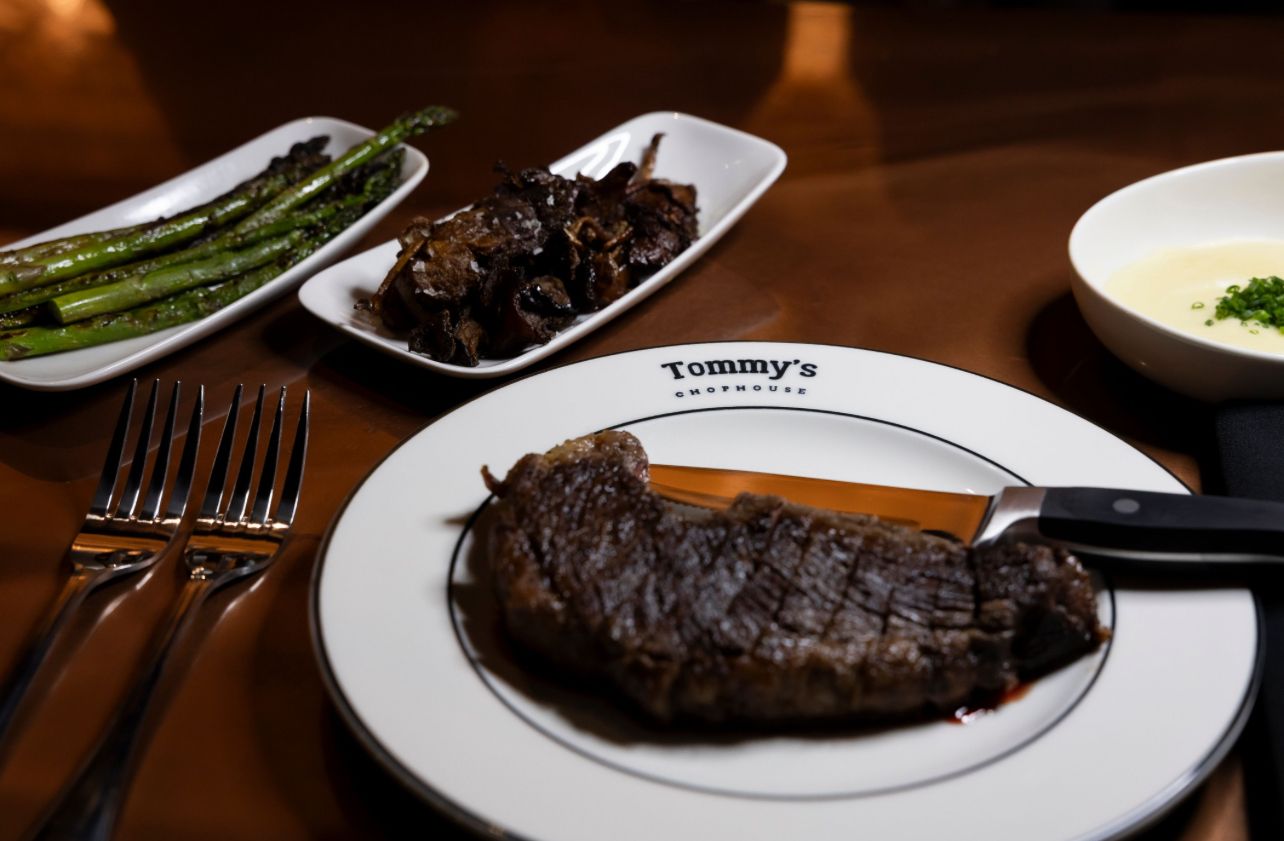
He needs Tommy’s to work for both occasions. A restaurant trying to become part of a neighborhood cannot depend entirely on anniversary dinners, especially while beef prices remain high. The pricing only works if Emery gets repeat business, which makes the apartments outside his door part of the restaurant math. Those 766 units at The Stevedore and Olivette create potential regulars, people who may need dinner on an ordinary Tuesday as much as a destination on Saturday night.
Repeat business requires more than $100 steaks, which is why the chicken, lasagna, hanger steak and picanha matter. Chastain’s family comes from North Carolina and his wife’s family is Peruvian, while the menu also draws on Caribbean, Italian and Florida ingredients. A pork chop comes with braised greens and cornbread. Chicken carries Peruvian influence. Dessert can combine peanut praline, guava caramel, strawberries and Florida citrus.
“We want to give people the ability to taste what their home actually tastes like,” Chastain said.
Writing that menu is easier than sourcing it. Chastain said finding a small producer can begin with a Google search, word of mouth or “a guy who knows a guy who knows a guy.” Red’s Farm in Riverview supplies chicken from a small family operation, and Emery said the birds can move from the farm to Tommy’s in less than a day.
Buying the shrimp requires more work. Tommy’s buys from the Versaggi family, which Emery said once operated 30 shrimp boats and now has five. When Emery asked what Tommy’s could buy that would actually help their business, the answer was smaller shrimp. Large shrimp sold easily. Smaller shrimp did not. Tommy’s agreed to buy a size down.
Emery asks ranchers the same question: What do you need to move? He then looks for ways to build those cuts into the menu. That approach helped make hanger steak Burwell’s bestseller and now gives Tommy’s highly marbled picanha Emery can keep below $60.
The approach gets harder once Tommy’s needs more product than a small supplier can provide. Emery likes beef from a producer in Ocala, but he said the operation cannot handle the restaurant’s volume. Most of Tommy’s American Wagyu therefore comes from Snake River Farms in Idaho. Chastain runs into the same problem with small farms: A producer may have the product he wants without enough volume to supply Tommy’s consistently.
Florida’s growing seasons narrow the possibilities further. Chastain said the heat makes hyper-local sourcing uneven during parts of the year, sometimes forcing restaurants and their suppliers to widen the radius into states such as Alabama. The menu can begin with food from close to home, but the kitchen still has to find enough of it to serve every table.
None of this makes the restaurant easier to run. Emery said he sometimes drives to pick up shrimp himself, while employees may travel farther for fish and other products that would be easier to order from a broadline distributor. “No truck. No hiding it in your warehouse for three days,” Emery said. “We want it now. Today. Off that boat. So it’s just that crazy. And that’s a lot of work.”

The work does not disappear once the ingredient reaches the kitchen. Chastain has to find the farm, place the order and coordinate pickup or delivery. Someone has to butcher and prepare the product, while the dining room has to explain why that chicken or shrimp costs more than something that could have arrived on a distributor’s truck.
The hardest cost to recover may be the one diners cannot see. A customer can taste the shrimp without knowing whether it came off a nearby boat or crossed an ocean in a container, just as the chicken can arrive from Riverview without the customer knowing where it was the day before. “If you don’t tell every table,” Emery said, the additional effort can disappear into the price.
The Kress building imposed another constraint on what happened after those ingredients arrived. Emery could not easily vent a wood-fired kitchen through three occupied floors. Burwell’s uses wood fire, deliberately putting smoke into steaks and other dishes. Tommy’s could not reproduce that setup, so the kitchen went electric.
Chastain had to adapt without the smoke, and Emery came to prefer what the cleaner cooking did for fresh ingredients. Shrimp, oysters and chicken no longer had to compete with another dominant flavor. “The cleaner the cooking and the less smoke, the more true flavor of where it comes from,” Emery said. “Why impart that with smoke, rather than let that speak and shine?”
Other businesses are filling in the hours around Tommy’s. Foxtail Coffee, Tico’s Bakery and Kaia Bowls give Seventh Avenue places that operate before dinner. Mise en Place has moved its longtime fine-dining restaurant to Ybor, while Tokyo Swim Club is planned above it in the Casa Gomez building. Darryl Shaw, the Tampa developer behind Gasworx and the restoration of the Kress building that houses Tommy’s, said Emery recognized something familiar in the district’s evolution. “He saw the evolution in Charleston and sees the changes taking place in Ybor,” Shaw said.
Emery wants the bars to remain, but he wants restaurants, retail and residents using the same blocks alongside them, closer to the neighborhood economy he associates with old Ybor, when cigar workers lived near the factories and spent their money around the district.
“They lived and died and breathed and worked here,” Emery said. “It was a community driven by workers.”
The apartments give Emery reason to believe Ybor can support more daily restaurant traffic, but they also create the timing problem Tommy’s has to survive. Asked what he says to diners who might like the restaurant but no longer want to come into Ybor because of the clubs surrounding it, Emery did not dismiss the concern. “That’s what scares me,” he said.
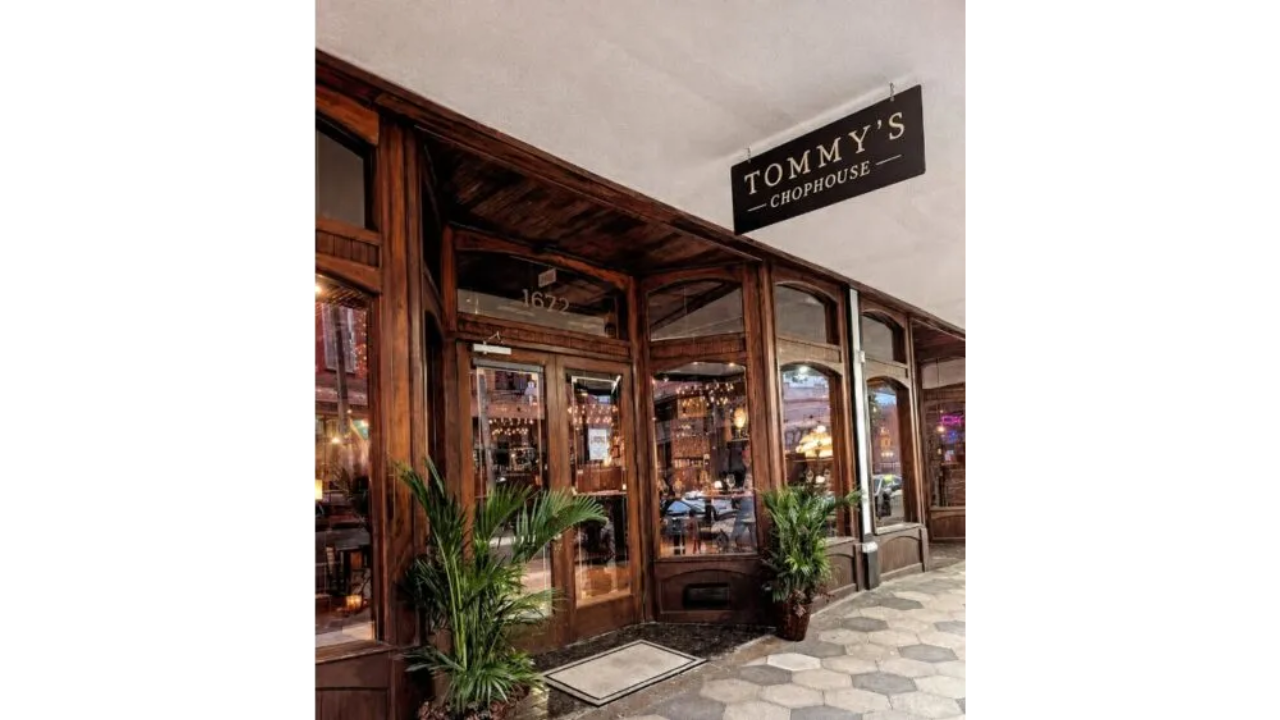
For now, Tommy’s needs some of the diners who have stopped coming to Ybor. Emery can keep a lasagna below $35 and highly marbled steaks below $60. Chastain can buy chicken from Riverview, search for small producers and widen the radius when they cannot supply enough. Emery can drive for shrimp himself. None of it fills the apartments faster or changes the nightlife surrounding Seventh Avenue.
In Charleston, Emery had 500 feet to overcome. He decided Burwell’s had to become good enough that diners would keep walking when they otherwise would have turned around. “I needed to be worth going to,” he said.
Ybor asks more of him. Tommy’s can give people another reason to come to Seventh Avenue, but one restaurant cannot determine what the street becomes. The apartments have to fill. Other restaurants and retailers have to survive. Most immediately, the diners who say they want something different from Ybor have to show up while those businesses are still trying to establish themselves.
“You change things by action, not avoidance,” Emery said. “By coming down and supporting any business that’s trying to turn this around, you turn it around.”
Youth Soccer Tournaments Bring $43M to Hillsborough County
The World Cup has drawn the country’s attention to professional soccer. In Hillsborough County, the business supporting the sport begins with thousands of children whose families spend an estimated $43 million a year on club dues, tournaments, equipment and travel.
That spending supports about $66 million in modeled economic activity, according to a TBBW analysis. Visiting teams and spectators account for an estimated $16.5 million, the largest share of the direct spending. Registrations, dues, camps and training add $14 million. Local families spend another $7.4 million on equipment, meals and transportation, while tournament fees, field rentals, parking, concessions, sponsorships and merchandise contribute about $5.1 million.
The business beneath the World Cup operates every weekend on youth fields. Hillsborough tournaments draw hundreds of teams, fill hotel rooms and restaurants and put local players in front of college scouts. The same schedule can price families out of the coaching and competition that attract those recruiters.
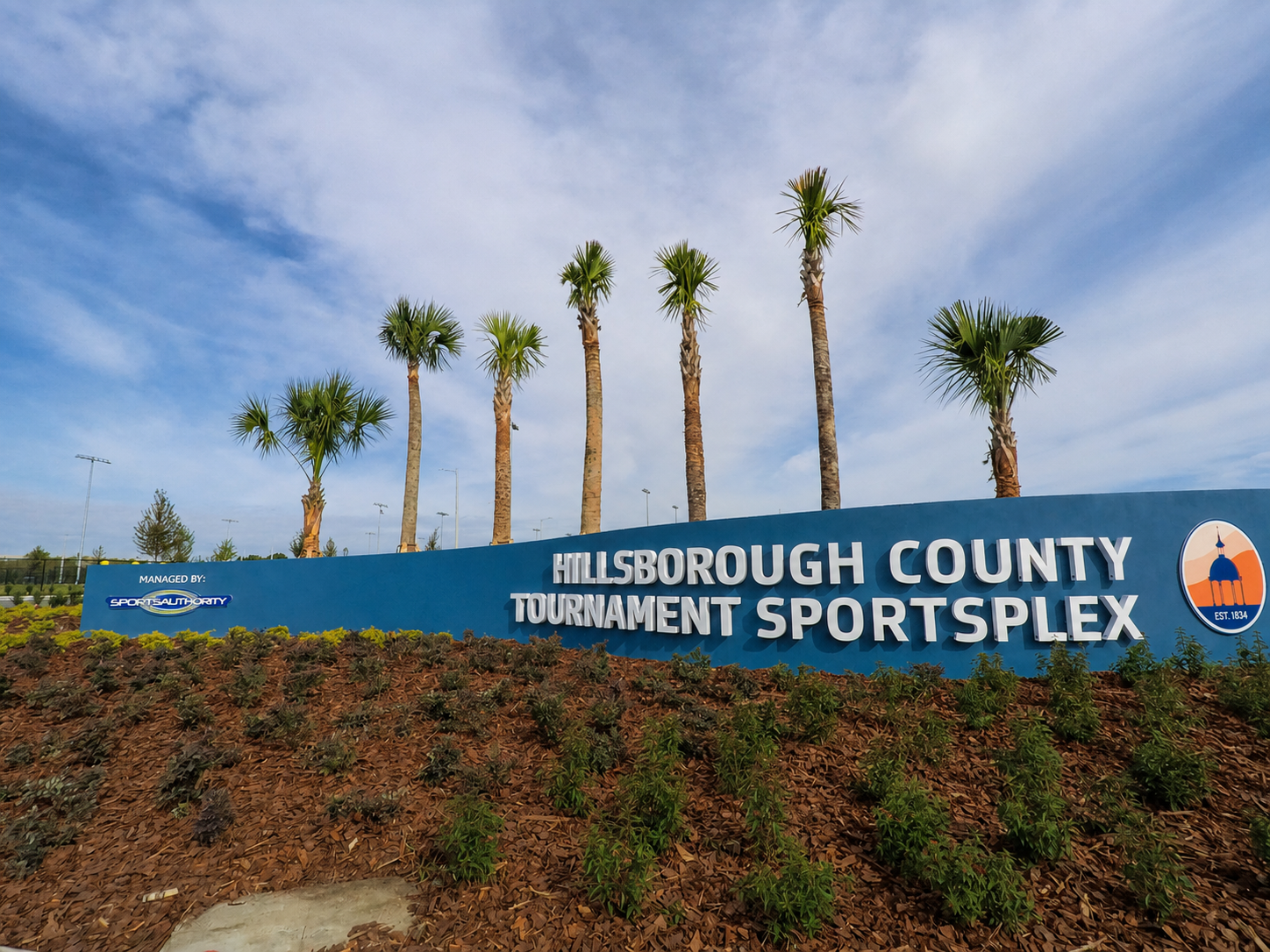
Florida Premier reported that its 2025 Tampa Bay Super Cup drew more than 1,000 teams, 15,000 players and 150 college scouts from more than 35 states and five countries over three weekends. The 2025 US Youth Soccer National Presidents Cup brought 104 qualifying teams to the Tournament SportsPlex for five days. The Tampa Cup advertises more than 200 teams from at least 20 states and Canada.
Those events sit within a calendar that shifts from league play in the fall to near-continuous tournament travel in the spring, said Christina Unkel, president and general manager of Tampa Bay Sun FC. “Spring turns into tournament season,” Unkel said. “It’s tournament after tournament.”
TBBW estimates that youth-soccer tournaments produce about 42,000 hotel room nights and $6.4 million in room revenue each year in Hillsborough County. The county’s 6% tourist development tax would add about $386,000, subject to exemptions available to qualifying organizations.
Sporting events held at the Tournament SportsPlex generated more than 88,000 room nights in fiscal 2025, according to the facility. Because the county does not break out youth soccer, TBBW calculated those stays from tournament records and used Visit Tampa Bay data to set the nightly rate at $152.
Families incur many of those costs before they reach a hotel. The Adidas Champions Cup charges teams between $895 and $1,195 to enter, along with referee fees ranging from $105 to $265 per game per team. Hillsborough County charges $275 per tournament field per day before lighting, staffing, security and concession expenses. Club dues, coaching, uniforms, equipment, gasoline, airfare, lodging and meals raise the bill further.
At the midpoint of TBBW’s estimate, registrations, dues, camps and training average about $1,120 per Hillsborough player. Equipment, meals and local transportation add about $592, bringing the combined average to $1,712 before some tournament expenses are assigned. Families who cannot sustain the dues, travel and tournament schedule often lose access to advanced coaching and competition.
American youth soccer’s pay-to-play system ties advanced coaching, competition and recruiting exposure to what families can afford. Selective clubs offer stronger competition, but year-round dues and travel can end a player’s path before ability determines how far he or she advances, Jenni Luke, national executive director of the American Youth Soccer Organization, told Front Office Sports.

“In a traditional pay-to-play system, access to coaching, competition and exposure is often correlated to a family’s ability to pay,” Luke said. “A child should not have to earn the right to participate.”
Unkel sees the divide among players moving through Tampa Bay’s soccer system. Some pursue college scholarships or professional careers, while others prefer recreational leagues. Between them are players who want stronger coaching and competition but whose families cannot sustain the travel, fees and time required by many competitive clubs. “They end up either fizzling out, or they just kind of never get identified,” Unkel said.
U.S. Soccer officials have responded by promoting stronger competition closer to home. Dan Helfrich, the federation’s chief operating officer, told Front Office Sports that national and regional events can impose unnecessary hotel and transportation bills on younger players, particularly in metropolitan areas with enough teams to play competitive schedules locally.
Soccer organizations elsewhere have begun testing ways to preserve competition without requiring as much travel. Evan Dabby, executive director of New Jersey Youth Soccer, said multiple memberships, leagues and tournaments add costs throughout the sport. “The fragmentation and all the different memberships and leagues and competitions, I think, is creating more barriers,” Dabby said. “It’s creating higher costs to play.”
New Jersey Youth Soccer has responded by creating a statewide competition for clubs from different leagues. The organization has also held registration fees flat for a decade through sponsorships and public funding that help cover fields, insurance, equipment, referees, coaching and administration.
In Hillsborough, those expenses are spread across an estimated 10,000 to 15,000 youth players and 650 to 1,000 teams. The midpoint estimate places the number of players at about 12,500. Because one team may enter several tournaments, the analysis estimates that Hillsborough teams generate between 1,500 and 2,500 tournament entries each year.
No countywide registry tracks every player. TBBW based its estimate on statewide registrations, county demographics, public recreation programs and club records and accounted for players outside the Florida Youth Soccer Association. The estimated per-player expenses exceed the broad national average because Hillsborough’s market includes higher-cost competitive programs as well as recreational leagues.
Tampa Bay United reported $4.36 million in program-service revenue in fiscal 2025. Florida Premier reported $6.94 million in total revenue in 2024, including revenue from areas outside Hillsborough. TBBW did not add the full amounts to its spending estimate because some club revenue already appears in the calculations for camps, tournaments and sponsorships.
Hillsborough’s thousands of youth players also give Tampa Bay Sun FC a pipeline of academy prospects and paying fans. Unkel estimates that the Tampa Bay region has roughly 230 youth teams, connecting the professional club with thousands of players, parents and coaches who already follow the sport. “The youth side of it, what impacts us the most, is truly the fan,” Unkel said.
Young players and their families buy tickets and merchandise and can continue following the club after their playing years end. Some players also enter the professional development system through the USL Super League’s academy contract, which allows players younger than 18 to train and compete professionally without losing NCAA eligibility. Unkel said Tampa Bay-area players make up about 80% of the Sun’s academy roster.
The $43 million spending estimate is the midpoint of a range from $29 million to $58 million. Applying a 1.53 multiplier produces an estimated $66 million in business activity at the midpoint and a range from $44 million to $89 million.
TBBW derived the 1.53 multiplier from Tourism Economics’ 2025 Hillsborough County visitor model, which found that $6.05 billion in visitor spending supported $9.49 billion in business sales. TBBW used a slightly lower multiplier than the implied 1.57 and reduced the county estimate to account for spending that tournaments may send to hotels and fields in Pinellas, Pasco and other counties.
Hillsborough residents account for part of the $43 million, so the figure should not be read as $43 million brought into the county. Separating visitor spending from local spending would require attendee ZIP codes, hotel booking records, actual room rates, spectator totals and tournament expense reports.
The available records show where the money moves: through club dues, tournament registrations, field rentals, hotel charges and restaurant tabs. Families finance much of that business, including the costs that determine which children can continue playing.
Bonu’ Brings the Heart of Italy to St. Petersburg
As high-rises continue to pepper the Central Avenue corridor, one corner of downtown still feels like it belongs to another country entirely. Bonu’ brings the comfort of traditional Italian cooking to the heart of Central Avenue, and it does so with the kind of warmth that no amount of new construction can crowd out.
It’s a family partnership: Brothers Antonio and Luca Martucci partnered with husband-and-wife team Mario and Mia Maccarrone to open the restaurant in the space formerly occupied by Cider Press Cafe. The family vibe it exudes isn’t a marketing line. The owners can regularly be found greeting customers and making sure the room feels the way it did on opening night. Their goal was simple from the start: bring a genuine taste of Italy to the heart of the city. It shows in the details, from the house-made pasta to the hand-pressed pinsa, a centuries-old Roman-style pizza dough known for its light, crackling bite.
That same sense of hospitality extends to the expansion, where Senza Fine, Italian for “without end,” offers a sophisticated setting for every occasion, from corporate buyouts and cocktail receptions to business dinners, wine tastings and milestone celebrations. The space has quickly become known for its monthly wine tasting, a three-course dinner capped at 30 guests and built around a different region of Italy each time. It sells out every month. For guests who want a hands-on experience, Bonu’ also runs a mixology lab, where they learn to build the restaurant’s signature cocktails themselves rather than simply order them off the menu.
Back in the kitchen, the commitment to authenticity starts long before a dish reaches the table. The pasta and sauces are made in-house daily, and the pinsa dough gets its signature texture from a specialty flour milled in Rome. Blended with rice flour and a third supporting grain, the flour is Bonu’s closely guarded secret. It’s what gives the crust its light, gluten-friendly character and sets it apart from every other pie in the city.
The attention to ingredients carries through a menu that rotates seasonally and pulls from Southern Italy’s full range of flavors. The Tomino, an oven-baked wheel of soft Piemontese cheese wrapped in speck and finished with balsamic, is exclusive to Bonu’. The Anguria pairs watermelon with goat cheese, pistachio pesto and basil sorbet for a starter that reads more like a composed dessert. Then there’s the Porcini, where dried porcini and mixed mushrooms simmer in a cream sauce finished with truffle oil, the earthy layers of the mushrooms unfolding across the fettuccine like a slow, deliberate symphony of flavor. The Toto Ripiena is something you won’t find anywhere else in the city: that same pinsa dough, butterflied and filled with stracciatella, arugula and prosciutto di Parma. And for guests craving the classics, there’s Saltimbocca, the traditional Italian dish of veal scaloppine, prosciutto and sage finished in a white wine sauce. Taken together, it’s a menu that doesn’t just reference Italy; it transports you there, one carefully considered bite at a time.
In a city that keeps building upward and outward, Bonu’ has planted something rare: a restaurant that feels like it was always there. It is a place where craftsmanship matters, where recipes are treated as traditions rather than trends and where the people behind the dining room remain personally invested in every table. From a carefully made plate of pasta to a sold-out Italian wine dinner at Senza Fine, Bonu’ is doing more than bringing Italian food to St. Petersburg. It is creating a little corner of Italy and inviting the city to stay awhile.
Ralph Lauren & Busch Gardens
Hyde Park Village adds Ralph Lauren
Ralph Lauren has opened at Hyde Park Village, adding one of fashion’s most recognizable names to a shopping district that continues building one of Tampa Bay’s strongest luxury retail lineups.
The retailer joins LoveShackFancy, PAIGE, Rag & Bone, Reformation, FRAME, Hill House Home and Studs, adding to Hyde Park Village’s growing concentration of luxury fashion and lifestyle brands.
The store carries Ralph Lauren Women’s Collection, Men’s Purple Label and men’s and women’s Polo Ralph Lauren apparel. The design draws inspiration from nearby Tampa Bay marinas, combining cherry wood, white millwork, brass hardware and light maple floors with nautical details including a suspended racing scull and oars, decorative accessories and curated artwork.
For Hyde Park Village, Ralph Lauren adds another globally recognized retailer to a shopping district that has steadily attracted higher-end fashion, dining and lifestyle brands.
Ralph Lauren is open from 10 a.m. to 6 p.m. Monday through Saturday and noon to 6 p.m. Sunday.
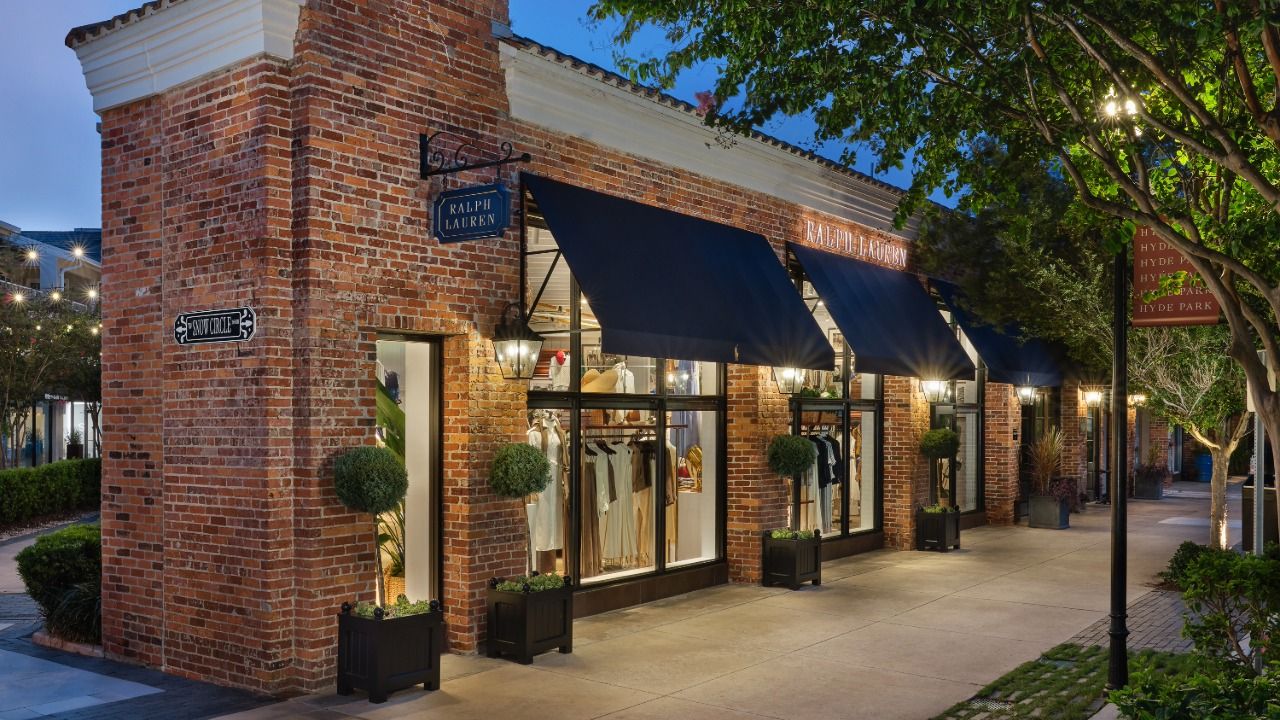
Busch Gardens opens Lion & Hyena Ridge as part of $200M park overhaul
Busch Gardens Tampa Bay has opened Lion & Hyena Ridge, a 38,000-square-foot habitat that marks the first major project in the theme park’s planned $200 million, five-year redevelopment.
The new exhibit features five lions and two spotted hyenas, with 270-degree glass viewing areas, overhead bridges and interactive cave spaces. The habitat also includes climbing structures, water features and heated and cooled rock formations designed to support the animals’ well-being.
Busch Gardens said the $200 million investment will bring additional attractions, animal habitats and guest experience improvements to the park over the next five years.

Sarasota Mansion With No Hallways Hits Market for $18.95M
Newly built waterfront home Lunara has hit the market for $18.95 million in Sarasota’s Sapphire Shores neighborhood, offering 7,428 square feet across four levels overlooking Sarasota Bay.
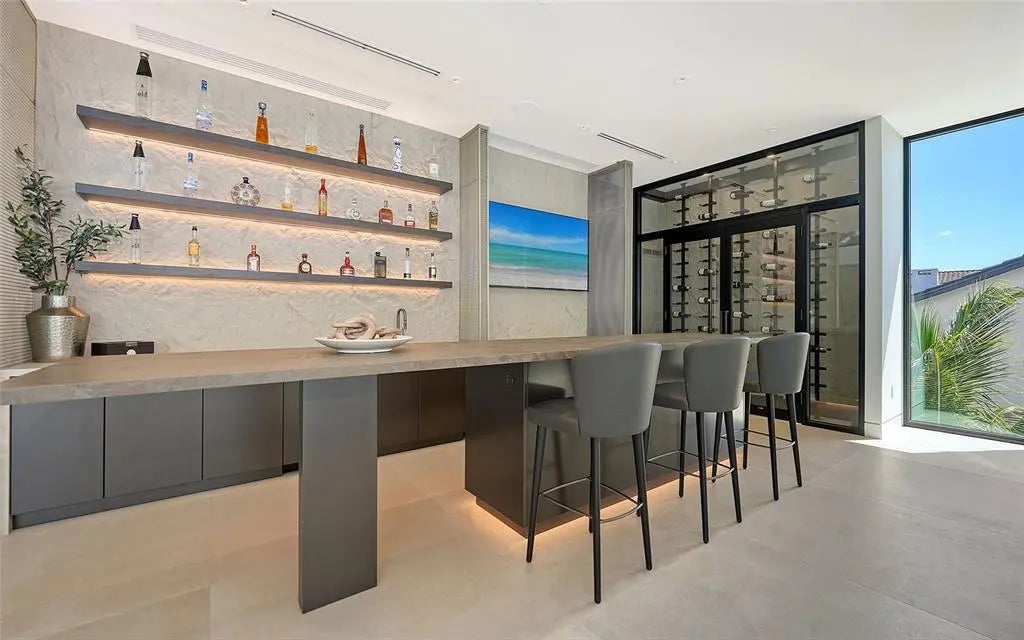
Upstairs, the main living area rises two stories beside a wall of windows facing Sarasota Bay. An 11-foot automated glass wall opens onto a trellised sun deck, with the interior and exterior floors built at the same level. Black framing traces the glass and balconies throughout the house, while an open second-floor gallery looks down into the living room and toward the water.
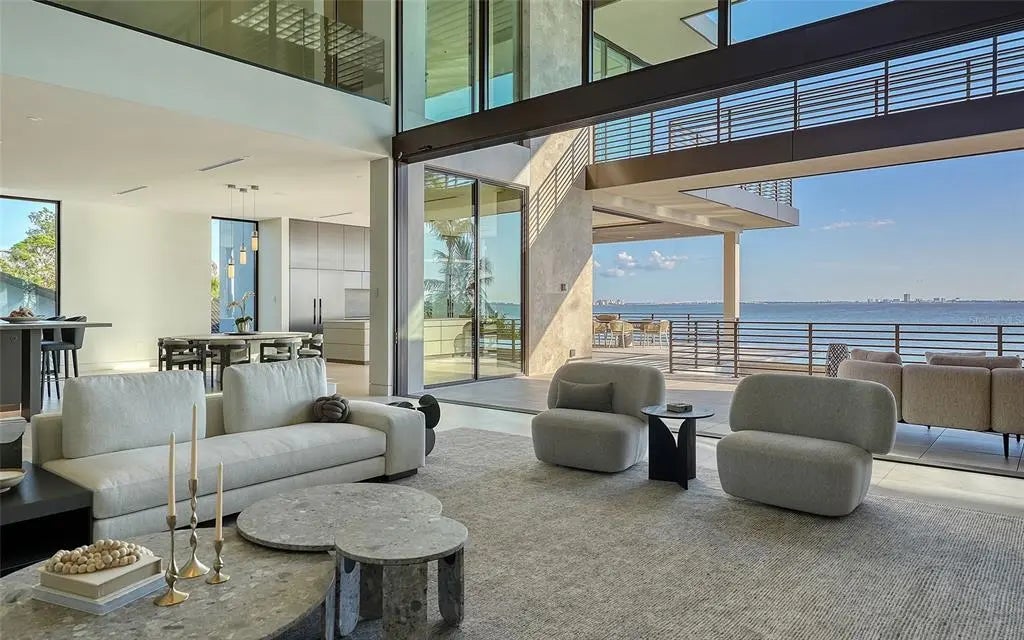

Those connected spaces trace back to a no-hallway design directive for the 7,428-square-foot home at 388 S. Shore Drive, according to the listing provided by Smith & Associates Real Estate. Architect Mark Sultana of DSDG Architects designed Lunara, and Michael Voigt of Voigt Brothers Construction built the five-bedroom residence in 2025 on a 0.46-acre waterfront lot.
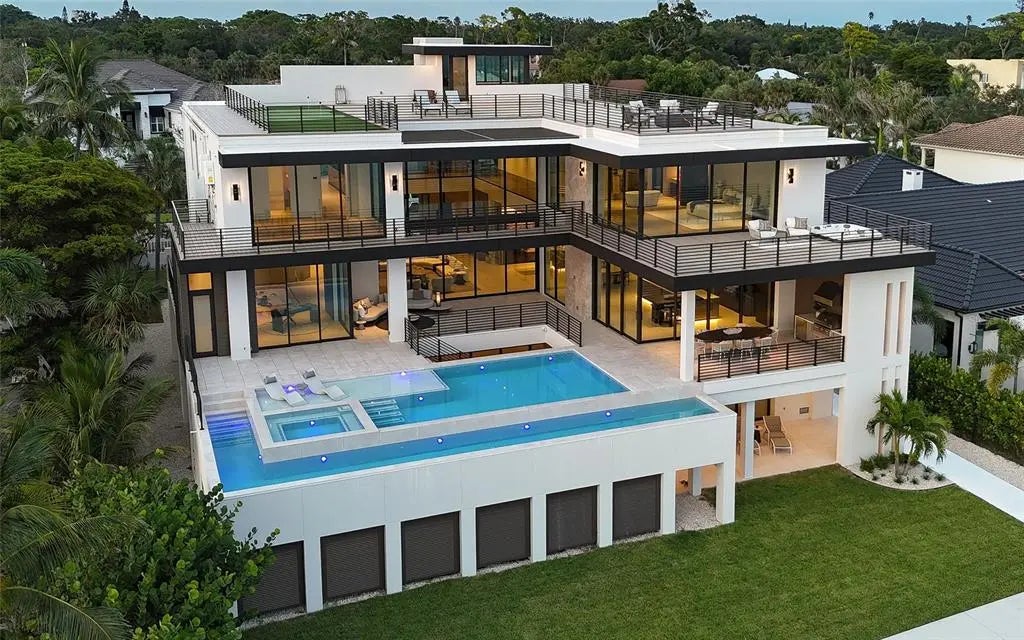

The kitchen shares the bay view through floor-to-ceiling glass and opens directly onto the waterfront terrace. A retractable pass-through connects the main kitchen to a concealed prep kitchen, while an entertainment bar has floating liquor shelves beside a climate-controlled wine display. Elsewhere, a movable wall of privacy glass in the primary bathroom can open the room to the view or screen it from sight.

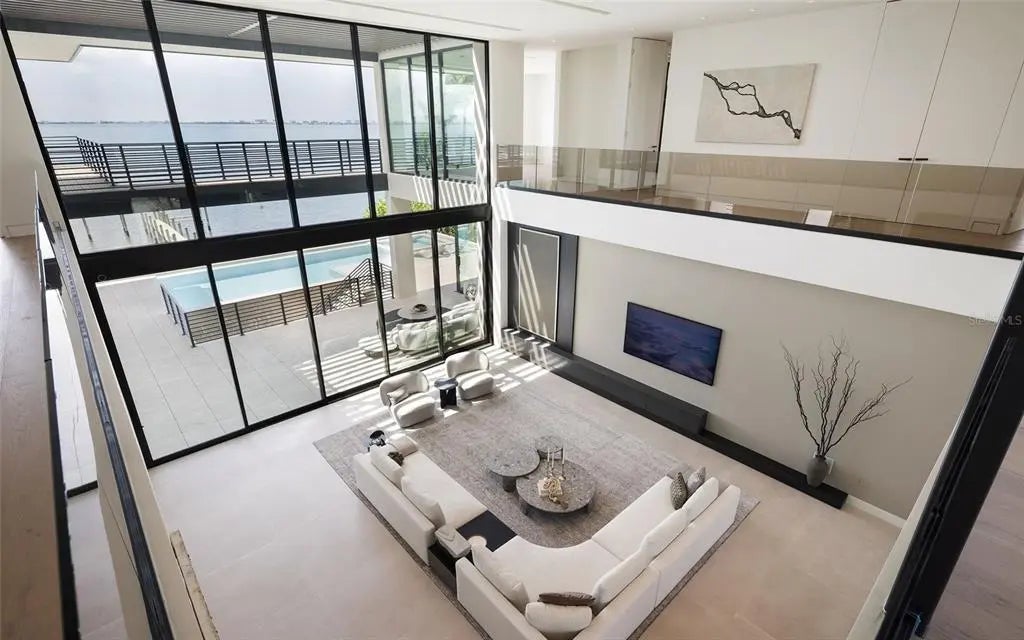
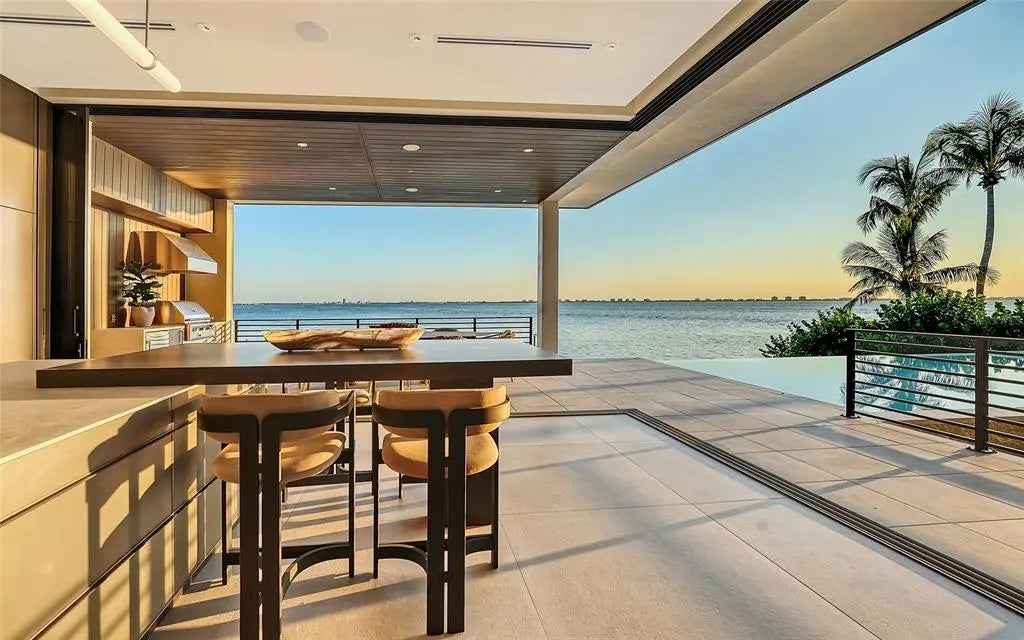
The pool occupies two levels, cascading from an infinity edge into a lap lane below, while terraces extend across multiple floors before reaching a rooftop with a putting green, fire pit and additional entertaining space. A glass elevator connects the four levels, and among the home’s more specialized storage is a closet built specifically for a Christmas tree.
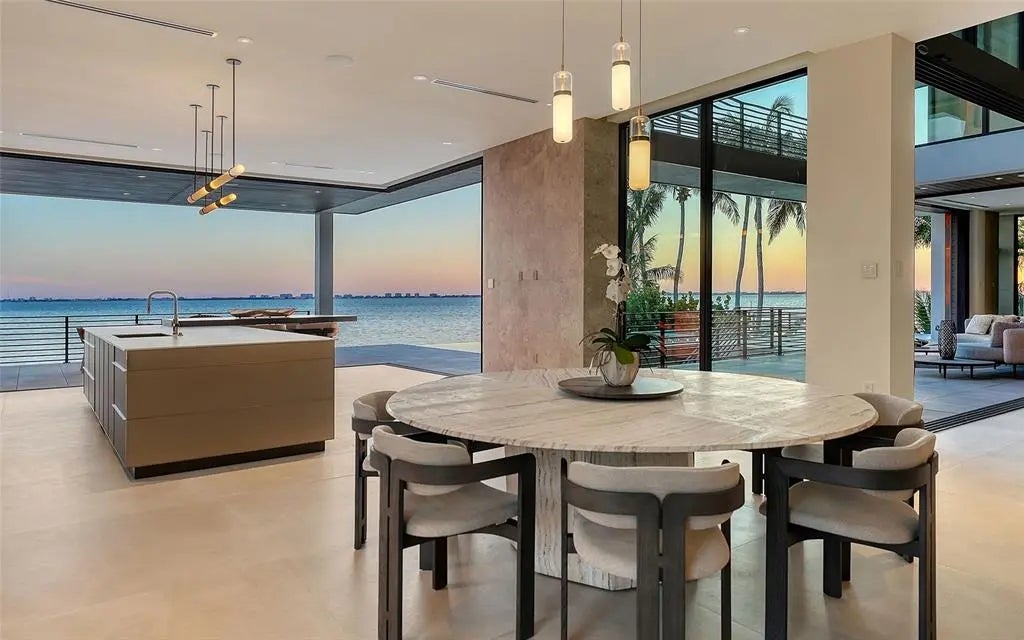
Premier Sotheby’s International Realty holds the listing. Property details and photos were provided by Smith & Associates Real Estate.
CEO Connect
Rob Higgins
USF’s CEO of Athletics discusses leadership, health, the on-campus stadium and the university’s national ambitions.
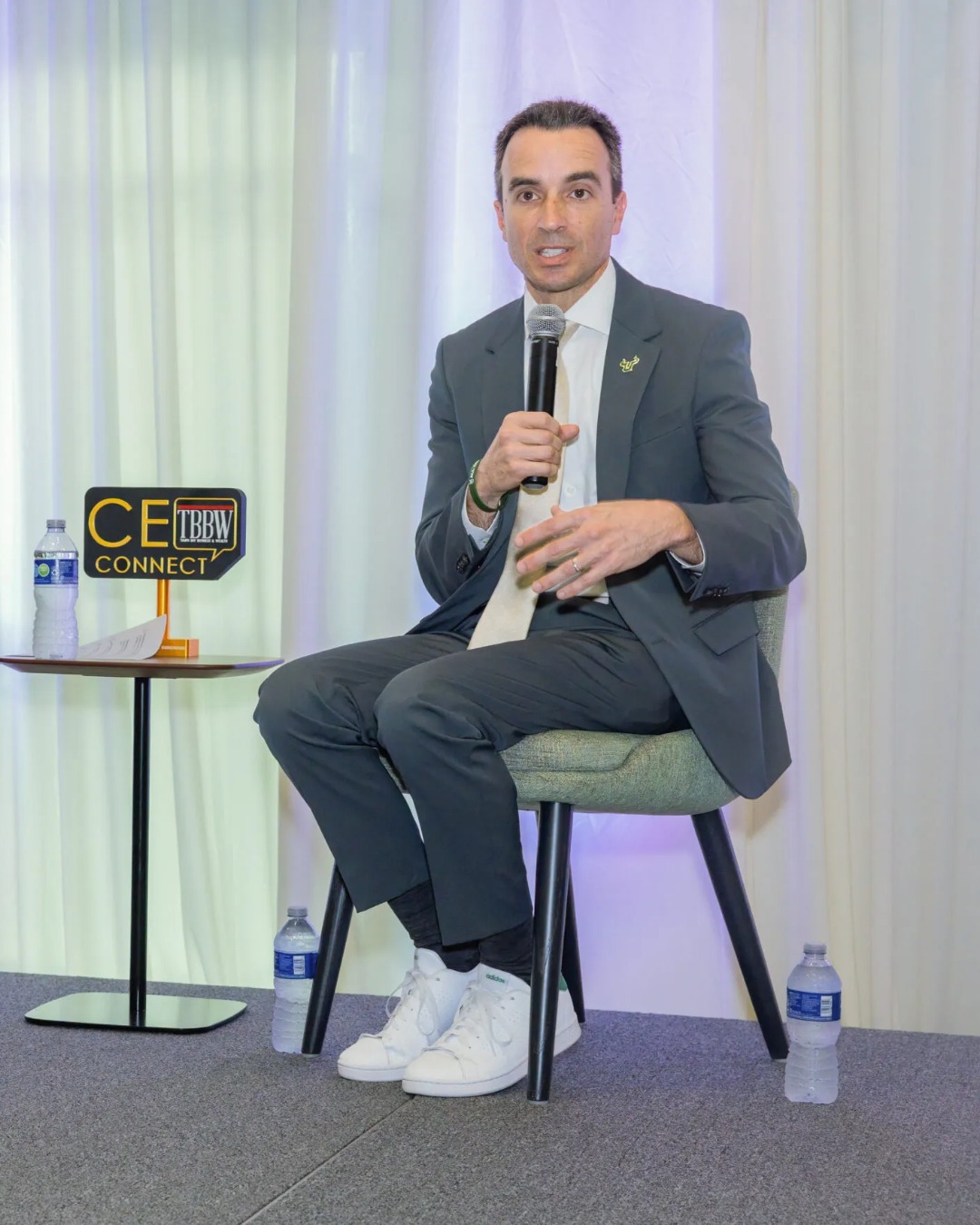
Presented by
Rob Higgins on USF, leadership and what comes next
Open a question to begin reading.
You first became part of USF Athletics as an 8-year-old ball kid. What does it feel like to return as CEO of Athletics?
I still feel like that little kid. USF is a place where an 8-year-old can have a dream, pair it with an education, work hard and surround himself with the right people. When I look back, I see how many people supported me and gave me a chance. I started by cleaning floors. Once I did that well enough, they let me clean the locker room. Then they let me do the laundry. Every step taught me that you get what you work for, not what you wish for.
I also look at it with gratitude. My wife, Casey, has been the ultimate teammate, and we will celebrate our 25th anniversary in September. None of this happens without her support. The same applies to the people I worked with across Tampa Bay and at USF. I cringe when a biography says Rob did this or Rob did that. We did those things together. The unity within this community has always been the backbone of the work.
USF gave you the title CEO of Athletics rather than athletic director. What does the title mean?
College athletics has changed so much that the old title no longer captures the job. Athletic departments now have an opportunity to compensate student-athletes, but that also creates new revenue demands. We still have to recruit great talent, hire strong coaches, support academics and create a high-level experience for student-athletes and fans. Those responsibilities remain, but the enterprise has grown around them.
USF Athletics is a nine-figure business with extraordinary affinity. People do not buy season tickets or jerseys for most Fortune 500 companies. They do for universities. That passion creates a responsibility to serve students, alumni, donors and fans at a high level while operating with the discipline of a chief executive. USF recognized where the job was going and put the right title on it. Since then, other schools have started moving in the same direction.
You have said USF should measure itself by performance rather than potential. Why?
Potential has a time and place, but it can become an immeasurable standard that delays accountability. USF has about 50,000 students and roughly 400,000 living alumni. The university has joined the Association of American Universities and continues to grow its academic and research profile. At this point, we should measure ourselves by production, performance and results.
That means setting real goals, establishing standards and asking whether we won the day. Rankings have value, but we have to be accountable for what we produce across athletics, academics, fundraising, facilities and the student-athlete experience. The days of talking about what USF might become are behind us. We are responsible for what we do now.
Your cancer diagnosis became a major part of the cover story. Why have you chosen to speak about it publicly?
I want people to understand their family history and prioritize their health. I had not been to a doctor since I was 15. In sports, you are taught to be tough and work through pain, and I treated avoiding the doctor like a badge of honor. That was foolish.
I learned about my family history during my father's first oncology appointment after his bladder cancer diagnosis. The doctor asked about relatives, and I learned that my grandfather had died from colon cancer at 53. I started reading about hereditary risk during the appointment and realized I should have been screened earlier. I scheduled a colonoscopy, and doctors found a four-centimeter tumor. They later learned the cancer had spread to my lymph nodes.
The diagnosis changed the way I thought about health and family. I was not afraid for myself as much as I was concerned about what it would do to my wife, my children and everyone around me. My father and I went through treatment on nearly the same schedule, with him about two weeks ahead of me. We are both clean now, and we continue to get screened every three months.
The easiest appointment to postpone may be the one that saves your life. Your family needs you. That means knowing your history, going to the doctor and putting health and family first.
What will the on-campus stadium mean for USF?
It will give USF football the home it has waited for throughout the program's history. One of our original football players, Jacoby Blunt, visited practice recently. I asked when Coach Jim Leavitt had told the team the stadium would be finished. He said 1999. Thousands of players have worn the USF jersey while waiting for this building.
The stadium also will change the student experience. We placed a construction beam at the Marshall Student Center so students could sign it before it was installed in the student section. We thought 500 or 600 students might participate. More than 5,000 signed it in 72 hours. Those students will be able to walk from a residence hall or nearby apartment to watch classmates play in a stadium on their campus.
The project will give alumni a reason to return and see how much the university has changed. USF has about 400,000 living alumni, and many live within driving distance. A home football weekend can reconnect them to the campus, their classmates and the university.
The stadium also creates opportunities beyond six home football games. It can host concerts, professional wrestling, soccer matches and other events that fit a 35,000-seat venue. Its location adds to the effect. The stadium, the Fletcher District redevelopment and the Museum of Science and Industry site place three large projects within roughly three-quarters of a mile. Their timelines overlap, giving the university area a concentration of investment that few communities see at one time.
How does the stadium fit into USF's conference realignment goals?
USF deserves to compete on the biggest national stage. The university checks many of the boxes that matter. Academically, USF is one of two public AAU universities in Florida. From a media standpoint, Tampa is the largest television market in the state, the 11th largest in the country and the second largest in the Southeast. Our athletic performance also is moving in the right direction. USF won six American Athletic Conference championships during the past year, more than any other member of the conference.
Facilities matter, too. USF has one of the strongest athletic districts in the country, and the stadium fills the most visible gap. It is scheduled to open Sept. 4, 2027, against Louisville.
The path forward begins with our current conference. We have to become the best version of ourselves in the American and compete for championships across the department. Success now strengthens every argument USF can make later. We cannot wait for realignment to improve our position. We have to produce results that place us in that position.
What does the stadium mean to the wider Tampa Bay community?
The stadium gives the region another venue for events that may not fit its larger buildings. It can bring people to campus for sports, concerts and entertainment while introducing visitors to a university that supports the regional economy, graduates thousands of students each year and supplies talent to local employers.
USF also can use the stadium to deepen relationships with companies and civic organizations. The university already works closely with Tampa General Hospital, local banks, construction companies, hospitality businesses and other employers. A campus venue creates more occasions for those relationships to grow through sponsorships, events, hospitality and student engagement.
What did your years at the Tampa Bay Sports Commission teach you about leading USF Athletics?
They taught me to focus on service and the work behind the event. During a Super Bowl or Final Four, fans see the field or the court. The people running the event are working through transportation, security, fundraising, sponsorships, hotels and hundreds of operational details. When the Buccaneers won the Super Bowl in Tampa, I did not see a play. I checked the score when I could and returned to the next responsibility.
That experience applies directly to college athletics. The public sees games and championships, but the department has to manage academics, compliance, facilities, fundraising, media rights, name, image and likeness, revenue sharing, travel and student welfare. The event works when those responsibilities come together without drawing attention away from the athletes and fans.
What brought you back to college athletics after 21 years with the Sports Commission?
At the Sports Commission, athletes came to Tampa for several days and then left. At USF, student-athletes may be here for months or four years. That gives us time to serve them daily and support what they want to accomplish in athletics, academics and life.
Their energy reminded me why I entered this work. Wide receiver Mudia Reuben is one example. He transferred from Stanford, chose USF over several other programs and used name, image and likeness money to help bring clean water to his parents' village in Nigeria. When teammates entered the transfer portal, he stayed. College athletics is often discussed through money and movement, but each decision affects a student with goals that reach beyond the field.
You hired five head coaches during your first seven months. What were you looking for?
The turnover was greater than I expected, but the searches gave us a chance to establish what we value. We wanted coaches who had led before and still had something to prove. Some people want to inherit a program with banners already hanging. We wanted people who were attracted to building what comes next at USF.
That mindset fits where the university stands. The stadium is under construction, the athletic district is growing and our teams are expected to compete for championships. We need coaches who see that work clearly and want responsibility for the result.
How has your family's connection to USF shaped your return?
Both of my parents graduated from USF. My sister graduated from USF. I graduated from USF, and I met Casey here while she was completing an internship. Nearly every part of our family's story connects to this university.
When I was a ball kid, I sat under the basket with a towel. If a player fell, I ran onto the floor and wiped up the spot so no one slipped on the next possession. During games, I sometimes looked into the stands and saw my parents watching me even when play had moved to the other end of the court.
My mother died unexpectedly four years ago after a stroke. She did not get to see me take this job, but I know what it would have meant to her. My father still attends games and tells everyone he meets that I am the CEO of Athletics. I am convinced that when I was a ball kid, a manager and now in this role, they were not watching the game. They were watching me.
What do you want Tampa Bay business leaders and USF alumni to do now?
We need people to talk about what is happening at USF and participate in it. That can mean becoming a season-ticket holder, making a gift, supporting a student-athlete, attending events or simply correcting the old perception that USF remains a university waiting for its future.
The university has not always received its fair share of attention in a state dominated by older institutions in Gainesville and Tallahassee. The way to change that is through performance and participation. USF has to win, and the region has to recognize what is already happening here. This is the moment to come get our fair share.
Rob Higgins CEO Connect
Photos from TBBW’s CEO Connect with Rob Higgins at the University of South Florida.
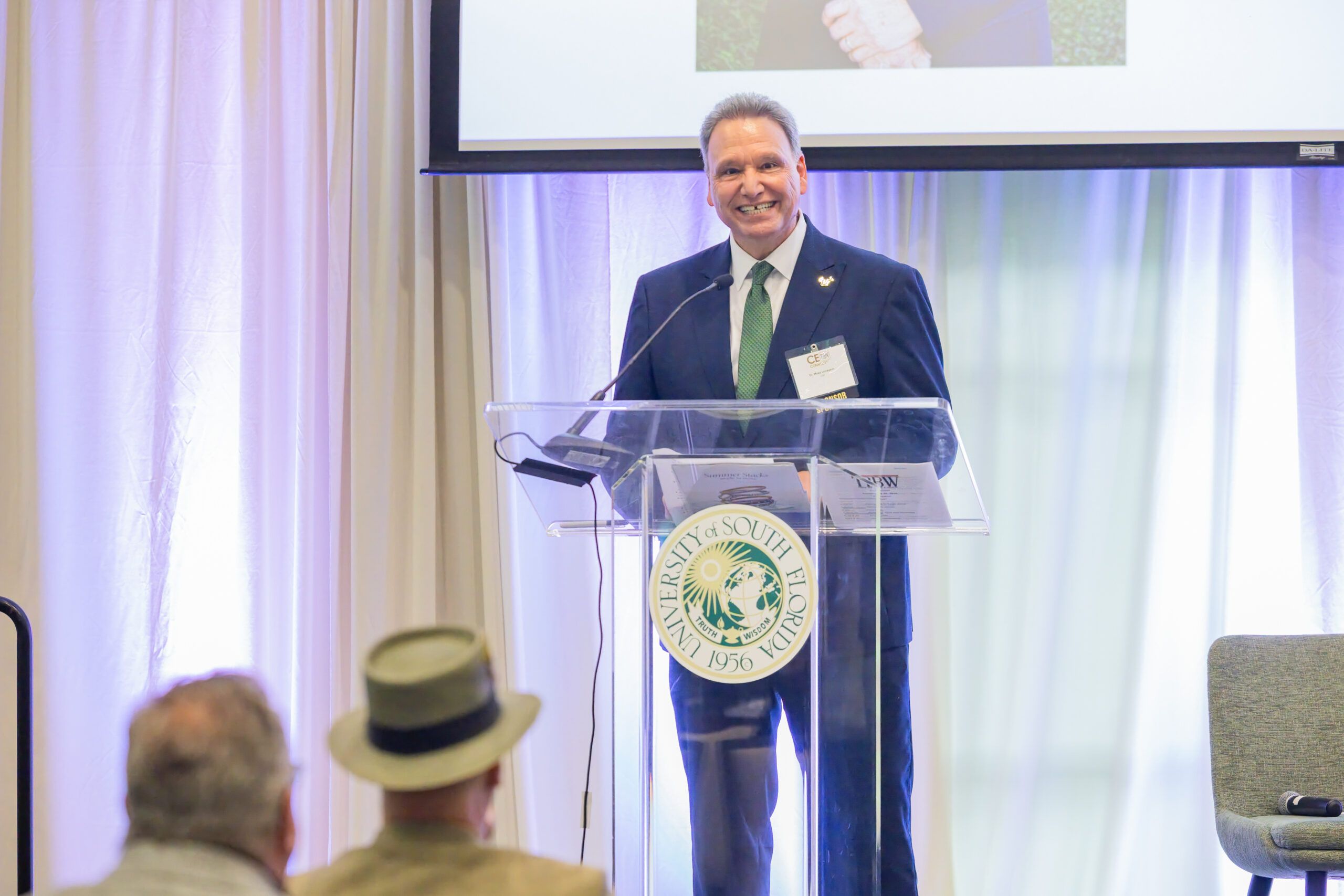




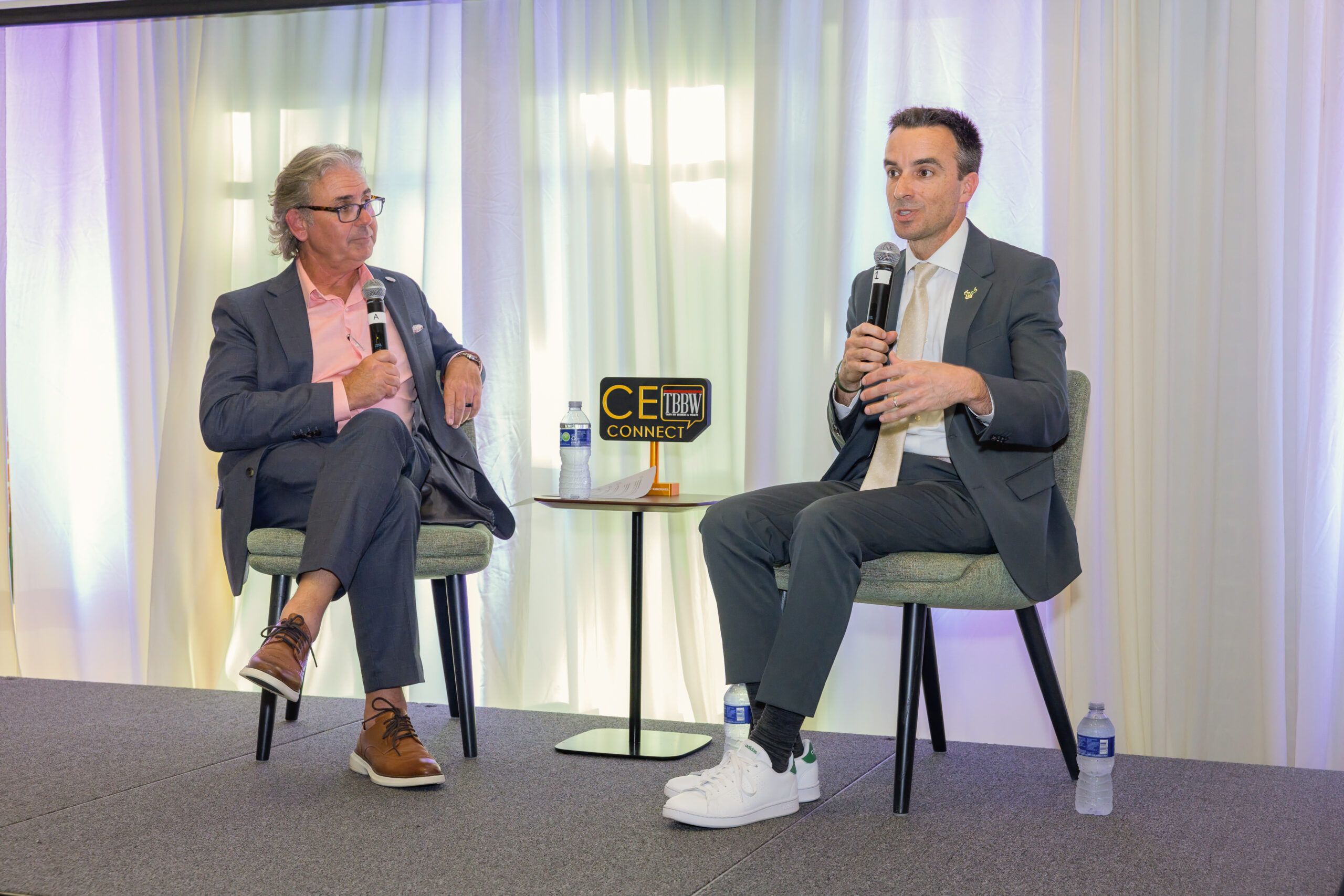


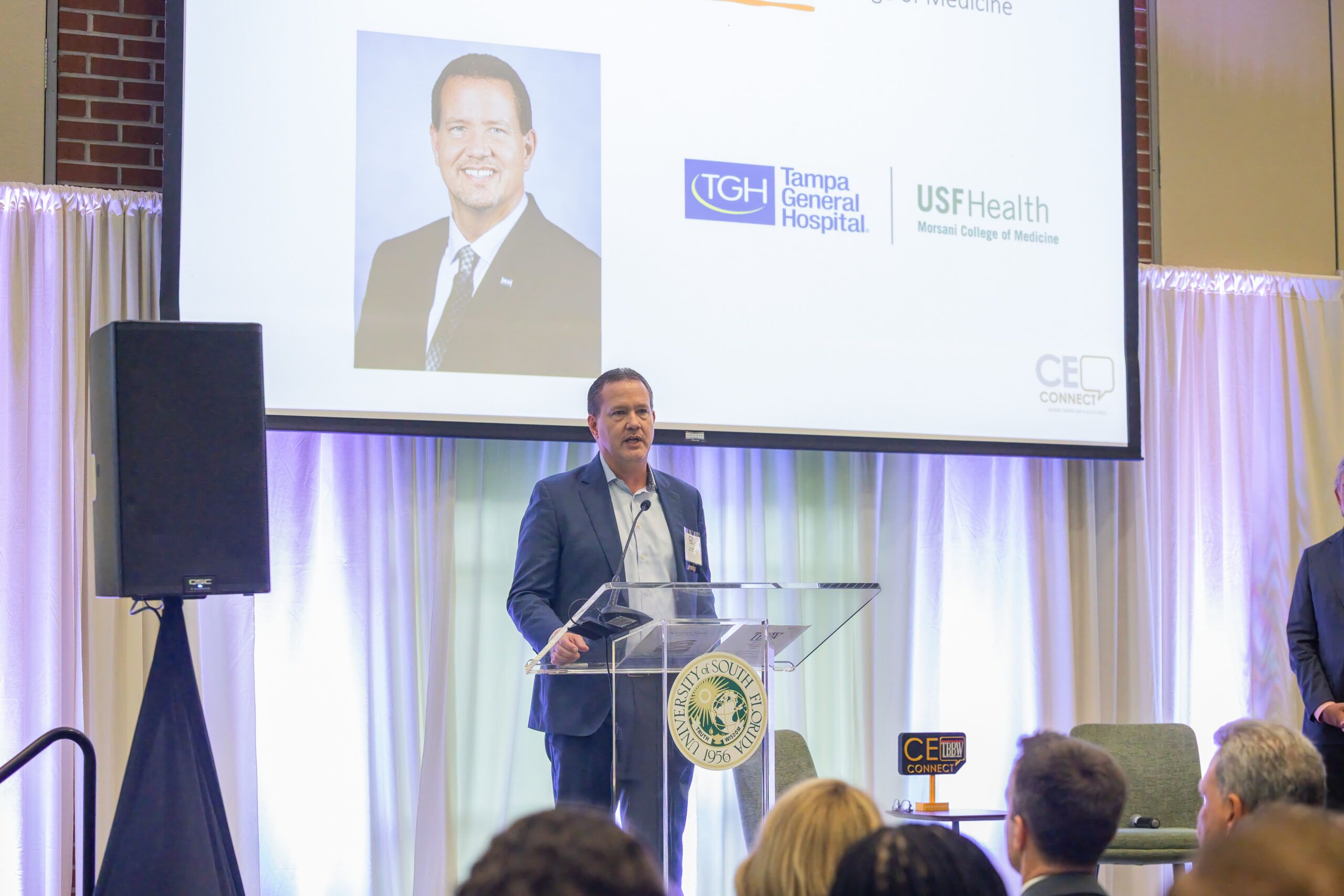
20 Questions with Lanness Robinson
Lanness Robinson joined the Tampa Bay Sports Commission (TBSC) as executive director in December 2025. He previously served as district director of athletics for Hillsborough County Public Schools (HCPS) from 2006 to 2025.
In addition to his athletic administration role, Robinson was elected president of the association in 2020 and led the NIAAA at the beginning of the COVID-19 pandemic. He also served on the staff of the NIAAA Professional Development Academy (PDA).
-
01
College alma mater?
Florida State University (B.S.) and Saint Leo University (M.S.)
-
02
First job?
Summer camp counselor
-
03
Favorite TV show of all time?
College GameDay
-
04
Place in Tampa Bay where you do your best thinking?
Tampa Palms Golf Course
-
05
Most-used phone app?
Sudoku
-
06
Wake-up time on workdays?
5:30
-
07
Habit you rely on when your schedule gets overwhelming?
Write down everything
-
08
First album you bought?
“Candy Girl” by New Edition
-
09
Local restaurant you recommend most often?
Union New American
-
10
Last book you finished?
“The Dichotomy of Leadership” by Willink and Babin
-
11
A decision you would make differently today?
Selling my first house
-
12
First cellphone?
Motorola flip phone
-
13
Skill you had to learn the hard way?
Patience
-
14
Most famous person you’ve met?
Joe Montana
-
15
Last thing that made you laugh out loud?
Unsuccessfully attempting to change my flight home, only to have my original flight canceled and my original seat sold to another traveler. I could do nothing but laugh to avoid getting angry!
-
16
Movie you will never watch again?
“Ponyo”
-
17
Last place you traveled for fun?
Pinehurst, North Carolina
-
18
Charity or cause you support?
Freddie Solomon Legacy Foundation
-
19
Something you were overly confident about early in life?
Being successful
-
20
Best advice you still think about?
Be better today than yesterday.