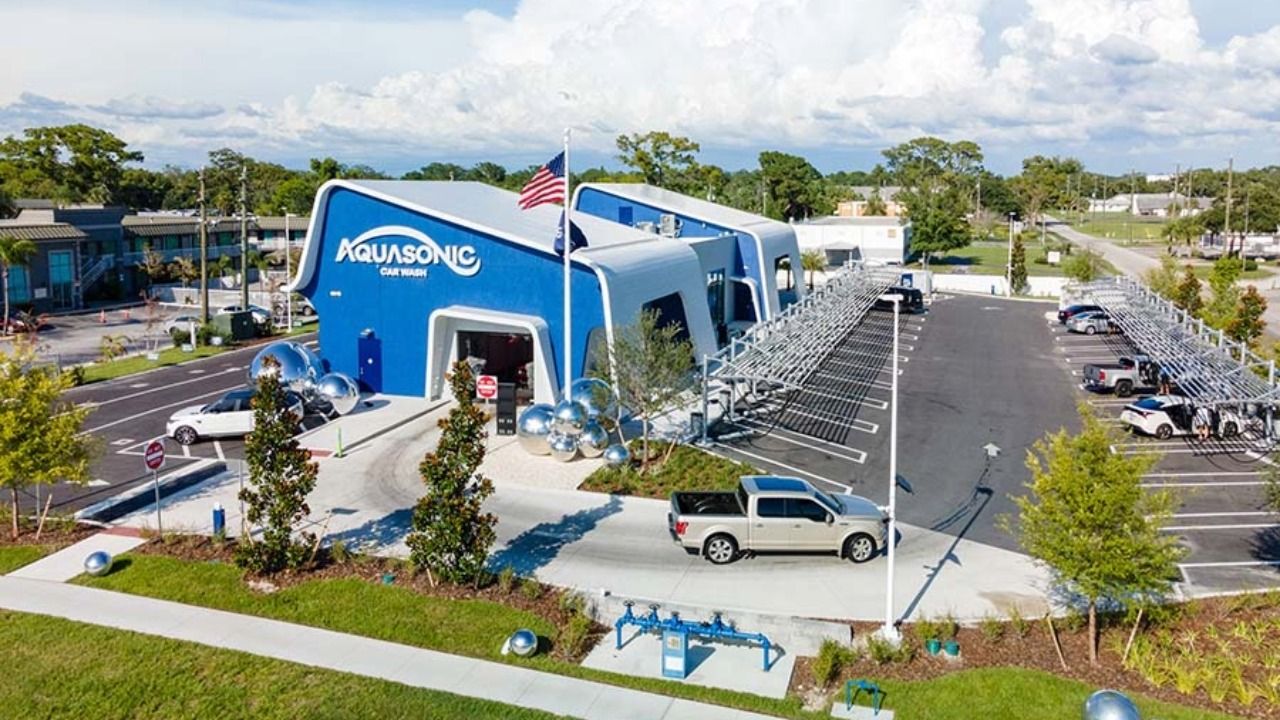
Drive around Tampa Bay long enough and the express washes are hard to miss, with conveyor tunnels, rows of free vacuums and monthly-membership signs planted near the entrance. TBBW identified at least 37 private-equity-backed express washes across the six-county region as of June, roughly 28% of the estimated 134 tunnels operating here. The money has not stopped, either.
Bubble Down Car Wash secured $200 million in June to build and buy, while Woodie’s Wash Shack is being folded into a larger company that will keep the Tampa Bay brand.
Private equity spent more money in 2025 without doing more deals, as investors concentrated their money in fewer, larger transactions. Global deal value rose about 17%, according to Cooley, while add-on acquisitions accounted for roughly three-quarters of PE activity. John Hill Jr., managing partner and co-founder of Tampa investment bank Hyde Park Capital, has watched that caution work its way through the M&A market.
“I think about it like risk and return — fear and greed is what drives it all,” Hill said, describing a market that has become increasingly focused on limiting downside. “People have been more focused on risk than they have been return in the last few years. So deals have taken longer because everybody is doing everything they can to create risk mitigation.”
Fragmented industries can still work in that cautious market because consolidation gives buyers several ways to improve the economics at once. Instead of carrying a separate management team, accounting operation and other fixed costs at every small business, an acquirer can spread more of that overhead across a larger company.
“There’s always a certain amount of fixed costs that you need to operate a company,” Hill said, explaining why those costs can become more manageable as an operator grows. “But if you can amortize those fixed costs over a larger revenue base, you can get more favorable margins and more profitability. So with a fragmented business, you go out and buy them up, combine them and consolidate the infrastructure — all the overhead expenses you need to operate it. You can basically operate a much larger enterprise with a smaller amount of overhead, and the business becomes more profitable.”
Size can also change what a company is worth, giving buyers another way to create value as they assemble smaller businesses into a larger operation. “You get a higher multiple in general as you get bigger,” Hill said. He gave the example of a company producing $5 million of EBITDA that might sell for six to eight times earnings, compared with a $20 million EBITDA company that might command 10 to 12 times. Buying smaller businesses at lower valuations and combining them can therefore create a larger company whose scale itself commands a higher multiple.
Tampa Bay gives investors plenty of businesses to consolidate, with more than 130 express tunnels spread across the six-county market alone. WashIndex counted 110 express tunnels in Hillsborough, Pinellas, Pasco and Hernando counties, another 20 in Manatee County and four in Citrus County. The six counties also had nearly 2.93 million registered autos and pickups as of June 2025, led by more than 1 million in Hillsborough and 700,000 in Pinellas.
The market was already crowded with car-wash businesses before institutional capital began building and buying express tunnels across Tampa Bay. WashIndex’s four-county Tampa inventory separately counted 197 detail shops, 53 in-bay automatics, 15 full-service washes and 13 self-serve bays. Since 2010, the U.S. Small Business Administration has backed 75 car-wash loans totaling $100 million in the four-county metro, with 49% financing new washes compared with 33% nationally.
By 2024, the buildup had become pronounced enough in Pasco County that commissioners moved to slow the proliferation of new car washes. Commissioners said car washes were proliferating at an “unprecedented rate of growth” along major employment corridors and worried that low-employment businesses were taking up commercial frontage too quickly and clustering too close together. Pasco rewrote its rules, requiring conditional-use approval in several commercial districts, barring new freestanding washes from some employment and industrial areas and requiring applicants to map every existing or proposed wash within 1.5 miles.
Hill sees the same tension in the capital cycle, where the investment that followed an underserved market eventually helped make that market more competitive. Car washes initially offered investors a large, fragmented market with plenty of room to build, but the money that followed helped change those conditions.
“I think initially everybody looked at it and said, ‘This is a pretty big underserved marketplace,’ and they can cash flow, right?” Hill said, describing how the investment thesis changed as more capital entered the sector. “But now what’s happened is there’s been a flood of capital that got into the sector. So there’s been a lot of development, and things become increasingly competitive. And you’ve got all this CapEx to build these things out. So I think the question is, how long can that run? How many car washes can you have in Tampa?”
The answer matters to owners as much as investors because consolidation can change what buyers are willing to pay even while a business continues to grow. Hill has watched acquisition multiples climb as capital moves into a sector, then retreat as the market matures. Growing the company does not necessarily make up for waiting through that shift.
“Sometimes sellers wait too long to sell,” Hill said, pointing to the way a falling acquisition multiple can erase the value created by higher earnings. “You could wait and grow your EBITDA, so you think you’re going to get a higher price. You can grow your EBITDA from $7 million to $10 million, but if the multiple drops from 12 times to eight times or nine times, you’re making less money. So a lot of it is timing.”
Car washes still have one important piece of the business model working in their favor as investors weigh whether the sector has room left to grow. Across more than 3,000 nonpublic washes, membership revenue rose 10.6% in the first quarter of 2026 while revenue from one-time washes fell 3.3%, according to industry data included by Raymond James. Same-store sales rose 5.8% over the same period.
The investors choosing which companies get the next round of capital are not necessarily applying the same standard to every acquisition they consider. Hill said a smaller add-on can carry more risk when the buyer is paying a lower price, but selecting the company that will serve as the foundation for a roll-up is a different decision.
“If you’re doing a roll-up within a fragmented market, you’re buying smaller companies and attempting to create a bigger company,” Hill said, distinguishing those add-on deals from the initial platform investment. “If you’re paying a lower price, you can afford to take a little more risk. But if you’re buying that first company, you’re going to be highly selective because that’s going to be your platform to go out and build around — grow organically plus make acquisitions.”
Bubble Down had built eight Tampa Bay locations and put several more into development before Strategic Capital committed $200 million in June to help fuel its next stage of growth. The Tampa operator can use the money to buy existing operators, build new washes and invest in the systems and staff behind them. Strategic Capital sits within BTG Pactual Global Alternatives, the roughly $11.5 billion alternatives business of Latin America’s largest investment bank.
The exact structure of the $200 million commitment has not been disclosed, which means Bubble Down is not included in TBBW’s count of 37 PE-backed Tampa Bay washes.
“Nothing about Bubble Down is accidental,” founder and Chief Executive Officer Bryan Zinober said in the June press release announcing the investment, describing the company’s approach to expansion. “From site selection, design, and engineering to the customer experience and wash quality, every decision has been deliberate and intentional.”
Woodie’s shows what the acquisition side can look like once a platform begins assembling existing car washes and their underlying businesses across a market. Links Car Wash, the multi-state operator owned by the Hanks family’s Back Nine Equity, had already bought four Tampa Bay locations before the Woodie’s transaction surfaced, acquiring the former Jallo Car Wash portfolio in 2025 and planning to rebrand those sites.
Back Nine later agreed to acquire Woodie’s and combine it with Links, turning the Tampa Bay brand into the name of a larger car-wash company. Woodie’s brings 18 operating washes, one site under construction, three development parcels and three more locations already under contract, along with the real estate, equipment and improvements tied to those sites.
The buyer is also acquiring the business behind the tunnels, including the operations, memberships, customer data and intellectual property that support the Woodie’s network. Links is acquiring Shine Time Management, which employs Woodie’s operating staff, and WWS Memberships, which administers its memberships. The customer and membership data come with the deal, too, along with Woodie’s digital assets and intellectual property. The combined company will operate under the Woodie’s Wash Shack name and keep expanding in Tampa Bay and surrounding markets.
Links closed on the first four Woodie’s sites Aug. 21, beginning a transaction that is expected to bring the remaining operating locations and other assets together by Dec. 1. The remaining 14 operating locations, equity interests and intellectual property are expected to close by that date. Links founder Ryan Hanks will run the combined company, while Woodie’s founder and majority owner Donald E. Phillips will stay involved through a new brand-management company overseeing the Woodie’s name, trademarks, trade dress and creative identity. Financial terms were not disclosed.
“This transaction represents the next chapter in the evolution of Woodie’s,” Phillips said in the press release announcing the sale, describing plans for the combined company. “Together, we have the opportunity to build one of the premier regional car wash companies in America while preserving everything that makes the Woodie’s brand unique.”
For private equity, buying and combining businesses is only part of the cycle because the funds backing those platforms eventually have to return money to their investors. That means the platforms they spend years assembling ultimately need some form of exit.
“At some point they have to return capital to their investors,” Hill said, describing the deadline that eventually sits behind even a long-term consolidation strategy. “These funds are usually around a seven-year life, sometimes they stretch to 10 years, but they’re trying to exit within five years. If the plan didn’t go that well and now they’re exiting at a lower price than they hoped, they’ll tend to keep it going and try to fix it. But at some point you run out of runway.”
That exit market may be starting to loosen as Hyde Park sees more companies entering its M&A pipeline, although those early engagements can take months to become completed deals.
“Right now we are seeing a fairly meaningful uptick in M&A activity, particularly at the tip of the funnel where we’re getting new engagements and signing up more companies,” Hill said, pointing toward what could become more completed transactions in 2027. “I think that bodes well for an improved M&A market going into 2027 because the deals take a long time. I still think it’s selective, but as you get more activity, people focus more on return than on risk.”
Private capital is still putting money behind Tampa Bay car washes, but it is doing so in a market that looks considerably different from the one that first drew investors to the sector. More tunnels have been built, one local government has already tightened the rules and competition has made timing and price matter more. What investors still appear willing to back are platforms that already have locations, memberships and enough infrastructure to keep growing by acquisition as well as construction.