
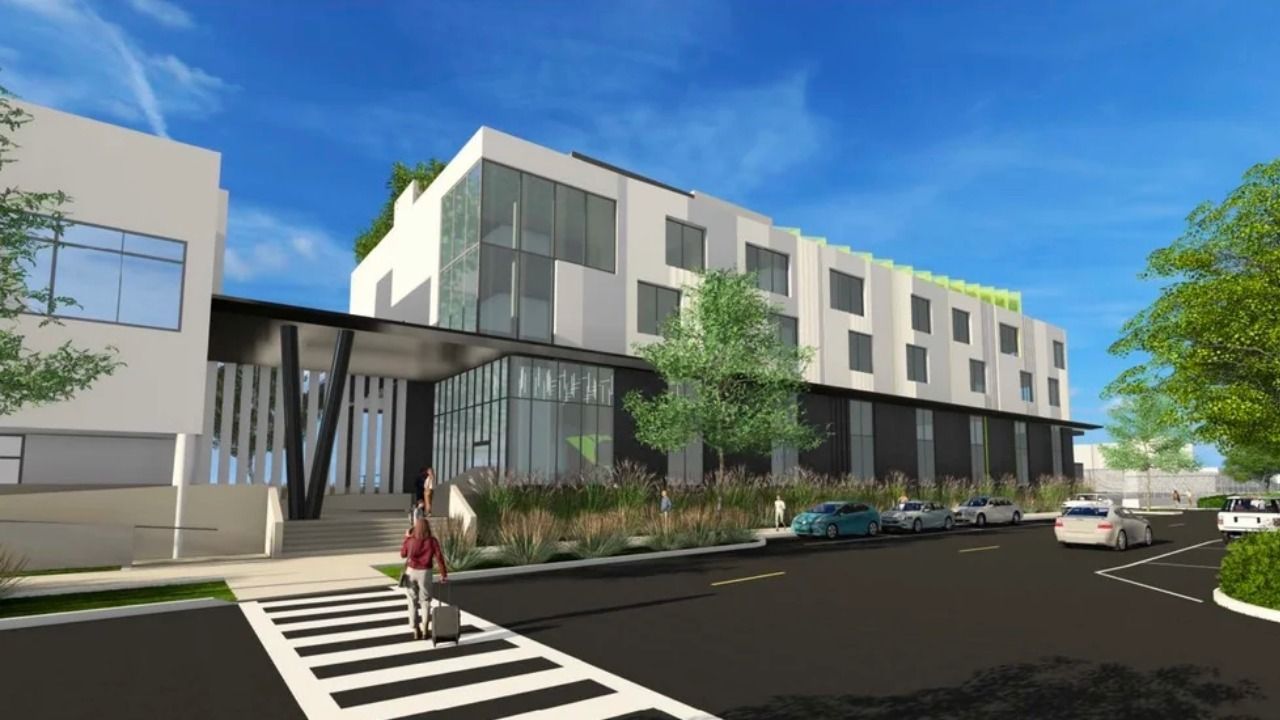
St. Petersburg’s Economic and Workforce Development Committee voted unanimously Feb. 26 to advance a November 2026 referendum that would allow a long-term waterfront lease at the Port of St. Petersburg for expansion of the Maritime and Defense Technology Hub.
Without voter approval, the project cannot secure the federal disaster mitigation funding and long-term financing needed to build the next phase.
The site sits on city-owned waterfront property. The City Charter limits most private leases on waterfront land to five or 10 years. Project backers say that window does not work for the federal grants and private financing they need to construct the expansion.
The committee directed legal staff to prepare a resolution that would send the lease question to voters on Nov. 3, 2026.
Why the lease matters
Jason Mathis, CEO of the St. Petersburg Downtown Partnership, described the lease term as the gating issue. The Hub 2 plan depends on capital that requires long-term site control.
“If the federal government gives us $18 million, they want to know the building will be used for this purpose and managed by an entity focused on coastal resilience,” Mathis said. “We probably can’t get a loan if we can only get a five-year lease on the land.”
READ: TAMPA BAY REAL ESTATE NEWS
Sponsors initially discussed a 50-year lease. That conversation shifted after council members pointed to a 2004 referendum that allowed the airport to offer 25-year leases. Mathis said aligning the Port with the airport’s 25-year structure would be simpler to explain to voters and still satisfy federal funding requirements.
“50 was just a big round number,” he said. “25 years works fine.”
The referendum would authorize the city to offer a longer lease. City Council would still have to approve the final lease terms.
What Hub 2 adds
Hub 2 would expand a facility that has operated at capacity since opening. Mathis said the current Hub remains fully leased and maintains a waiting list of prospective tenants.
The proposal calls for roughly 52,000 square feet of new space adjacent to the existing 32,000-square-foot Hub at 450 8th Ave. SE. The expansion would rise on a surface parking lot at the Port.
Mathis said variations of the project have been under discussion since 2017, including earlier plans tied to a potential relocation of a NOAA lab that did not materialize. The current proposal advances independently of a federal tenant commitment.
The expansion responds to physical constraints inside the existing building. Plans call for maritime work bays with 20-foot clear heights and direct deepwater access, allowing companies to stage and maintain larger marine equipment on site.
“Right now, because of the specifications of the existing Hub, we can only fit sort of the smallest drones inside the bays,” Mathis said. “So one of the things we’re going to do is build the bays up to 20 feet high so that we can have a lot more opportunity with equipment.”
READ: TAMPA BAY BUSINESS NEWS
He cited Saildrone as an example. The California-based company operates unmanned ocean drones that collect hurricane data and map ocean conditions. Mathis said the next phase would better accommodate that scale of equipment and similar operations.
The plan also includes space for the Florida Flood Hub for Applied Research and Innovation, which focuses on flood modeling and sea level rise research. Relocating that operation into a dedicated facility would free capacity in the existing Hub and concentrate resilience-focused research at the Port.
The Port location is central to the pitch. The site offers direct deepwater access and sits within a short walk of the University of South Florida’s College of Marine Science, as well as offices for the National Oceanic and Atmospheric Administration, the Florida Fish and Wildlife Conservation Commission and the U.S. Geological Survey.
Project leaders argue that placing private firms alongside federal and academic research operations strengthens a marine science cluster already concentrated in the Innovation District.
The expanded facility would be jointly managed by the Innovation District and the Downtown Partnership, with tenants spanning nonprofit and for-profit firms, as well as government and academic collaborators focused on coastal resilience.
Who the building targets
Hub 2 would operate as an incubator space shaped by federal grant requirements and the existing Hub’s operating model.
“It has to be incubator space,” Mathis said, referring to U.S. Economic Development Administration requirements. “This is really about providing below-market cost space to new startup companies in marine science, coastal engineering and flood mitigation companies.”
READ: TAMPA BAY RAYS NEWS
The current Hub houses 27 companies working in related but distinct areas. Mathis said proximity remains central to the model.
“You’ve got 27 different companies all working there, and they’re all doing related stuff,” he said. “Nobody’s doing exactly the same thing.”
How the project gets funded
Project leaders are pursuing a funding structure built primarily on grants.
Mathis said the timing reflects disaster mitigation funding made available after Hurricanes Helene and Milton. He said the EDA opportunity stems from allocations tied to those storms and would not exist under a typical funding cycle.
“So the time really is right to do this,” he said.
The team plans to seek funding from the Florida Ports Council, similar to an earlier $8 million appropriation secured for prior planning efforts. It has also applied to Pinellas County’s Employment Sites Program for $3 million.
“Between all those grants, it should cover the cost of building the building,” Mathis said.
If grant funding falls short, the Downtown Partnership could finance the project through private debt, a structure that also requires a longer-term land lease to satisfy lenders.

The economic case
Mathis said the existing Hub supports higher-wage employment, with average salaries around $91,000 among full-time employees. Project leaders are assembling additional impact data for grant submissions.
“This is why venture capitalists put money at risk,” he said. “Some of these companies could become really successful.”
Supporters frame the expansion as part of a broader effort to deepen St. Petersburg’s research-driven sectors, particularly in marine science and coastal resilience. The strategy emphasizes growing firms locally rather than recruiting mature companies from outside the region.
“If a company starts in St. Pete and grows in St. Pete, they’re much more likely to stay here forever,” Mathis said.

What happens next
City Council must vote to place the referendum on the ballot, then hold required public hearings and publish legal notices.
Mathis said the project team is asking City Council to place the lease question before voters and to formally support grant applications already in progress with the EDA, the Florida Ports Council and Pinellas County.
If voters approve the referendum in November 2026, City Council would still need to approve the final lease agreement. If voters reject it, the project would remain constrained by the existing short-term lease limits.
Stay Informed
Stay up to date on Tampa Bay business news, executive profiles and the companies shaping the region.