
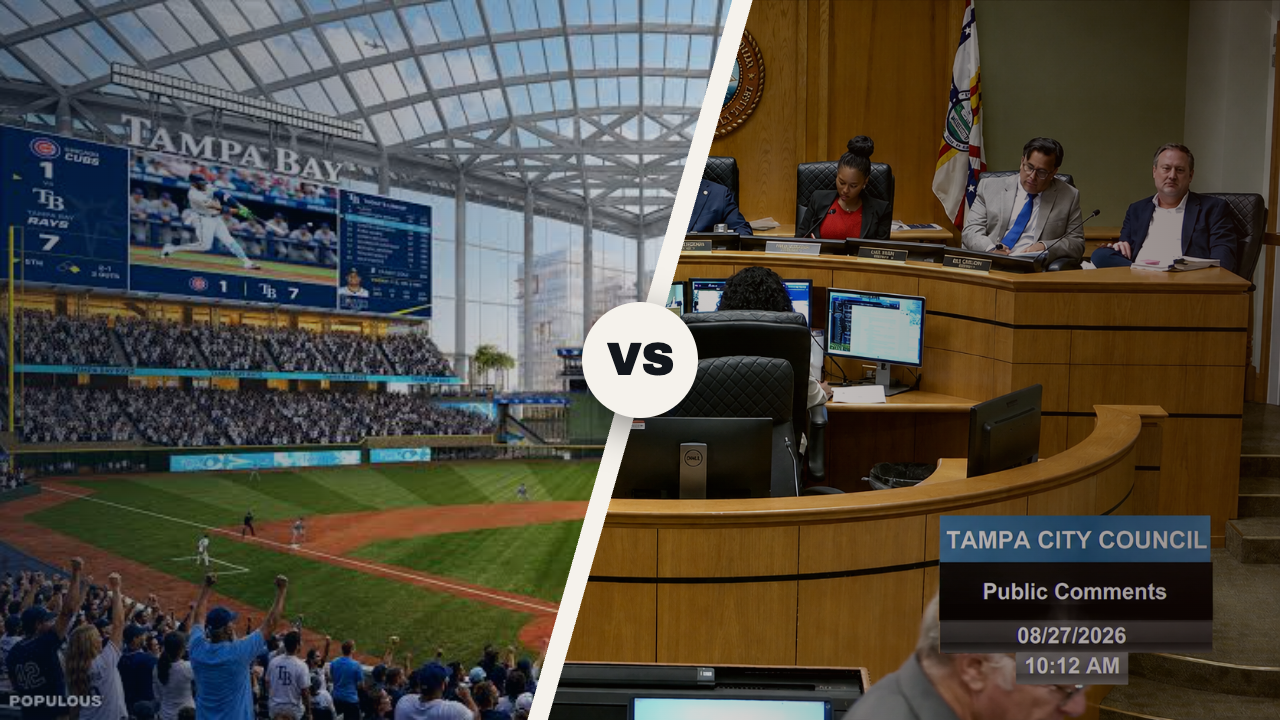
The Rays arrived at Tampa City Hall Thursday morning needing four votes, the latest test in a stadium search that had already survived one failed plan after another. A proposed waterfront ballpark in St. Petersburg went nowhere, the Ybor City deal collapsed in 2018 and Major League Baseball rejected a split season with Montreal in 2022.
The Rays then returned to St. Petersburg and secured approval for a new ballpark in the Historic Gas Plant District, only for Hurricane Milton to tear the roof off Tropicana Field in 2024 before financing delays and rising construction costs helped unravel that deal the following year.
This time, the stadium plan made it through. After nearly eight hours inside Tampa City Hall, the four votes the Rays needed came from Alan Clendenin, Bill Carlson, Naya Young and Luis Viera, who approved Tampa’s $80 million piece of the proposed $2.3 billion ballpark. Lynn Hurtak, Guido Maniscalco and Charlie Miranda voted no, leaving the Rays with a 4-3 victory and their first approved piece of the Tampa financing package.
That $80 million will not go directly into the ballpark. Tampa would reimburse infrastructure after it is built, then recover the money from property-tax growth generated by development around the stadium. Before the first payment can be made, however, the project must clear several financing and government conditions.
The land generates no property taxes today, so Tampa’s repayment depends on what gets built around the ballpark. Housing, hotels, restaurants, retail and other development would create the taxable value used to pay the city back, a structure Carlson said changed the calculation from earlier proposals that relied on existing city revenue.
“The $80 million is a loan,” Carlson said. “Before, it was TIF, and we would have been taking out of fire trucks and police cars. We’re not doing that now.”
Tampa cannot make its first payment until the city completes required budget actions, the financing clears judicial validation and Hillsborough County proceeds with its bond sale. The city also must receive an updated project budget and construction schedule and move the stadium property out of the Drew Park redevelopment area and into a new community development district.
The financing also redirects 50% of downtown CRA revenue, which raised questions Thursday about what would remain for other redevelopment priorities, including the planned streetcar extension into Tampa Heights.
Tampa’s $80 million is the smallest of the three principal stadium contributions, with the Rays committing about $1.37 billion and taking responsibility for construction overruns while Hillsborough County’s share is approximately $796 million.
Hurtak pressed attorneys on costs outside those figures, including language requiring the city and county to pay for certain future capital maintenance and repairs at the ballpark from legally available funds. She sought clearer limits on those obligations and also challenged a community benefits agreement that still lacks a final dollar commitment, saying she wants at least $75 million attached to it when the agreement reaches City Council.
The final documents did not reach council members until Wednesday afternoon, another issue raised during Thursday’s debate. Clendenin viewed those documents in the context of months of negotiations that had already changed Tampa’s role in the project, replacing an earlier structure involving the city’s community investment tax and a $100 million CRA contribution with the $80 million cap approved Thursday and leaving construction overruns with the Rays.
Those negotiations also produced provisions involving East Tampa, jobs, people with disabilities and first responders, along with incentives for development around the stadium. The Rays have proposed a privately financed mixed-use district with housing, restaurants, retail, hotels and public space, and Clendenin argued that the broader project could bring billions of dollars in additional private investment while expanding Tampa’s tax base.
For Clendenin, the vote extended beyond whether Tampa should help finance a baseball stadium because the development around it could bring construction and permanent jobs, new businesses, housing and other investment to the city.
“It’s not merely a vote on a baseball stadium,” Clendenin said. “It is a vote on whether Tampa is prepared to compete for investments, jobs, housing, education and opportunity, or whether we’re willing to let those opportunities go elsewhere.”