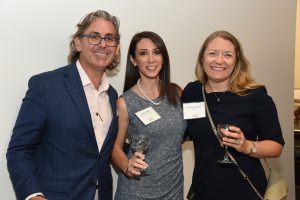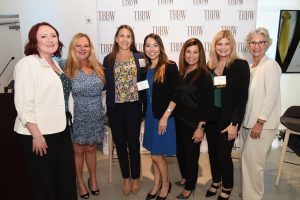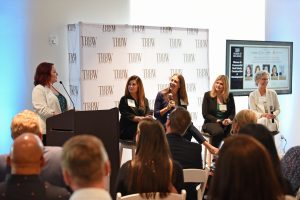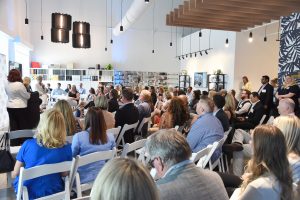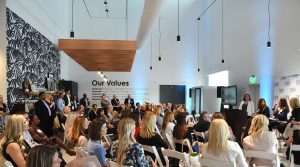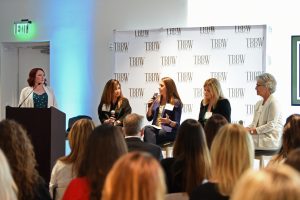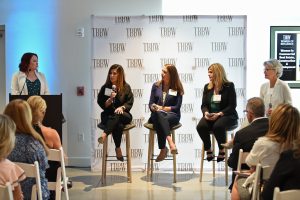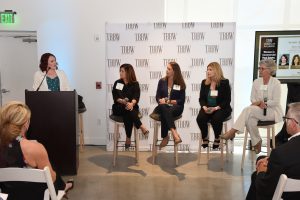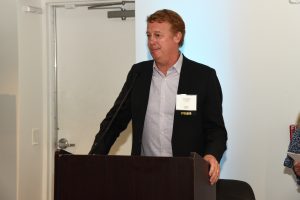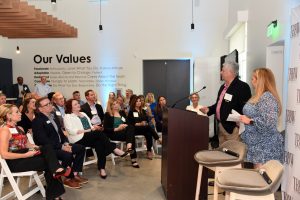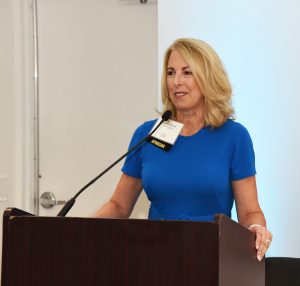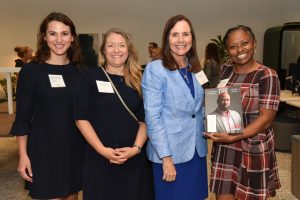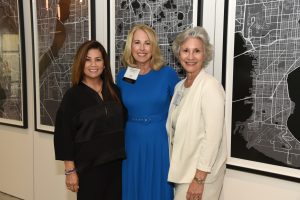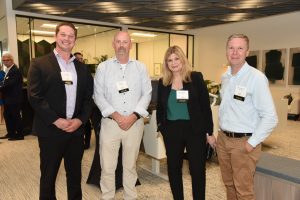
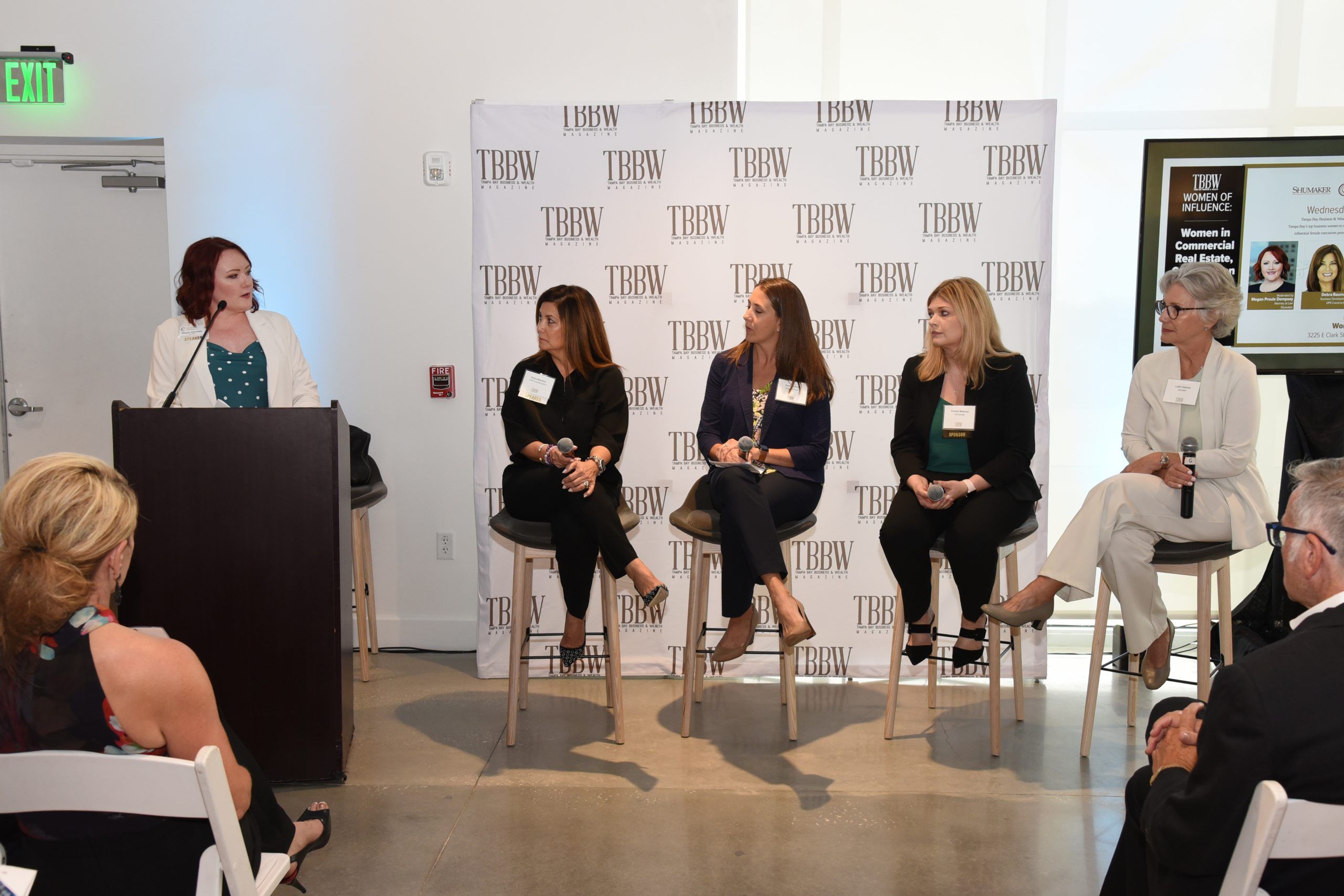
Tampa Bay Business & Wealth’s “Women of Influence” series is an exclusive, invitation-only event that brings together Tampa Bay’s top businesswomen to meet, mingle and talk among their peers. The evening features a live discussion with a panel of influential female executives providing insight into their personal lives, careers and views affecting the business community.
This panel was moderated by Megan Proulx Dempsey, a lawyer at Shumaker.
The panelists:
• Debra Bauman, business development leader, DPR Construction
• Leith Oatman, practice area leader, Gensler
• Danielle Ruiz, director of industry recruitment, Duke Energy
• Pamela Williams, director of asset management, Stoneweg
This is a transcript of the panel discussion held at Workscapes, in Tampa. It has been edited for length and brevity.
Our first question is one that all of you should share your two cents or more on. What do you think is the most important change happening in your respective industry right now?
Bauman: Not unique to construction, I think what we’re seeing, across the country, is the skilled workforce. I think the media likes to call it “the grand retirement.” I think it’s a compilation of folks, the baby boomers, finally retiring. We have a culture of [Generation] X and Gen Z, all of those, that may not want to work the way that our parents and we did.
Specific to construction, immigration reform has kind of impacted us. Then we have direct labor that our workforce isn’t getting paid a fair, living wage. So when you look at our younger population, and they have an opportunity to go work in the hot sun for 10 hours a day, or they can go work for Amazon for $25 an hour, plus benefits, in an air-conditioned warehouse, you can see where that trend is going.
I think the skilled workforce is a big deal. I read a recent survey that polled 1,900 CEOs in the architecture/construction industry. They said that by 2039, we’re going to have a crisis facing our industry.
What are we going to do about it? I would say it’s technology and innovation. What we’re seeing is the trend towards robotics, to manufacturing, through prefabrication and modular construction. For example, taking the automobile assembly process and implementing it into construction. The net interest in that is, it’s going to increase efficiency. It’s going to reduce waste on our planet. And then it’s going to really keep our labor to a minimum, but high-paying jobs, more than likely.
Ruiz: In the energy industry, with electric vehicles, there’s the charging that goes along with that. It’s one thing to have one house in a neighborhood with an electric vehicle, if a whole neighborhood has them, it puts further strain on the grid, as well as renewables.
Sustainability is a big push from the construction side. Most of our large projects that we see is there is several hundred thousand square feet of manufacturing, or warehouse distribution space, and many clients are asking what the options are around sustainability and whether it’s solar on the roof or solar on the land. Oftentimes, they don’t want to put it on their own land, because for every five acres of solar, you get one megawatt. If a large user of power, they typically don’t want to use up that much acreage. So, they want a partner in the energy space to be able to provide that.
Williams: I’d like to answer this question from an investor’s perspective. For our investors, I think it’s important that their focus is on diversification of our portfolio. Where, historically, we have acquired garden-style apartment communities, now our focus is going to be on diversifying that portfolio by including mid-rise, luxury style and ground-up, development communities. The other thing I think, as it relates to sustainability, is that the investor is also highly focused on that. So, they are driving us to move forward with implementing sustainability into our developments and our value-add assets.
Oatman: What has really changed in our industry is that we have become, more, of a technology-oriented industry. We refer to ourselves more as consultants than we do as architects. The firm has spent a great investment designing software programs that are geared so that you can input data and outcomes. It’s referred to as computational design and outcomes, things like test fits, blocking diagrams for developments, just making minor tweaks in the data. And, very quickly, developers and users are able to visualize the options that are available to them.
Architects are finally learning to really embrace design build, which is bringing products to market much more quickly. Our willingness to collaborate, not only with our clients and their design solutions but also with our brothers in the construction industry is truly producing beautiful, and elegant, solutions with great speed. I think those are the major things that I would have to say that has changed in our market, using software and being more collaborative on delivering projects.
Do you think there are still barriers to entry for women in each of our respective fields?
Oatman: I will have to say for architecture look out world, because the women are very embraced in architecture. They’re leading firms, our CEO happens to be a woman. It’s one of the world’s largest architectural firms. This is a difficult and challenging career. It doesn’t matter if you’re a male or a female. It’s challenging, no matter what.
I believe that one of the things that was uncovered during our work-from-home experience is that our partners got to see how hard it was to juggle work with the family. It really broke down a lot of barriers from stigma and we all have biases. I have a bias. How can I understand what it is like for someone else when I haven’t lived, and worked, in their skin? Until you are experiencing it yourself you can try and be empathetic, as best as you can. But until you actually live it, you can’t really know what that is like.
Williams: I think it’s inspiring how far we have come in commercial real estate over the last few years. In our organization, women are leading all facets of the business and they’re doing a phenomenal job at it. We have actually recently hired a construction manager and she will be leading all facets of capital improvement projects, across our 54-property portfolio. In addition to that, we recently announced the addition of a woman to serve as our chief legal officer. She is the first woman to serve on our legal, or executive, team since the inception of the organization.
Ruiz: We also have a woman CEO, at our headquarters is in Charlotte, North Carolina, and we also have a state president in Florida that’s a female as well. She has been with our industry for 34 years. So, truly committed to the energy industry and talking about seeing the shift of that I will say, it is hard balancing whether you’re male or female. I agree [with Oatman] that being a working parent, as a whole, is challenging in its own right. And I think the more that folks have a dual-income family the more responsibilities have to be shared.
Bauman: From a construction standpoint, I think we’re probably the slowest to make the change. What I would tell you is that I’ve seen a big change over 20 to 25 years, but we have a long way to go.
We made it a point to hire 40% diversity within our organization. I think that what we’re seeing with the more progressive architecture and construction firms, it that having diversity around your leadership table is a must. It’s critical to have everybody represented around a table. ♦
Photos by Tacy Briggs-Troncoso