
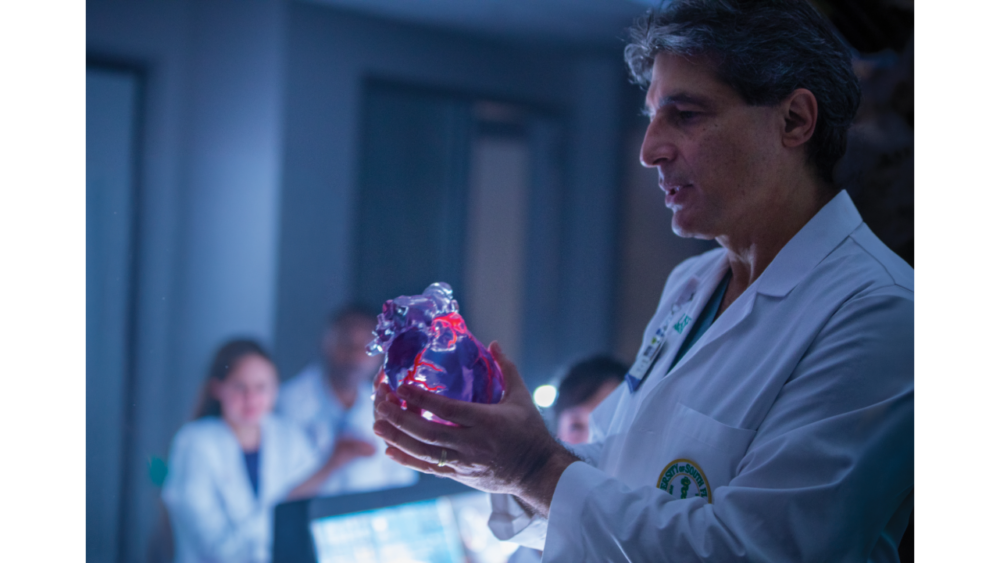
Dr. Fadi Matar held a heart in his hand — not an anatomical model from a medical textbook, but a physical recreation of a patient’s heart, fabricated in precise detail by a 3D printer using high-resolution scans of that individual’s actual anatomy. The bulges, bends and delicate surfaces were exact, as if the heart had been removed from the chest and frozen in place.
Matar, interventional heart failure program director, director of the Research and Innovation Center of Excellence at the TGH Heart & Vascular Institute, and professor and chief of cardiology at the USF Health Morsani College of Medicine, uses these models to plan surgeries and transcatheter procedures. Before a single incision is made, he can test approaches, study angles and determine precisely how a replacement valve will fit.
The 3D-printed heart is one of several innovations transforming how the academic health system treats heart patients. Matar, working closely with Dr. Devid Zille, director of the 3D Medical Visualization and Printing Lab at Tampa General and assistant professor of medicine at the USF Health Morsani College of Medicine, has helped pioneer new approaches to conditions that were once largely untreatable.
“Now we have hope,” Matar said. “We have the ability to help people whom we were unable to help previously.”
Heart disease remains the leading cause of death in the United States, accounting for one in every three deaths, including more than 919,000 in 2023 alone, according to the U.S. Centers for Disease Control and Prevention.
Despite that long-standing reality, more than half of U.S. adults do not realize that heart disease is the leading cause of death. In this environment, advances that diagnose disease earlier, deliver more precise treatment or prevent illness altogether are not merely innovations — they are critical to survival.
At Tampa General, innovation is continuous. Cardiac specialists are redefining what is possible in cardiovascular medicine. That spirit of collaboration took Dr. Daniela Crousillat, director of the Women’s Heart and Cardio Obstetrics Program, associate program director of the Cardiology Fellowship Training Program for the TGH Heart & Vascular Institute, and assistant professor of the Division of Cardiovascular Sciences and Department of Medicine and Obstetrics and Gynecology at the USF Health Morsani College of Medicine, to Charlotte, North Carolina, where she joined cardiologists committed to understanding spontaneous coronary artery dissection (SCAD).
Read the latest Tampa business news and updates
SCAD, a tear in the artery wall that disrupts blood flow, is the leading cause of heart attack in women under 50 and the most common cause among women who are pregnant or postpartum. It often presents with classic heart attack symptoms, such as chest pain, shortness of breath and nausea, but without traditional risk factors like smoking or high cholesterol. About half of patients have an additional arterial disorder.
Today, Tampa General is the only hospital in Florida participating in the International SCAD Registry, an independent quality-data repository designed to accelerate research and improve outcomes. Crousillat hopes the collaborative work underway will lead to targeted treatments within the next decade.
“If we can figure out the why, we can help people on the other end,” Crousillat said. “For us, moving the needle forward means knowing the answers to the questions.”
SCAD research is only one example of Tampa General’s expanding impact. When Matar began his career, tricuspid valve disease was so overlooked it carried the nickname “the forgotten valve.”
Despite controlling blood flow between the right atrium and right ventricle, the tricuspid valve received little attention. When it fails, blood backs up into the abdomen and legs, causing swelling, liver damage and, in severe cases, immobilization.
In April 2025, Tampa General and USF Health cardiologists performed Florida’s first TricValve procedure under the Food and Drug Administration’s Early Feasibility Studies Program. Led by Matar and Dr. Hiram Bezerra, the minimally invasive procedure targets severe tricuspid regurgitation, a condition in which blood leaks backward through the valve. Tampa General has already completed seven TricValve cases — the most in the nation — through the FDA’s compassionate-use pathway.
“These valves allow patients to live better lives,” Matar said. “Before this, all we could offer was medication. We used to be helpless with those patients.”
The 3D-printed heart in Matar’s hand represents only the beginning. Tampa General’s 3D-printing lab is developing a “pulsatile” heart model that will pump fluid exactly as a patient’s heart pumps blood, offering an even more realistic platform for procedural planning and training.
“As physicians, when we’re faced with suffering patients in front of us, it’s not a good feeling when we cannot give them options,” Matar said. “Here at Tampa General, we’re fortunate to have a very solid academic heart team.”
That future is also being shaped by advances in imaging technology. New GE HealthCare Revolution APEX 512-slice CT scanners allow clinicians to detect heart disease before symptoms appear, enabling cardiologists and radiologists to diagnose everything from arterial blockages to structural defects with greater speed and precision.
Together, these innovations, spanning imaging, intervention and research, are redefining cardiac care and expanding what is possible for patients facing complex heart conditions. Learn more at TGH.org/Heart or call (813) 844-3900.
Read More Tampa Bay Business News
Explore the latest Tampa Bay business news, real estate deals, development projects, executive moves and company updates shaping the region.