
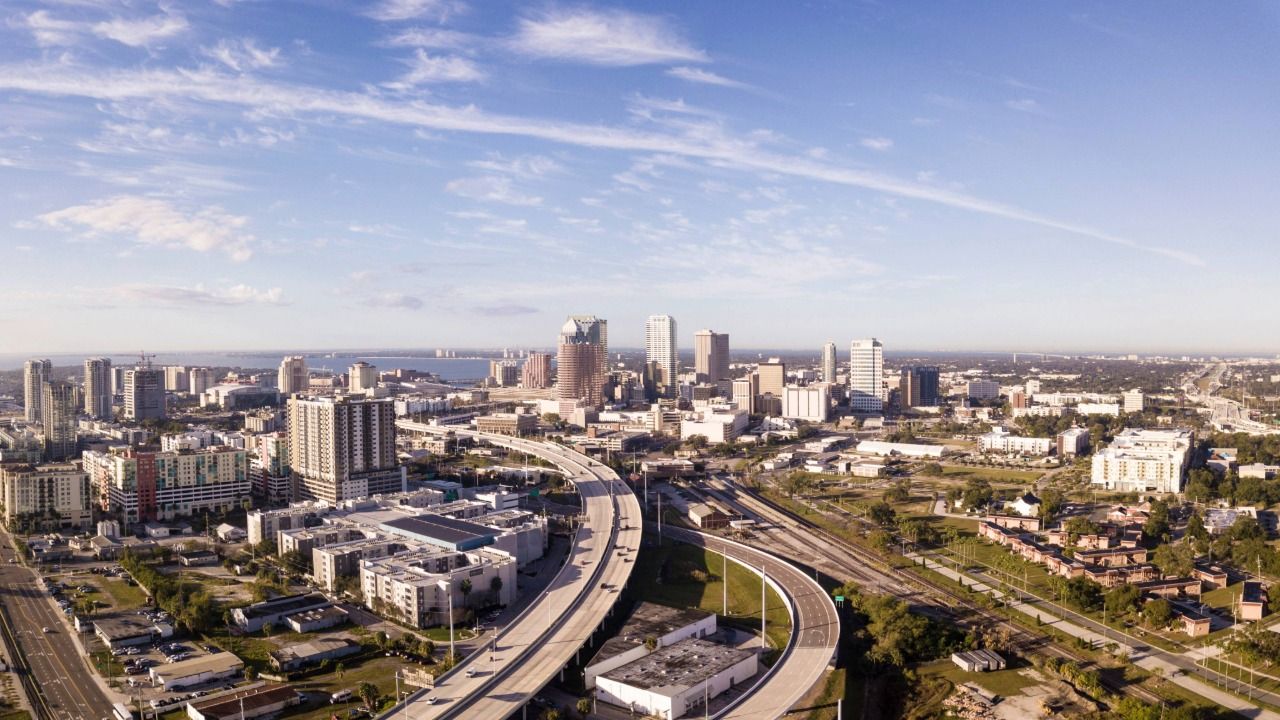
The Tampa Bay Economy: Midyear Report
Tampa Bay’s economy is moving into a slower and more selective phase, with growth increasingly driven by healthcare, infrastructure, logistics, tourism and long-term population demand.
Tampa Bay’s economy is shifting into a slower and more selective phase after several years of rapid post-pandemic expansion, but the region’s underlying growth drivers remain firmly intact.
The University of Tampa’s Spring 2025 The Tampa Bay Economy report and the latest U.S. Bureau of Labor Statistics Tampa area summary suggest the region avoided recession even as higher interest rates cooled housing activity, speculative development and parts of the white-collar economy. The broader transition underway is less about economic weakness and more about economic rebalancing as Tampa Bay moves beyond the broad-based expansion that defined much of the pandemic recovery and into a slower-growth environment increasingly driven by healthcare, infrastructure, logistics, tourism and population-based demand.
Together, the articles that follow show how Tampa Bay’s next phase of growth is being shaped less by speculative expansion and more by industries tied to healthcare access, freight infrastructure, tourism demand, housing needs and long-term population growth.
Developers across Tampa Bay are slowing new projects, investors are becoming more selective about where they place capital and companies are shrinking office footprints as the region’s real estate market settles into a slower and more disciplined phase after several years of explosive post-pandemic growth.
Data from the University of Tampa’s Spring 2025 The Tampa Bay Economy report and Cushman & Wakefield suggest Tampa Bay avoided the type of sharp real estate correction many markets feared after interest rates surged in 2022 and 2023. Instead, Tampa Bay’s commercial property sectors are transitioning into a more measured market supported by population growth, business relocation and long-term demand.
Multifamily developers are seeing that shift play out most clearly in the apartment market, where the wave of post-pandemic construction is still working its way through the system.
Diego Bonet, managing partner of LD&D, said Tampa Bay is still absorbing the apartment inventory delivered in 2022, 2023 and 2024, though fewer projects breaking ground should improve supply conditions over the next several years.
“A lot of that inventory is finally getting close to absorbed,” Bonet said. “On the demand side, the story is very strong. You still have strong job growth, very strong population growth and we don’t see that stopping anytime soon.”
Bonet said Tampa Bay continues benefiting from migration, quality of life and growing interest from younger workers seeking walkable urban neighborhoods near restaurants, retail and entertainment. He pointed to downtown Tampa, downtown St. Petersburg and Water Street as examples of districts continuing to attract demand because of their location and long-term appeal.
“It’s not about excessive amenities,” Bonet said. “It’s about how well curated it is and where it’s located.”
Bonet said debt has become more available and less expensive in recent months while institutional investors are beginning to re-enter the market after sitting on the sidelines during the peak interest-rate cycle. Developers are still underwriting projects more conservatively and taking a longer-term view as uncertainty surrounding interest rates, inflation and economic policy continues affecting investment decisions.
“We always try to think five years out, 10 years out,” Bonet said. “Tampa Bay is a market we’re very bullish on long term.”
New construction activity is slowing sharply. Cushman & Wakefield reported multifamily starts are down 25.2% from the market’s five-year average as developers respond to higher financing costs and softer rent growth.
The shift toward a slower and more selective market is becoming visible across nearly every major property sector.
Tampa Bay’s office market is no longer growing through broad expansion as demand concentrates in newer, higher-quality buildings where companies are shrinking footprints and competing for premium space in districts such as Westshore and downtown Tampa.
Tampa Bay’s office vacancy rate fell to 18.2% during the first quarter, down 110 basis points year over year, as tenants continued shifting toward newer Class A buildings in Westshore and downtown Tampa. Developers have largely stopped speculative office construction, with Gas Worx representing one of the few major office projects currently underway.
Class A asking rents climbed 4.6% year over year to $36.30 per square foot while premium space in Tampa’s central business district reached asking rents as high as $75 per square foot, according to Cushman & Wakefield.
Industrial real estate is moving through a similar reset as developers absorb millions of square feet of warehouse construction tied to e-commerce growth, logistics expansion and population migration.
Industrial vacancy rose to 6.8% in the first quarter as developers continued absorbing the wave of warehouse construction. Plant City alone accounted for more than 1.5 million square feet of industrial deliveries in 2025 and nearly 60% of that space remained available for lease.
Leasing activity, however, remains active. Tampa Bay recorded more than 1.15 million square feet of industrial leasing activity during the first quarter while direct asking rents increased 2.6% year over year to $10.59 per square foot.
Retail has remained one of the market’s strongest sectors because years of restrained construction collided with sustained population growth across Tampa Bay.
Retail vacancy stood at 3.4% at the end of 2025, below the national average of 4.3%, while asking rents rose 4.3% year over year to $27.47 per square foot, according to Cushman & Wakefield. Westshore and South Tampa posted some of the region’s tightest conditions with vacancy below 2.5%.
Tampa Bay retail investment sales reached $1.5 billion in 2025, up 18.4% year over year, as investors continued targeting well-located centers in high-growth suburban corridors.
Multifamily has faced more pressure as thousands of apartment units delivered during the post-pandemic construction boom pushed occupancy and rents lower across the region while renters gained more negotiating power after years of rapid rent growth.
Higher borrowing costs, rising labor expenses and tighter financing conditions have also sharply slowed new construction starts as multifamily developers pull back on supply.
Cushman & Wakefield reported Tampa Bay multifamily occupancy fell to 91%, the lowest level recorded in the past decade, while effective rents declined 4.9% year over year to an average of $1,806 per month. Developers delivered 1,059 units during the first quarter while another 8,908 units remained under construction across the region.
Long-term housing demand remains supported by migration, population growth and the rising cost of homeownership.
Together, the data suggest Tampa Bay real estate is no longer in a phase where nearly every asset class expands rapidly at the same time. The market is becoming more dependent on long-term population growth, household formation and premium locations while speculative development and short-term growth expectations cool.
Developers are slowing projects without pulling away from the market altogether. Tampa Bay multifamily investment sales reached $2 billion during the first quarter, second highest in Florida behind Orlando, while retail investment volume climbed to $1.5 billion in 2025.
Those investment flows reflect a broader shift across Tampa Bay real estate as developers, lenders and investors place greater emphasis on projects backed by long-term demand, strong locations and durable population growth.
Healthcare systems across Tampa Bay are hiring aggressively, expanding outpatient networks and continuing to invest in long-term growth even as much of the region’s economy settles into a slower and more cautious phase after several years of explosive post-pandemic expansion.
The University of Tampa’s Spring 2025 The Tampa Bay Economy report and the latest U.S. Bureau of Labor Statistics Tampa area summary suggest healthcare has become one of the region’s clearest sources of sustained economic growth as population increases, aging residents and rising demand for medical services continue driving hiring and investment across the sector. While broader job growth has normalized and several industries have slowed, education and health services added 7,500 jobs year over year through February, a 3% increase that outpaced every major industry sector in the Tampa Bay area.
That growth is extending beyond hospitals and clinics and into the broader research, education and workforce infrastructure supporting the region’s healthcare economy. A University of South Florida economic impact report released in January found USF generates nearly $10 billion annually across Florida, including $6.6 billion within the Tampa Bay region, while USF Health delivers more than 1 million patient encounters annually through more than 750 physicians and providers affiliated with the Morsani College of Medicine. The report also found more than 80% of USF graduates remain in Florida, strengthening Tampa Bay’s long-term healthcare workforce pipeline.
Tampa Bay’s economy is also shifting away from the broad-based expansion that defined much of the post-pandemic recovery. The University of Tampa report described a regional economy settling into slower but more stable growth after higher interest rates cooled housing activity, construction pipelines and consumer spending.
Healthcare, however, continues to expand because demand for care remains more closely tied to demographics and population growth than to short-term business cycles.
Population growth across Hillsborough, Pinellas, Pasco and Hernando counties is increasing demand for hospitals, physicians, outpatient centers, specialty care and senior healthcare services. Tampa Bay also continues attracting retirees and older residents who consume more healthcare services over time, creating a longer growth runway for medical providers even as other industries grow more cautious about hiring and expansion.
A recent Hyde Park Capital healthcare staffing report found the U.S. healthcare staffing industry reached roughly $46 billion in 2025 and is projected to grow to approximately $63 billion by 2030 as hospitals, outpatient providers and healthcare systems continue confronting structural labor shortages and rising patient demand. The report said staffing shortages are no longer viewed as temporary post-pandemic disruptions but as a long-term workforce imbalance driven by clinician burnout, retirements and limited training capacity.
The Hyde Park report also noted healthcare systems are increasingly relying on flexible staffing models, technology-enabled recruiting platforms and outsourced workforce solutions as care delivery expands beyond traditional hospitals into outpatient clinics, urgent care centers, home healthcare and other decentralized settings.
Those trends are increasingly visible across Tampa Bay as healthcare providers continue expanding ambulatory care, medical office buildings and specialty clinics closer to growing residential corridors. USF’s continued expansion in research funding, healthcare partnerships and medical education is also strengthening Tampa Bay’s position as a larger regional healthcare hub. USF reported $738 million in research funding during fiscal year 2023-24, a 35% increase from fiscal year 2021-22, while healthcare, biotechnology and artificial intelligence projects continue expanding around the university and the USF Health-Tampa General Hospital partnership.
That population-driven growth is also shaping real estate and development activity across the region.
Diego Bonet, managing partner of LD&D, said Tampa Bay continues benefiting from long-term demographic and migration trends that support healthcare-related development and investment.
“A lot of that inventory is finally getting close to absorbed,” Bonet said, referring to the multifamily sector. “On the demand side, the story is very strong. You still have strong job growth, very strong population growth and we don’t see that stopping anytime soon.”
Bonet said Tampa Bay continues attracting residents seeking walkable urban neighborhoods, healthcare access and quality-of-life amenities, particularly in districts such as downtown Tampa, downtown St. Petersburg and Water Street.
“It’s not about excessive amenities,” Bonet said. “It’s about how well curated it is and where it’s located.”
The labor data increasingly reflect healthcare’s expanding role in the regional economy. Tampa-area nonfarm employment declined 0.3% year over year through February while professional and business services lost 4,800 jobs and information employment fell 3.6%. Education and health services, by contrast, remained one of the few major sectors still expanding at scale.
University of Tampa economist Vivekanand Jayakumar warned that uncertainty surrounding tariffs, immigration policy and federal spending cuts could weaken business investment and hiring as companies delay expansion when future costs and demand become harder to predict.
Healthcare systems are not immune to those pressures, particularly as labor shortages, reimbursement concerns and rising operating costs continue affecting hospitals nationwide. Hyde Park Capital’s report noted healthcare providers are increasingly redesigning staffing models around contingent labor and flexible workforce structures because patient demand remains difficult to predict while labor availability remains constrained.
Even so, healthcare demand remains more durable than cyclical industries because medical services cannot easily be postponed in the same way discretionary spending, office expansion or speculative real estate projects can.
The University of Tampa report also noted Tampa Bay’s unemployment rate remained historically low even as hiring slowed and the economy softened into what economists described as a “stable but perhaps soft economy.” In that environment, hospitals and medical providers continue to function as one of the region’s stabilizing economic forces, with hiring and investment sustained through both strong and weak economic cycles.
That stability is helping support additional healthcare-related development across the region, including medical office buildings, outpatient centers, specialty clinics and senior housing projects designed to serve a growing and aging population. As speculative development slows in other sectors, healthcare-related projects are becoming a larger share of Tampa Bay’s long-term growth pipeline.
Healthcare now sits near the center of Tampa Bay’s economic transition as the region moves away from speculative growth and toward industries driven more by population growth, long-term demand and essential services.
Logistics, warehousing and port-related infrastructure are emerging as some of Tampa Bay’s most durable sources of economic growth as the region shifts into a slower and more selective phase after several years of explosive post-pandemic expansion.
The University of Tampa’s Spring 2025 The Tampa Bay Economy report and the latest U.S. Bureau of Labor Statistics Tampa area summary suggest the regional economy has normalized without falling into recession as higher interest rates cooled housing activity, speculative development and business expansion. Even so, freight movement, port infrastructure and distribution demand continue expanding alongside Florida’s population growth and the rise of the I-4 corridor as a logistics hub.
Port Tampa Bay sits at the center of that demand, COO Brian Giuliani said, because its cargo mix touches fuel, construction materials, consumer goods and the distribution infrastructure feeding Central Florida’s growth.
“We see more companies over the last year or two looking at Tampa as that strategic place to bring goods through and get them to their destinations more efficiently,” Giuliani said. “They’re able to come into Tampa and get to their distribution center in the I-4 corridor much easier and faster than if they were to come through some of the other ports.”
That demand is becoming more important as Tampa Bay’s broader economy slows. Tampa-area nonfarm employment declined 0.3% year over year through February while professional and business services lost 4,800 jobs and information employment fell 3.6%. Construction remained modestly positive despite higher borrowing costs while transportation, warehousing and port activity continue benefiting from Florida’s expanding distribution infrastructure and population growth.
While several sectors normalized, freight movement and distribution activity continue supporting a large share of Tampa Bay’s supply chain economy. Port Tampa Bay alone supports an estimated $34 billion in annual economic impact and roughly 192,000 jobs tied to port operations, trucking, fuel distribution, construction materials, shipping and logistics-related activity, according to the port.
“We basically import about 43% of the fuel for the state,” Giuliani said. “We’re very diversified. Autos, food, construction materials, cement, steel, aggregates for road construction, furniture, appliances. All of those things really drive our business.”
That diversification helps explain why logistics continues expanding even as more cyclical sectors cool. Like healthcare and other necessity-driven industries, freight demand remains tied to construction activity, freight distribution and daily consumption rather than discretionary business expansion.
The University of Tampa report described an economy settling into what economists called a “stable but perhaps soft economy” after higher rates slowed housing permits, home-price growth and payroll expansion. Even so, Florida’s continuing population growth is still sustaining demand for warehouses, trucking operations, industrial real estate, road construction and freight infrastructure.
Giuliani said industrial development and logistics infrastructure continue moving alongside the region’s demographic expansion.
“As all of those things occur, you need more products,” Giuliani said. “There’s the need for more distribution centers. There’s the need for more trucking. There’s the need for more housing. I think it all goes hand in hand.”
Alex Critcher, chief executive officer of CURA Freight, said Tampa Bay’s logistics sector is becoming more important as the region attracts more industry, distribution activity and population growth.
“The more they add ships coming in and merchandise coming in, the bigger logistics will play in the economy of Tampa,” Critcher said. “As it continues to grow and attract more people, it’s going to become a bigger factor.”
Critcher said logistics growth increasingly follows the same industrial and demographic trends driving Tampa Bay’s broader economy because nearly every major industry depends on freight movement in some form.
“Most companies selling goods rely on trucking in some form,” Critcher said. “As Tampa becomes more attractive for various industries, logistics is going to continue to grow with it.”
Rising freight demand is also driving a major expansion of the port’s cargo infrastructure. Port Tampa Bay handled 32 million tons of cargo during fiscal year 2025 while container volumes have increased more than 300% since 2018 to nearly 263,000 TEUs annually, according to the port. In April, the port welcomed the ZIM Canada, an 11,900-TEU container vessel that became the largest-capacity ship ever handled at Port Tampa Bay.
The arrival reflects why the port is advancing what officials describe as the largest infrastructure project in its history: a $1.3 billion channel-deepening project that would increase shipping depth from 43 feet to 47 feet, extend the entrance channel by 1.9 miles and improve access for larger cargo vessels.
“One just came online. One’s under construction. Two others are under construction,” Giuliani said of several new cargo berths tied to cement, aggregates and container operations. “Those are all tied to demand.”
Alongside the new berths, the port is expanding container capacity with additional post-Panamax cranes expected to become operational by the end of 2026, helping position Tampa to compete for larger cargo volumes moving through Gulf Coast supply chains.
Containers remain one of the clearest links between the port and Central Florida’s expanding distribution economy. Giuliani said trucking efficiency between Port Tampa Bay and logistics hubs in Lakeland and the broader I-4 corridor creates a significant operational advantage for companies moving cargo through Tampa.
“In trucking from the Port of Tampa to a facility in Lakeland, you could potentially do three moves per day versus probably one from some other locations,” Giuliani said.
Critcher said freight volumes have also started improving nationally after several years of weakness tied to excess inventories and supply-chain disruptions following the pandemic.
“Since the start of this year, we’ve seen an uptick in truckload volume and freight being moved,” Critcher said. “The indicators are pretty positive.”
Those gains come as companies continue reworking supply chains following pandemic disruptions, labor shortages and shipping volatility.
The University of Tampa report warned that tariffs, immigration policy and federal spending cuts could weaken business investment as companies delay expansion plans when future costs become harder to predict.
Critcher said tariff uncertainty initially caused some importers and exporters to temporarily pause shipments before normal operations resumed.
“I think the costs are eventually going to be passed down to the consumer,” Critcher said. “But I also think it could help bring manufacturing facilities back to the United States, and that creates more jobs and logistical needs.”
That uncertainty remains especially important for logistics operators, who are highly sensitive to major disruptions ranging from global supply-chain shocks to hurricanes, Giuliani said.
“We learned a lot throughout a short period of time,” Giuliani said. “People did whatever they had to do to get through it.”
The port’s hurricane response became one of the clearest examples of those operational lessons. After back-to-back storms disrupted fuel distribution and equipment staging operations, the port worked with fuel companies to create local equipment-storage options designed to help operators restore operations faster following future hurricanes.
“We’re definitely more prepared,” Giuliani said.
Critcher said logistics companies are also navigating rising operating costs, tighter regulations and increasing pressure on trucking capacity as demand strengthens.
“The cost of everything is going up freight-wise,” Critcher said. “Insurance, liability, fuel, drivers, the cost of operating a truck. It’s only a matter of time before we really see more increases in the price of everyday goods.”
The port’s expansion is also extending beyond cargo and into cruise operations, another area benefiting from Florida’s population growth and tourism demand.
Port Tampa Bay is projected to record 394 cruise ship calls in 2026 after handling a record 1.66 million cruise passengers in 2025. The port expects to approach 1.8 million passengers this year while setting a new monthly record of 51 cruise ship calls during March.
The port is advancing plans for a fourth cruise terminal projected to open around late 2029. Port officials estimate the project could add more than 200 annual ship calls, approximately 1 million additional cruise passengers and another $100 million in annual economic impact.
Tampa Bay’s economy is becoming more selective as industries tied to freight movement, infrastructure investment, healthcare and population growth carry a larger share of regional expansion while sectors dependent on cheap capital and speculative growth continue slowing.
Logistics sits near the center of that transition because population growth continues driving demand for fuel, building materials, consumer goods and freight infrastructure even as businesses become more cautious about expansion.
Tourism, conventions and cruise activity have become some of Tampa Bay’s most resilient economic drivers as the region settles into slower post-pandemic growth.
The University of Tampa’s Spring 2025 The Tampa Bay Economy report and the latest U.S. Bureau of Labor Statistics Tampa area summary suggest the regional economy has normalized without falling into recession as higher interest rates cooled housing activity, speculative development and parts of the white-collar economy. Even so, leisure, hospitality and visitor-related spending continue outperforming much of the broader regional economy.
Hotel stays generated a record $134.5 million in taxable hotel revenue during March, the strongest month ever recorded in Hillsborough County, underscoring how tourism demand continues outperforming much of the broader regional economy. Tourism Development Tax collections exceeded $8 million for only the second time in county history, according to Visit Tampa Bay.
The March performance followed another strong winter tourism season. Hillsborough County generated more than $125 million in taxable hotel revenue during February and more than $112 million during January as spring training, conventions, concerts, sporting events and cruise activity continued driving visitation across the region.
Visit Tampa Bay President and CEO Santiago Corrada said sustained investment in events and destination marketing continues driving visitation growth.
“March’s milestone-setting performance can be traced back to two founding principles that guide Visit Tampa Bay,” Corrada said in a statement. “The first principle is that we’re only as good as the commitment from our more than 1,000 partners, as well as city and county teammates. The second principle is that we must strategically invest and regularly promote the destination on a recurring basis to attract leisure travelers, business travelers and event planners.”
Tampa-area nonfarm employment declined 0.3% year over year through February while professional and business services lost 4,800 jobs and information employment fell 3.6%. Leisure and hospitality employment, however, remained stable while education and healthcare continued growing.
The University of Tampa report described the regional economy as “stable but perhaps soft” after higher rates slowed payroll growth, housing permits and home-price appreciation without triggering a broader recession.
Hillsborough County surpassed the billion-dollar mark in taxable hotel revenue for the fourth consecutive year in 2025, the first streak of its kind in the region’s history, according to Visit Tampa Bay. Occupancy rates also outperformed several competing convention and leisure markets including Orlando, Jacksonville, Charleston and Austin.
Nearly 60 meetings, conventions and major events took place across Hillsborough County during March alone, including four citywide conventions and the NCAA Men’s Basketball Tournament at Benchmark International Arena, generating tens of thousands of hotel room nights and hundreds of millions of dollars in estimated economic impact.
Spring training, Lightning playoff runs, major concerts, conventions and international sporting events now generate sustained waves of hotel occupancy, restaurant traffic and visitor spending throughout the year rather than concentrating demand into isolated tourism seasons.
The visitor economy is also expanding through Port Tampa Bay’s cruise operations, which are projected to record 394 ship calls in 2026 after handling a record 1.66 million passengers in 2025. The port expects to approach 1.8 million passengers this year while setting a new monthly record of 51 cruise ship calls during March.
“March is one of the busiest travel months of the year, and we’re thrilled to welcome more cruise ships and passengers than ever before,” Port Tampa Bay Executive Vice President and Chief Commercial Officer Raul Alfonso said in a statement. “This record demonstrates both the popularity of Tampa Bay as a cruise destination and the confidence cruise lines have in our port.”
The port expects 53 three-ship cruise days during 2026, more than double the roughly 20 recorded in previous years.
Annual cruise activity now generates more than $648 million in economic impact throughout West Central Florida, according to Port Tampa Bay.
Cruise terminals are now operating near capacity, prompting Port Tampa Bay to begin planning for a fourth cruise terminal projected to open around late 2029. Port officials estimate the project could add more than 200 annual ship calls, roughly 1 million additional passengers and another $100 million in annual economic impact.
Port Tampa Bay recently added luxury cruise visits from Oceania Insignia alongside existing operations from Carnival Cruise Line, Royal Caribbean International, Norwegian Cruise Line, Margaritaville at Sea and Celebrity Cruises.
The widening mix of conventions, cruise passengers and international visitors is helping Tampa Bay evolve into a more diversified year-round tourism economy.
Visit Tampa Bay’s current “Go and You’ll Know” campaign targets higher-value travelers in markets including New York, Chicago, Dallas, Philadelphia, Atlanta, Washington, Boston and several international markets including Canada, the United Kingdom, Germany, Mexico, Colombia and Brazil.
The University of Tampa report warned that tariffs, federal spending cuts and rising policy uncertainty could weaken business investment and consumer confidence in coming quarters, increasing pressure on industries tied to discretionary spending.
Tourism and cruise activity continue benefiting from Florida’s population growth, Tampa Bay’s expanding event infrastructure, year-round sports programming, convention growth and increasing airline and cruise connectivity.
Much of that tourism growth is now tied to longer-term demographic and infrastructure trends rather than the short-term burst of speculative expansion that defined much of the post-pandemic economy.
Tourism now reaches far beyond hotels and beaches, supporting convention centers, restaurants, cruise terminals, sports venues, transportation networks and thousands of hospitality jobs across the region as Tampa Bay’s economy shifts toward industries tied more closely to long-term population and infrastructure growth.
Read More Tampa Bay Business News
Explore the latest Tampa Bay business news, real estate deals, development projects, executive moves and company updates shaping the region.