
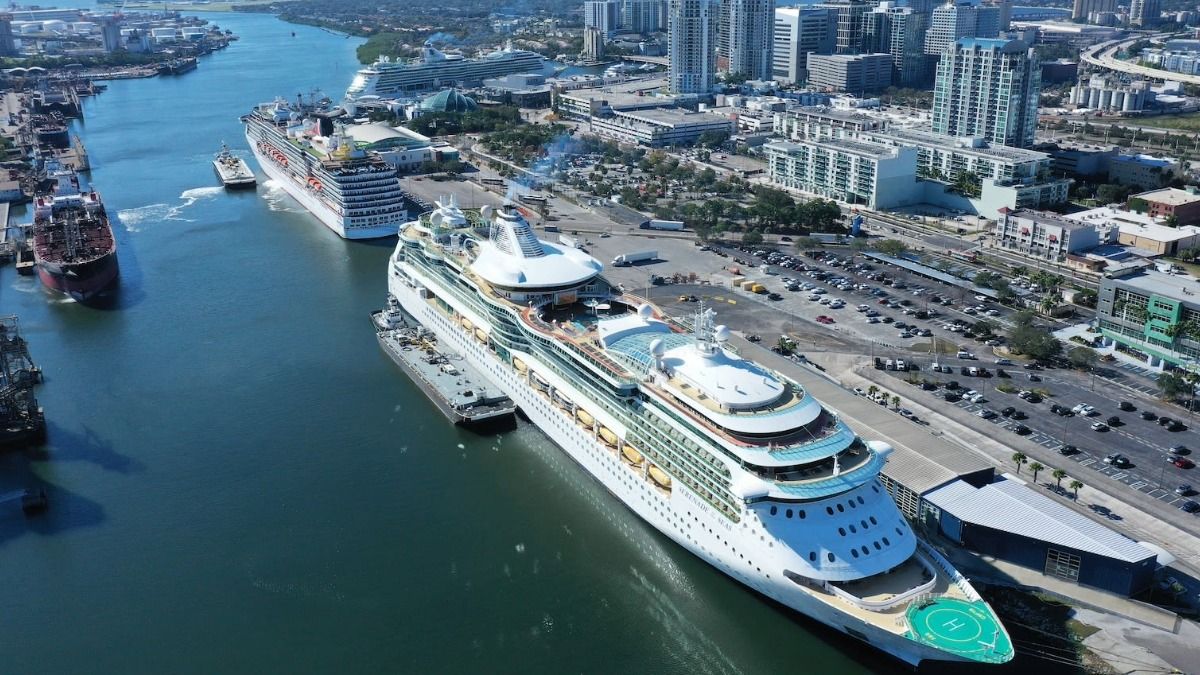
Port Tampa Bay’s planned fourth cruise terminal has become a near-term necessity as cruise demand pushes the port beyond existing capacity.
After handling a record 1.66 million passengers in 2025, Port Tampa Bay expects roughly 1.8 million passengers and 394 cruise ship calls this year. In March alone, the port scheduled 51 cruise ship visits, the highest monthly total in its history, while the number of days when all three terminals operate simultaneously has climbed to 53 this year from roughly 20 in prior years.
Port Tampa Bay Chief Operating Officer Brian Giuliani said the port already has turned away requests for additional cruise ships because all three terminals are routinely full during peak season.
“This year we had 54 what we call three-ship days, where all three terminals were full,” Giuliani said. “Some of the cruise lines would have liked to have an additional ship, and they weren’t able.”
“With the cruise business, this has been our best year ever,” Giuliani said. “We had a couple of inquiries for additional ships that we couldn’t handle.”
The new terminal is expected to add more than 200 annual ship calls, generate about $100 million in additional economic impact and bring as many as 1 million more passengers through Tampa each year, according to port officials, with completion targeted for October 2029 ahead of peak cruise season.
The additional passenger traffic is expected to add demand for hotels, restaurants, parking operators and transportation companies across Tampa Bay, where the leisure and hospitality sector grew 3% year over year as of February 2026, according to the U.S. Bureau of Labor Statistics.
The port has not selected a dedicated cruise line partner and still plans to operate the terminal as a shared-use facility. Giuliani said no cruise line has pursued exclusivity, though existing ship counts suggest one operator could use the terminal more than others. “Royal Caribbean has the most ships here, so we’ll leave it at that,” he said.
The cruise expansion mirrors broader growth across the port, where cargo volumes and logistics demand continue rising alongside west central Florida’s population and industrial expansion. While broader economic growth across Tampa Bay has moderated, recent reports from the University of Tampa’s Sykes College of Business describe the regional economy as stable but slowing, with logistics, construction and population-driven demand remaining comparatively resilient.
Read the latest Tampa news and updates
Giuliani said cargo moving through Tampa gives the port a real-time view of Florida’s economy, as it reflects both construction activity and consumer demand across the state.
“We’re always a good indicator where the economy’s going,” Giuliani said. “What people are building or buying.”
The port imports about 43% of Florida’s fuel and handles everything from autos and food to cement, steel, aggregates, furniture and appliances. That diversification helped stabilize the port during the pandemic, when cruise activity stopped but cargo continued moving, and later informed how the port prepared for hurricane disruptions and supply chain shocks.
Giuliani said most of the fuel moving through Tampa originates in Texas and Louisiana, reinforcing the port’s role in Florida’s domestic energy supply chain.
The fourth terminal is planned near Channelside, north of the port’s office building near the Florida Aquarium. Giuliani said the first phase involves rerouting city drainage infrastructure before the port fills the area, builds a bulkhead and constructs the terminal.
The project would reclaim land near the site of Tampa’s former banana docks. The area had been excavated decades earlier before the banana docks later operated there, Giuliani said.
Port Tampa Bay generates about $34 billion in annual economic impact and supports roughly 192,000 jobs tied to port operations, tugboats, vessel agencies, trucking and other supply chain activity.
Giuliani said Tampa’s location has become more valuable as population growth spreads across west-central Florida and companies continue to expand their distribution operations along the I-4 corridor. He estimated the corridor now includes about 500 million square feet of distribution space, with additional growth expected.
“Beneficial cargo owners have positioned themselves in the area because of the central location within the state,” Giuliani said.
That distribution growth continues fueling the port’s container business because cargo owners can move goods from Tampa to central Florida distribution centers faster and at lower cost than from more distant ports.
Giuliani said trucks moving cargo between Port Tampa Bay and Lakeland can make as many as three trips per day, compared with roughly one trip from some competing ports. The shorter haul reduces transportation costs and turnaround times while helping companies position inventory closer to Florida consumers instead of routing cargo through more distant East Coast ports.
Population growth across west central Florida continues driving demand for industrial real estate, warehousing, trucking capacity and housing, reinforcing the port’s role in the region’s expanding logistics network, Giuliani said.
“As all of those things occur, you need more products,” Giuliani said. “There’s a need for more distribution centers. There’s a need for more trucking. There’s a need for more housing.”
Read the latest Tampa Real Estate news and updates
Port Tampa Bay also continues investing in cargo infrastructure, including new berths for cement, containers, aggregates and dry bulk materials. One berth recently came online, another is being built and two additional berths remain in development, Giuliani said.
At Port Redwing, the port has leased all available waterfront-adjacent land as industrial tenants prepare for higher cargo volumes. SESCO is expected to come online around June or July, roughly when a related berth project is expected to be completed.
The port is also advancing a channel-deepening project that would increase the shipping channel from 43 feet to 47 feet. Giuliani described the dredging effort as one of the port’s most important long-term investments because deeper channels would allow larger ships carrying heavier cargo loads to reach Tampa.
“The dredging project is probably one of the biggest projects that will make a huge difference,” Giuliani said. “Currently, we’re at 43 feet. We’ll go to 47 feet.”
The broader outlook remains tied to continued population gains and construction activity across west central Florida. Giuliani said furniture, appliances, cement and road construction aggregates all have remained strong, reflecting sustained demand from housing, infrastructure and consumer activity.
Even as cargo and cruise activity expand, Giuliani said the port continues preparing for disruptions outside its control, including severe storms, supply chain shocks and another pandemic-scale event.
Hurricane planning remains an annual priority, and recent storms have forced the port and its fuel partners to rethink where equipment is staged ahead of severe weather.
During back-to-back storms two years ago, fuel companies moved equipment to other parts of Florida and then struggled to return it quickly enough to resume operations in Tampa. After those storms, the port offered a staging site about 15 minutes away, allowing companies to keep equipment nearby and restore operations more quickly in the event of future storms.
“In the future, if we have that happen again, we’re definitely more prepared,” Giuliani said.
Read More Tampa Bay Business News
Explore the latest Tampa Bay business news, real estate deals, development projects, executive moves and company updates shaping the region.