Last Thursday evening, business leaders across Tampa Bay gathered at Embarc Collective’s ReliaQuest Auditorium for a provocative conversation to discuss: What if time is no longer the best measure of value at work? The event, “Back to the Future of Work: Why Time-Based Pricing is History,” challenged attendees to rethink how we measure the value of work in an AI-powered economy.
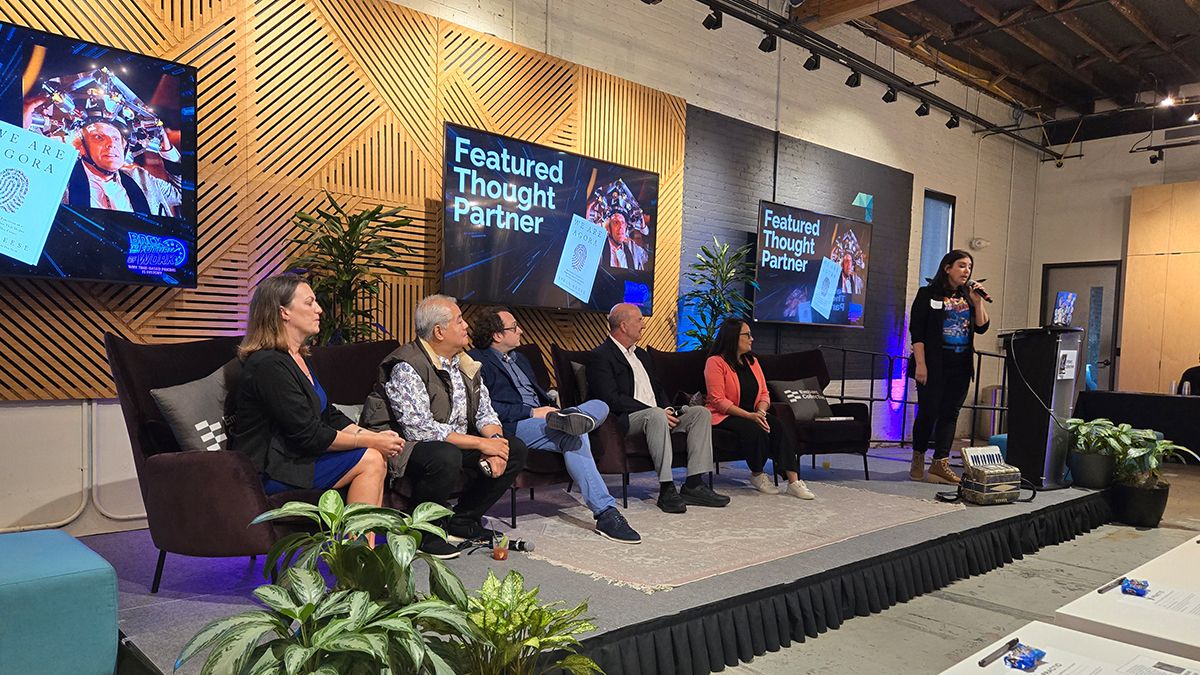
The panel event was hosted by Fractio, a member of the Embarc Collective, which has built a platform to help professional services and enterprise firms transition to usage-based workforce models. The event was supported by food and drink sponsor Florida CFO Group. It combined thought-provoking dialogue with playful nostalgic touches — from its “Back to the Future” theme and trivia to serving breakfast for dinner. The mix of substance and creativity reflects Tampa Bay’s entrepreneurial spirit: bold enough to question convention while still building practical frameworks to put change into action.
A diverse panel of experts
The evening’s panel, moderated by Fatin Kwasny, founder and chief executive officer of Fractio, featured a cross-section of leaders representing finance, technology, strategy and human capital:
- Phil Nahajewski, partner and chief financial officer, Florida CFO Group
- Joey De Villa, sales engineer at Fractio and senior IT consultant at Atypical Consulting
- Christina Adames, founder and CEO, Corus Innovation Labs
- Nicolas Genest, chief technology officer and founder and CEO, Codeboxx Academy
- Wendy Sellers, CEO, The HR Lady
Together, their perspectives built a dynamic picture of a business landscape where hours give way to outcomes.
Breaking away from the clock
For decades, billable hours have served as the backbone of professional services and corporate contracting. However, with artificial intelligence accelerating output and reshaping costs, the panel prompted the audience to ask a critical question: Is hourly billing still fair, sustainable or competitive?
Nahajewski cut right to the heart of the matter. “I can’t be the best CFO if my client thinks the meter is running every time they need to talk to me,” he said. His comment drew nods from attendees, many of whom face the same client relationship challenges tied to traditional pricing models.
Adames emphasized that output should replace hours as the true measure of value. “We don’t measure AI by the number of hours it’s working. We measure it by output,” she said. Adames added that transparency about the process and tools, including AI, is essential for building client trust.
Why Tampa Bay businesses are paying attention
The event drew a full house, with a mix of small- to mid-market professional services owners and executives from larger enterprise firms eager to weigh in on the future of work. Surveys revealed high pressure among smaller firms to move quickly toward outcome-based pricing, while enterprise leaders acknowledged moderate to high pressure, tempered by legal and infrastructure challenges.
De Villa framed the shift in economic terms. “AI is not a substitute for people. It’s an operating expense,” he said. He likened it to investing in software or computers — a cost that enables productivity rather than replaces it.
Genest expanded their vision. “The old question was, ‘What can I get for this outcome with this budget?’ AI enables us to dream of outcomes again. Let’s focus on helping clients express what success is and how we can get them there quicker,” he said.
From the HR perspective, Sellers noted how talent strategies must evolve. “AI makes us level up. Maybe we only need five people where we used to need 20, but we need those five to be really great at what they do,” she said.
Innovation rooted in Tampa Bay
The panel event also underscored Tampa’s growing reputation as a hub for innovation. Fractio, which won the Innovation Award in the startup category at Tampa’s Synapse Summit, in March, is helping professional services and enterprise firms reimagine how work is valued.
A community looking ahead
As the conversation made clear, the path forward for businesses lies in lowering the cost of achieving outcomes, not in counting hours. In an AI-powered world, the clock no longer defines productivity. For those willing to embrace change, the future of measuring work value may be closer than we think.